


Site reveals matrilineal society traits







In a groundbreaking discovery using DNA technology, Chinese scientists have found evidence of a prehistoric matrilineal society in East China, marking a huge stride in studies of early human social organization.
At a news conference on Thursday in Jinan, the capital of Shan-dong province, scholars from Peking University and the Shandong Institute of Cultural Relics and Archaeology unveiled their findings on a two-clan matrilineal community at the Fujia archaeological site in the province's Guang-rao county, dating back to between 2750 BC and 2500 BC.
Their findings on the matrilineal society — one in which ancestral descent is traced through maternal rather than paternal lines — were published on Wednesday in the science journal Nature.
Almost all previously published research results have supported patrilineal, or paternal line, social organization, and before this new discovery, the earliest genetic clues pointing to a matrilineal society could only be traced back to the Iron Age in Europe, said Ning Chao, a researcher at Peking University. The Iron Age in Europe began around 1200 BC.
The Fujia site, located in northeastern Shandong, covers about 37 hectares and is identified as a late site of the Dawenkou culture (a Neolithic culture in the lower reaches of the Yellow River from 4,500 to 6,500 years ago). There are two separate cemeteries, in the northern and southern parts of the site, at which archaeologists found the remains of more than 500 people during excavations in 1985, 1995 and 2021.
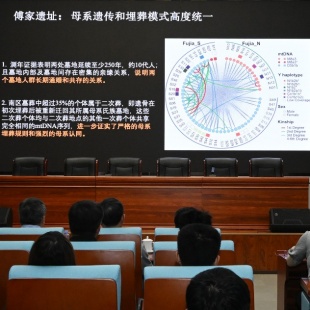
Scholars found that the cemeteries belonged to two maternal clans, linked by marriage, that followed strict matrilineal burial practices for more than 250 years.
Scientists selected 60 individuals with intact skulls from the two cemeteries and analyzed them using DNA methods to determine genetic relationships.
All 14 individuals from the northern cemetery possessed the same maternally inherited mitochondrial DNA haplogroup — a genetic population group sharing a common ancestor — and exhibited identical mitochondrial DNA sequences, while 44 of the 46 individuals from the southern cemetery had another mitochondrial DNA haplogroup and identical mitochondrial DNA sequences, indicating that the individuals in each group shared a respective maternal lineage.
Huang Yanyi, a researcher at Peking University, said that as mitochondria are only inherited from the mother, the fact that individuals share the same mitochondria proves that they originated from the same maternal ancestor.
Skeletal age estimations revealed that teenage and adult males were buried based on their maternal lines, a practice that aligns with the common norms of a matrilineal society, said Ning.
Near the Fujia site are numerous Dawenkou cultural sites displaying features similar to those of Fujia, indicating that rather than Fujia being an isolated case, matrilineal social organization was possibly common at that time in what is now the northern part of Shandong.
Fujia, which existed during a period of increasing social complexity in late Neolithic China, displayed less wealth, low levels of social differentiation and low population density compared with other contemporaneous sites of Dawenkou culture.
Since the 19th century, scholars such as Swiss anthropologist Johann Jakob Bachofen, United States anthropologist Lewis Henry Morgan and German philosopher Friedrich Engels proposed that early societies were generally matrilineal. However, with a lack of archaeological evidence at the time, such studies gradually fell out of favor.
"This discovery offered direct evidence to their theories about matrilineal society and significantly contributed to the studies of the origins of human civilization," said Sun Bo, director of the Shandong Institute of Cultural Relics and Archaeology.