


Tang Dynasty words of beauty still resonate







At dusk, the somber mountains loom afar,
In icy cold, the humble thatched cottage lies bare.
From the wattle gate, a dog's bark rends the air,
A wayfarer comes home under winter's wind-whipped, snow-bit glare.
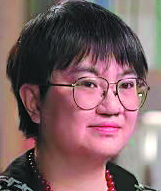
This was the first poem learned by Zhang Yinan, now a teacher of classical Chinese poetry and a poet working in the traditional style.
"I was leafing through an illustrated poetry book when a drawing caught my eye. I asked the adults to read it to me," recalls Zhang, who was just 2 years old at the time.
The poem was written by Liu Zhangqing (726-789), who lived during China's Tang Dynasty (618-907), an era known not only for its social prosperity and military strength, but also for the extraordinary outpouring of poetry, with more than 50,000 known works created within less than 300 years.
Such was the radiance of Tang's poets that, through the ages, their name alone awakens the spirit of ancient Chinese poetry.
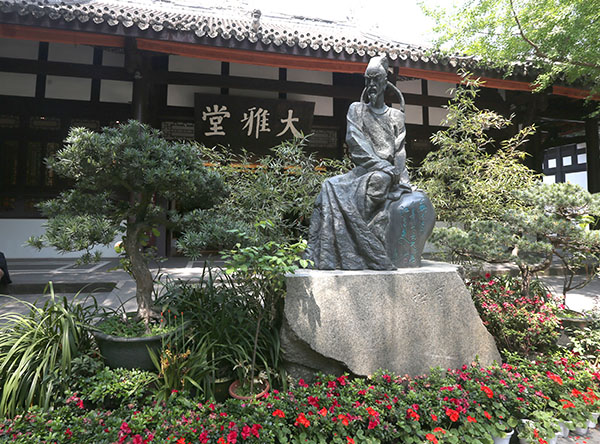
One of them is Du Fu, the subject of a 2020 BBC documentary boldly titled Du Fu: China's Greatest Poet, an accolade few would dispute.
"Du Fu engaged deeply with the metrical structures of classical Chinese poetry, exploring its intricate rhythmic patterns and a formal parallelism between couplets central to the regulated verse. He also possessed a keen sense of color that infused his poetic canvas," Zhang says.
"The mountains he climbed, from where he gazed into the distance, become powerful triggers of nostalgia, inspiring poetry that blends scenic imagery with philosophical depth — a profound expression of both individual sentiment and cultural memory."
Embracing realism in his work, Du Fu's posthumous reputation reached its peak nearly two centuries after his death, during the Song Dynasty (960-1276), and has endured ever since. Zhang believes this lasting legacy is closely tied to Du Fu being seen as the embodiment of the Confucian ideal: a poet of moral integrity who upheld the philosophy of universal love and broad, inclusive empathy.
Touched by the times, flowers draw tears from my eyes; grieving for parting, birds startle my heart with their cries.
Du Fu wrote in one of his most renowned poems, composed after the outbreak of rebellion in 755 and the ensuing civil war, a turning point that shaped both the fate of the Tang Dynasty and the artistic path of its poets.
"An 18th-century Chinese poet once remarked that a nation's misfortune could be a poet's fortune," Zhang says. "What he truly meant was that out of sorrow could emerge lines of rare authenticity and grace — an observation vividly reflected in the legacy of Du Fu and his contemporary poets, whose creative journeys spanned the turmoil of the rebellion.
"Across the sweep of Chinese history, poetry has mirrored the rise and fall of the nation's fortunes, capturing the ebb and flow of peace and turmoil," she continues.
"What's truly remarkable is the vast number of Tang poems that had survived into the 12th century, when woodblock printing became widespread and the preservation of literary works became more feasible," she says. "But for a verse — say, one by Du Fu — to endure that long, it had to weather not only the rebellion that marked his time, but also the decades of chaos following the fall of the Tang in 907, as well as the many conflicts that beset its eventual successor, the Song Dynasty."
Equally notable is that while the Tang Dynasty produced many poets revered then and now, almost none were seen solely as poets. Nearly all were members of the social elite, holding official posts rather than writing poetry as a profession, says Tan Zuowen, a fellow alumnus of Zhang's from Peking University's Department of Chinese Language and Literature.
"On one hand, writing poetry was regarded as a hallmark of the educated elite and a prerequisite for those seeking official rank; on the other, the Tang court provided avenues for talented poets to achieve social advancement," he says.
According to Tan, a professor of ancient Chinese literature, the Tang court not only administered civil service examinations testing subjects like poetry, but also deliberately opened up avenues of social mobility for men of exceptional literary talent. For example, Du Fu once held the position of zuo shiyi — a low-ranking yet influential role responsible for offering frank advice to the emperor and pointing out governmental missteps. The words shiyi literally means "to pick up something that's forgotten", which in the context of ancient officialdom refers to any dereliction or deficiency in decision-making that should be identified.
"These men possessed neither wealth nor real power; their greatest asset was the social esteem granted by the public, which was something they fiercely protected by speaking boldly and candidly before the emperor," Tan says.
Despite its might, the Tang court faced immense challenges in governing its vast territory. These extensive borders required constant defense, relying on conscripted soldiers drawn from a broad cross-section of society. Numerous poets, whether they had personally served on the frontier or not, composed works inspired by these distant outposts, giving rise to a distinct genre known as biansai shi, the frontier poetry.
"If you read these poems closely, it becomes clear that Tang poets overwhelmingly championed peace over war," Zhang says. "They drew deeply from history and wrote with a profound sense of social responsibility."
Zhang began writing poetry at the age of 7, influenced by her mother, who was among the millions of "educated youth" sent to rural areas to endure hardship during the tumultuous years of the "cultural revolution" (1966-76).
"Many in her generation turned to poetry to cope with inner turmoil. It was my mother who first showed me that poetry could be both an outlet and a form of salvation," says Zhang, who later found herself irresistibly drawn to ancient Chinese verses. "I've developed a deep affinity for the poets of the past likely because I share their philosophical outlook and their meditative approach to life."
In retrospect, Zhang says she feels that it was no mere coincidence that her poetic journey began with an illustration of a Tang poem. In that golden age, poets like Du Fu captured nature in vivid vignettes that later inspired generations of painters, embodying another enduring Chinese cultural belief that painting and poetry flow from the same wellspring.
Tan, who also teaches ancient Chinese literature to primary school children since 2009, says: "Across generations, Chinese poets have read and recited the verses of the past while composing their own. Poetry becomes a vital vessel of cultural inheritance: carrying aesthetics, emotion and moral vision.
"For the ancient Chinese, poetry was a way of being. For me, stepping into that tradition feels like returning home."