Liuzhou tops water quality list for 5th year
City's efforts to stamp out industrial and household runoff yield environmental rewards







Liuzhou's main urban area now has approximately 2,200 kilometers of underground drainage pipelines, covering major residential communities and commercial districts.
"All domestic water is collected through these pipelines and directed to our wastewater treatment plants," Zhou said. He stressed that the Liujiang River's only water input is natural rainwater.
Two decades ago, the city's daily wastewater treatment capacity stood at just 100,000 cubic meters. From 2005 to 2018, with the help of $250 million in financial support from the World Bank, several wastewater treatment plants were constructed and a comprehensive wastewater management network was gradually developed. As a result, Liuzhou's wastewater treatment rate increased from 15 to 75 percent.
Last year, Liuzhou's wastewater treatment plants had a daily treatment capacity of 914,000 cubic meters and processed a total of 283 million cubic meters. The treatment rate was 99.05 percent, and the centralized treatment rate was 92.01 percent, the city government said.
According to the government's work plan for urban domestic sewage, by the end of this year, the daily domestic wastewater treatment capacity will reach over 940,000 cubic meters in Liuzhou, and the centralized wastewater collection rate will increase to over 95 percent.
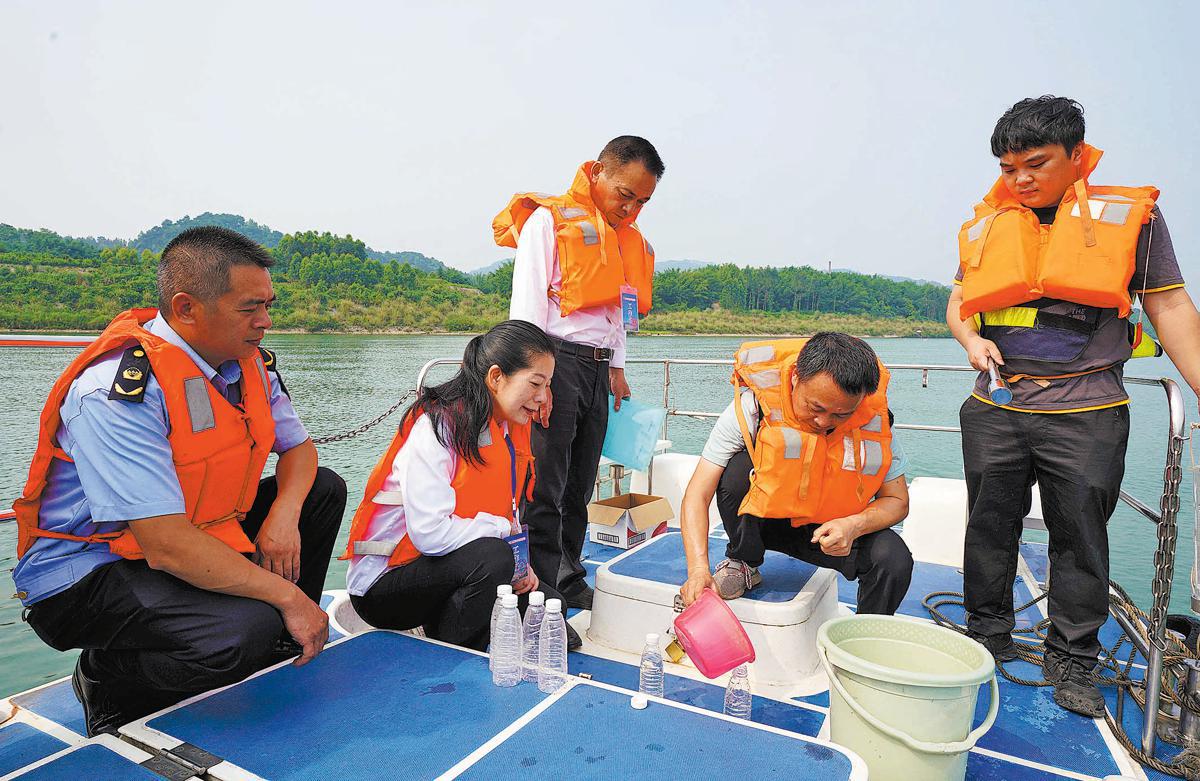
To maintain water quality, Liuzhou has also established a comprehensive monitoring network, including a central control center, 10 automatic surface water quality monitoring stations, 10 automatic micro-monitoring points, and a specialized emergency response vehicle for water quality incidents. The city has also introduced the region's first intelligent management system for enterprise wastewater discharge and an online monitoring system for enterprise pollution sources.
Once lined with factories, the Liujiang River is now lined by lush trees and greenery along its banks.
Pointing at a mountain across the river, Wei, from the environment bureau, said there used to be a dyeing factory whose wastewater polluted the river. "We shut it down to prevent its dyeing materials from contaminating the water," he said.
In the past two decades, Liuzhou has reformed its industrial layout to protect its water resources. Industrial enterprises have been relocated from the urban area to designated industrial parks in the suburbs, while those with outdated production capacity and heavy pollution have been shut down.
For example, an industrial park dedicated to electroplating was established in Luzhai county in Liuzhou, bringing together electroplating enterprises. As a key component of Liuzhou's industrial chain, the electroplating sector plays a crucial role in producing hardware for the automotive industry.
"With enterprises now clustered in industrial parks across the city, centralized management ensures that pollutant discharge standards are consistently met," Wei said.
In recent years, enterprises have also voluntarily raised their standards for wastewater discharge.
State-owned enterprise Liuzhou Steel is located in the northern suburbs of Liuzhou. Situated upstream of the Liujiang River, the plant's wastewater discharge matters greatly for the river's overall water quality. The company has stepped up efforts in environmental protection in recent years.
Huang Junjie, who is in charge of the company's power plant, said three wastewater treatment stations have been built capable of fully intercepting, treating and reusing all industrial wastewater within its industrial park, achieving zero discharge of industrial wastewater.
"The main discharge pipe intercepts wastewater from factories and directs it to the treatment plants, where it undergoes several purification processes," Huang said.
"Once purified, the clean water is then distributed back to the factories for cooling and other industrial processes via the network of pipelines within the park," he added.
The company's wastewater treatment stations have a total designed capacity of 332,000 cubic meters per day, said Huang, who added that the utilization and circulation rate of industrial water throughout the entire park has reached over 98 percent. Meanwhile, the company's freshwater consumption per metric ton of steel decreased from 54 tons in 2000 to 1.23 tons last year, which is 47 percent lower than the industry average, according to the company.
However, the cost of circulating water within the industrial park remains relatively high. "The estimated cost of circulating water is over 7 yuan ($1.15) per ton, which is higher than directly using the water from the Liujiang River," said Huang. "However, even though green practices bring a burden for the company, it is our responsibility to do that."