Matcha industry fattens wallets, revives culture







GUIYANG — As the morning light of early summer broke over the misty hills of Jiangkou county in Southwest China's Guizhou province, tea farmers began their day among rows of tea trees, skillfully plucking tender green buds.
By way of more than 20 processes, including steaming, drying, sterilizing and grinding, these fresh leaves are refined into premium matcha, destined for teacups around the world.
Nestled at the foot of Mount Fanjing, a UNESCO World Heritage Site, Jiangkou is home to over 10,000 hectares of tea plantations, nearly one-fifth of which are dedicated to matcha production.
Today, Jiangkou has emerged as a global matcha powerhouse. In 2024 alone, the county sold more than 1,200 metric tons of matcha, the highest in the country, generating an output value of over 300 million yuan ($41.75 million). Its products have reached numerous overseas markets including Japan, the United States and France.
Once a poverty-stricken mountainous region, Jiangkou designated tea as its key pillar industry in 2007, leveraging its favorable tea-growing conditions such as high altitude, low latitude, frequent fog and cloud cover, and limited sunlight.
An important step forward was taken in 2017 through cooperation with Guizhou Gui Tea Group Co Ltd, a leading provincial tea enterprise, which helped set up a high-standard matcha industrial park in the county, introducing advanced technologies in the process.
A comprehensive industry chain was soon established, with local farmers focused on tea planting, allied enterprises handling initial processing and Gui Tea Group managing refined production. This efficient model has boosted the incomes of nearly 100,000 tea farmers.
Luo Qixian, a local villager, works at a tea garden and earns roughly 10,000 yuan annually. "In the past, I could only make a living by growing crops. Now I have steady work year-round and my income is much more stable," she said.
Recognizing the rising global demand for matcha, Gui Tea Group has actively sought international expertise for guidance in terms of tea garden management and processing, and has sent local technicians and farmers to Japan for training and exchanges.
"Since 2018, our matcha with its vibrant green hue and rich aroma has earned recognition both at home and abroad," said Chen Xiaoming, deputy general manager of Gui Tea Group. In 2019, the company secured its first export order to North America.
The drinking of matcha originates from ancient China, and was later introduced to Japan. So far this year, Jiangkou has exported four tons of matcha to Japan, with another six tons scheduled for delivery. "The arrival of Chinese matcha has allowed tea cultures of both countries to flourish through exchanges and mutual learning," Chen said.
On a recent Saturday afternoon, a matcha-themed food experience store in Guiyang, capital of Guizhou, buzzed with customers. At the store, shelves featured a wide array of matcha desserts and beverages.
"Matcha chocolates and ice cream are my favorites. They really suit my taste," said Zheng Jin, a post-1990s tourist from Beijing, who made visiting the store a priority.
A white paper released in 2023 by a research institute under the Ministry of Industry and Information Technology showed that China had become the world's largest matcha producer and consumer. In 2024, sales at the Guiyang store alone exceeded 4 million yuan, an increase of 122.2 percent year-on-year.
As diverse matcha products gain popularity, the profound culture behind matcha continues to attract young consumers.
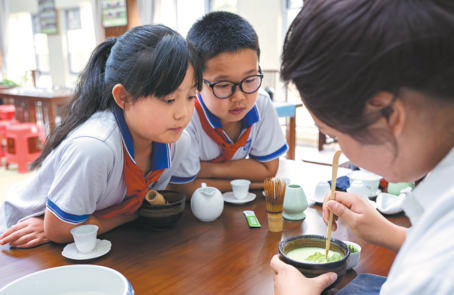
In a tourist attraction of Tongren in Guizhou, a matcha culture experience center showcases unique products such as matcha noodles and matcha lip balms, while inviting visitors to learn about the history of matcha and try their hand at diancha, a traditional tea-making technique.
Xinhua



Today's Top News
- Mainland pledges deeper cross-Strait integration in 2026 message
- Lai's 'separatist fallacy' speech rightly slammed
- Xi's message for New Year widely lauded
- Swiss bar fire kills around 40, injures more than 110
- New Year's address inspiring for all
- Xi congratulates Science and Technology Daily on its 40th anniversary