


600-year-old dragon kiln still fires in pottery heartland







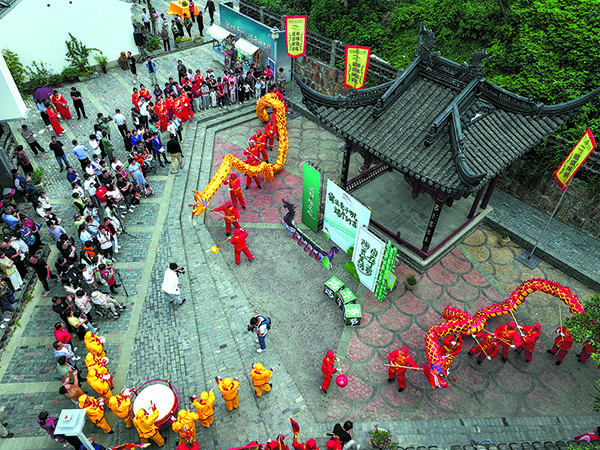
NANJING — In the heart of China's pottery capital Yixing in the eastern province of Jiangsu, the ancient ritual of firing the 600-year-old Qianshu Dragon Kiln persists, a testament to enduring craftsmanship despite modern alternatives.
For more than 40 hours, workers meticulously feed firewood into the kiln, driving temperatures above 1,000 C. The climax comes with the opening of the kiln, revealing thousands of ceramic pieces like "blind boxes", a major local event.
Nestled amid the rustic village houses of Dingshu township in Yixing, the Qianshu Dragon Kiln is unmistakable — a long, black-tiled roof structure snaking up a slope, sheltering an earthen core built from rammed yellow soil.
Dating back to the Ming Dynasty (1368-1644), this kiln holds a unique status as the only one in Jiangsu still firing ceramics using traditional wood-burning methods. Measuring 43.4 meters long with a distinct north-south orientation, it comprises a head, a body and a tail, capable of holding roughly 8,000 ceramic pieces per firing.
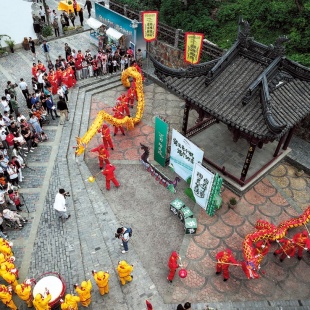
At precisely 9:58 am on the Dragon Boat Festival, which fell on May 31, the centuries-old Qianshu Dragon Kiln unveiled its latest treasures amid thunderous drums and undulating dragon dances. Over a thousand spectators gathered as a kiln master meticulously inspected each fireproof sagger container, his experienced hands assessing the integrity of every ceramic piece emerging from the dragon's belly.
Kiln firing remains the key to good ceramics. In southern China, the most popular kiln type is the dragon kiln, named for its dragon-like shape as it slopes along hillsides. Dating back thousands of years, the distinctive and efficient dragon kilns have played an indispensable role in China's ceramic history.
The dragon kiln was instrumental in forging Yixing's reputation as the nation's "pottery capital". Recognized for its historical significance, the Qianshu Dragon Kiln was listed as a major historical and cultural site protected at the national level in 2006.
"Originally, the dragon kilns fired daily necessities. Now, they primarily fire purple clay products, which is an invaluable cultural treasure here," says Wu Xiaoyang, a local kiln master with over 50 years of experience.
According to Wu, the purple clay from Huanglong Mountain in Dingshu is truly unique in China. Also known as "five-colored earth", the surface layer of this clay appears reddish, while deeper layers take on a purplish hue. Remarkably, even the same clay can exhibit different colors when fired at the same temperature.
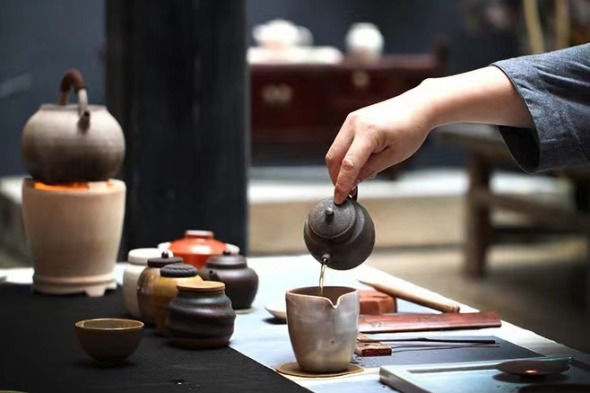
Also in 2006, Yixing's purple clay pottery-making techniques gained national intangible cultural heritage status. Evidence of this deep-rooted craft is visible throughout the area, with numerous family workshops advertising their ceramics and purple clay teapots.
The Qianshu Dragon Kiln now stands as the last of its kind, mostly producing miscellaneous wares like tea caddies and other decorative or functional objects, with limited teapot firings, according to Yin Qiuxia, a local artisan who runs a family workshop. She's been making purple clay teapots for 16 years.
"Traditional dragon kilns symbolize Yixing's ceramic artistry," says Fan Weiqun, a national-level intangible cultural heritage inheritor. A fourth-generation purple clay artisan, Fan works from a studio adjoining the Dasheng Art Museum — which showcases his family's legacy. "Dasheng" was the pseudonym of Fan Guangshan (1847-1902), a master potter whose teapots became so coveted that "a thousand taels of gold couldn't buy one". His son Fan Qinren (1875-1941) inherited the name, elevating its prestige with award-winning works exhibited across Europe and North America.
"While kiln technology has evolved, dragon kiln firing preserves traditional techniques and aesthetics. This ceremonial aspect helps the younger generation understand intangible heritage," Fan Weiqun says. Honored as a master of arts and crafts in Jiangsu, the craftsman has also trained his daughter into a skilled purple clay potter.
Contrasting sharply with the ancient kiln, most family workshops in Yixing now utilize electric kilns, where calibrated heat ensures uniform finishes without ash imperfections, Yin notes. Estimates suggest these modern kilns significantly reduce emissions compared with traditional wood firing — cutting annual carbon dioxide emissions by approximately 40,000 metric tons, sulfur dioxide by 131 tons, and nitrogen oxides by 114 tons.
"For everyday ceramic work, electric kilns offer better temperature control, stability and higher efficiency, which is particularly suitable for young learners like us," says Fan Qianwen, Fan Weiqun's daughter. From childhood, she apprenticed at her father's clay workbench, absorbing the artistry of Yixing's purple clay pottery tradition through years of immersion in this renowned ceramic family.
"The dragon kiln primarily serves to preserve traditional techniques, representing our cultural inheritance. For the youth, it's also a psychological cultural landmark, signifying our roots," she says.
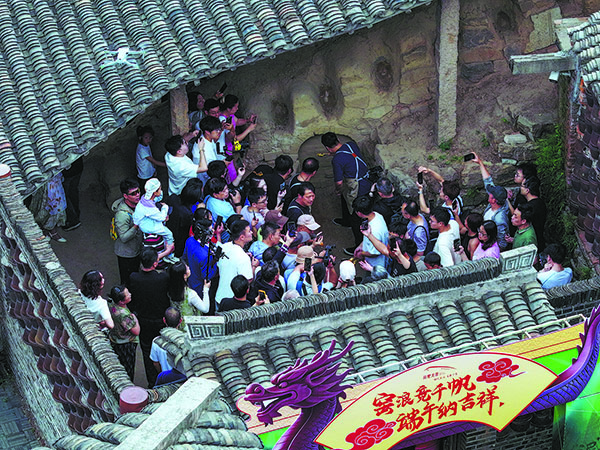
Despite the dominance of electric kilns, the ancient Qianshu Dragon Kiln is fired during special traditional Chinese festivals, accompanied by public opening ceremonies. These events have attracted crowds of local residents and tourists, with online livestreams garnering millions of views in recent years.
When Fan Qianwen first turned to short videos and livestreaming in 2019, her father resisted. "He saw it as breaking away from our craft's heritage," she recalls. But the effort paid off. Sales figures that once took a decade of toil to achieve can now be reached in a mere two to three years — all by plugging Yixing's time-honored purple clay teapots into the digital age.
The "ancient craft meets algorithm" formula has proved successful for local artisans. Dingshu has established China's first dedicated purple clay industry livestreaming base on Douyin, the Chinese version of TikTok. The hub now hosts over 8,000 businesses and employs 55,000 workers, with sales of purple clay products surging over the past two years, underscoring the sector's rapid digital transformation.
Yin began livestreaming her purple clay teapot-making process three years ago. In her studio, cameras now capture what was once a trade secret: the rhythmic kneading, sculpting and polishing of purple clay.
"This is our way to authentically showcase traditional craftsmanship to collectors and enthusiasts," she says. "Ultimately, it's about preserving the purple clay culture."