
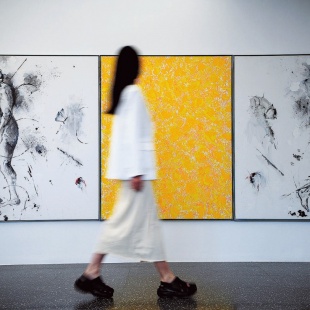



Spanish sounds, stones and strokes brought to Bund







The Spanish Arts Festival on Shanghai's Bund is bringing exhibitions related to the spectacular architectural legacy of Antoni Gaudi and paintings inspired by China's ink art.
Hosted by Jiushi Art Museum, the festival will continue through to Oct 22 in celebration of the 20th anniversary of the establishment of the comprehensive strategic partnership between China and Spain. To mark the occasion, Jiushi Group kicked off the unprecedented event that's bringing five exhibitions to four historical buildings on the Bund.
Three exhibitions are now open to the public. Splendor to Nature: Gaudi With his Era will run until Oct 8 at Bund 18 Jiushi Art Gallery. It features five original building components that are making their first appearance in China, seven manuscripts and important documents from the Architects' Association of Catalan and the Polytechnic University of Catalonia.
Antoni Gaudi (1852-1926) was a Catalan architect celebrated for his distinctive style featuring freedom of form, rich colors and extravagant structures. His work left an indelible mark on the cityscape of Barcelona becoming one of its most iconic symbols.
His creations also bear witness to the city's dramatic transformation at the turn of the 20th century, from its expansion beyond medieval walls to the prosperity brought by the industrial revolution, according to curator of the exhibition, Lluis Bravo Farre. This exhibition seeks to explore the boundaries between art, urban space and everyday life through Gaudi's multifaceted and cross-disciplinary body of work.
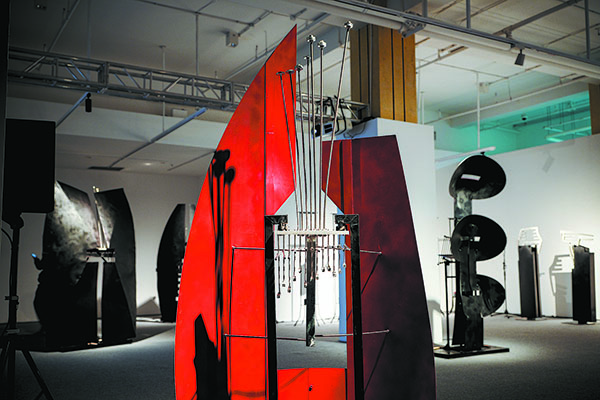
A second exhibition running simultaneously at Jiushi Art Salon at 230 Beijing Road East features the architecture of Gaudi from a new perspective. Splendor Immerses Everything: Sound of Gaudi was curated by Professor Josep Cerda of the University of Barcelona.
"Everybody knows about Gaudi, and we want to explore where his inspirations come from," he says.
Gaudi was the son and grandson of boilermakers, who hammered flat copper sheets into three-dimensional forms. Speaking of his architectural inspiration, Gaudi said: "I have that ability to feel, to see the space, because I am the son of a boilermaker, who makes a volume out of a surface. My father sees the space before he begins working".
Cerda grew up very close to the town where Gaudi used to live. His grandmother was an acquaintance of Gaudi's longtime friend, Eduard Toda, who told him stories about Gaudi.
Cerda designed a collection of sound sculptures that invite visitors to touch, strike and play. He had a series of large ceramic bells made in Jingdezhen, Jiangxi province, according to Gaudi's design, which was never realized before for lack of funding.
"There are many exhibitions about Gaudi, but this is the only exhibition where you can experience his architecture through sound and immerse yourself in Gaudi's world."
Cerda especially highlights Gaudi's lifelong friendship with Eduard Toda, who served as Spain's consul general in Shanghai. Toda, who was also a scholar of archaeology and Chinese culture, used to send Gaudi letters and photos of China. One tradition Toda shared with Gaudi was the mythical symbol of the dragon, which coincidentally aligns with Catalan folklore where dragons are equally iconic. Upon learning this cultural parallel, Gaudi incorporated dragons into many of his architectural works, Cerda says.
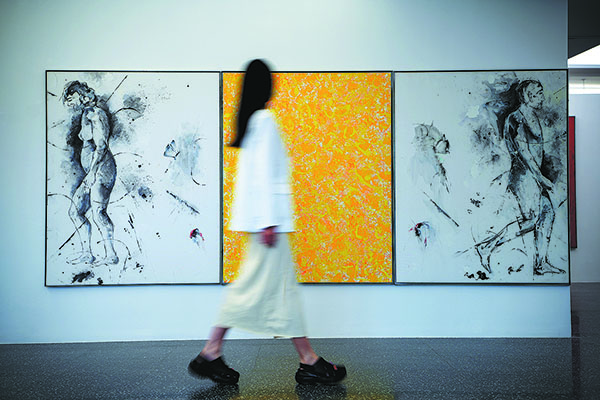
A third exhibition of Spanish art at Shanghai Jiushi Art Museum on the sixth floor of House Roosevelt on the Bund until Aug 22 is the first solo exhibition in Shanghai of Spanish painter Jorge Rando. Quiero Pintar la Vida (I Want to Paint Life) consists of 114 pieces and sets of artworks, 80 of which are being shown in China for the first time.
Rando is known as a "philosopher of art". His large thematic cycles depict love, compassion, dignity, identity and the call for a harmonious relationship between humans and nature, says Vanesa Diez Barriuso, director of the Jorge Rando Museum.
It was during his visit to Hunan province in the 1990s when Rando became inspired by Chinese ink art, as well as the Chinese philosophy that advocates for harmony between humans and their surroundings. He started at that time a series of paintings of butterflies, which he is still working on.
Later this year, two more exhibitions will kick off. Ballad of Ouroboros, which will run from Sept 5 to Oct 22, will highlight Spanish and Chinese women's perspectives on art creation and collection, while the first virtual reality exhibition centering on the collection of Prado Museum will take place from July 5 to Oct 11 at Jiushi International Art Center.




















