In major mining pivot, Guizhou powers economy from green sectors







Guizhou province, located in China's southwestern highlands, is executing an economic transformation that defies the old resource-reliant development mode.
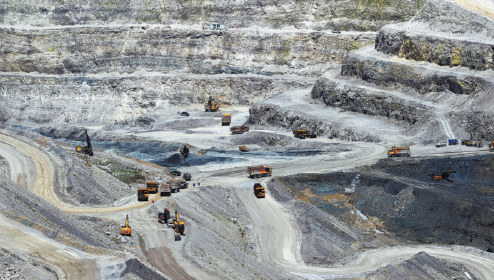
Known for its vast mineral wealth, Guizhou, which was once heavily engaged in low-value mining that scarred its mountainous landscape, now generates nearly half of its GDP from green sectors, such as big data, electric vehicles and recycling.
Demonstrating that natural wealth and ecological stewardship can coexist, the province has set a better example by managing to develop an innovative mining model, turning geological endowments into engines of sustainable prosperity.
High-tech mining
Among global resource regions striving for energy transition, Guizhou has gained the upper hand by promoting a mining sector based mainly on four principles — precise exploration, targeted ore allocation, refined extraction, and deep processing.
In this mode, the province aims, and has actually already started working, to rebuild the value chain in the mining sector and apply more green technologies to extract maximum value from every metric ton of rock.
Beneath the province lies an estimated 80 billion tons of coal, historically burned for power or exported raw with minimal economic return. Nowadays, the province leads in converting this carbon resource into advanced materials. An example worth mentioning is the Meijin coal-coke-hydrogen comprehensive project in Liuzhi Special District in Guizhou's Liupanshui.
A major benefit of promoting the coal-coke-hydrogen model is that it can create a circular value chain — mining enables coking, coking generates gas for hydrogen, and hydrogen is used for clean energy. By leveraging clean coke technology, the plant can produce 3.8 million tons of metallurgical coke annually and refines some 40 million standard cubic meters of high-purity hydrogen, qualified for NEV use.
Every ounce of byproduct heat and gas is recycled into over 20 derivative products — from ammonium sulfate to specialty chemicals — creating businesses at every turn. In addition, each byproduct can spawn a downstream sector, attracting supporting enterprises, boosting tax revenue and creating jobs.
According to the local government, this circular approach is projected to generate 20 billion yuan ($2.75 billion) in annual output while boosting growth in power generation, rail logistics, equipment manufacturing and advanced materials.
Shift of roles
Home to China's third-largest phosphate reserves, Guizhou has shifted from being just a basic mineral trader to a high-tech battery materials provider. The Chuanyandong open-pit phosphate mine — with 87.95 million tons of recoverable ore — exemplifies this evolution. Using precision extraction, companies now isolate lithium iron phosphate and battery-grade iron phosphate while capturing companion elements like gallium and fluorine.
The payoff is stark: one in every three new EVs in China relies on batteries powered by Guizhou's refined phosphate. Industry giants BYD and CATL have established operations locally, followed by automakers like Geely setting up assembly plants. In 2024 alone, Guizhou's EV output surpassed 100,000 units.
In October, the first batch of "Made in Guizhou" electric buses, numbering 55, were exported to Laos. In November, China's first rail freight pilot for lithium battery transport between Guizhou, Sichuan and Chongqing was launched — a marvelous credential for the inland province on the nation's clean energy landscape.
Discoveries expected
In 2024, local mineral exploration authorities in Guizhou said they have discovered three large to medium-sized bauxite deposits, and with further discovery work underway, it is also expected to find two super-large and four large phosphate ore deposits.
Eyeing advantages in mineral deposits, prefecture-level regions in Guizhou are enhancing efforts in the energy industry and building it into a key pillar in strengthening the local economy, promoting green transition and facilitating development of industries with a more modernized framework.
For example, with rich phosphorus resources, Qiannan Bouyei and Miao autonomous prefecture has focused on deep-processing material industries, with modern chemical and new energy battery materials as the leading sectors.
The potential economic value of the 10 major mineral resources in Guizhou is estimated to reach 113.9 trillion yuan, with extractable value reaching 62.4 trillion yuan. Refining mining for richer resources is heralding a bright future for the province's economy.
Beyond minerals
To date, Guizhou has certified 832"Green Mines", and is rolling out specialized cleanup programs for phosphogypsum, manganese slag and coal gangue.
While minerals anchor heavy industry, Guizhou's agricultural transformation proves that value addition applies equally to organic resources. In Jiangkou county, centuries-old tea traditions have birthed a booming matcha industry. Leveraging high-altitude fields and misty climates, the county produced over 1,200 tons of matcha in 2024, valued at 300 million yuan, with exports reaching Japan, the United States and France. A province-wide network now spans 22 counties, empowering nearly 100,000 tea growers through integrated farming and processing partnerships.
Last but not least, pushing ahead with Guizhou's industrial pivot should also include confronting mining's environmental legacy. In 2021, voices of concern over bauxite damage in Xiuwen county catalyzed a restoration drive, culminating in the replanting of 76,000 trees by June 2022. The new Guizhou Mineral Resources Regulation, effective July 2024, mandates coordinated soil, water and vegetation remediation, legally binding operators to post-mining rehabilitation.
While the province still faces technological gaps and talent shortages, its pivot toward precision, intelligence and sustainability charts a course that will bring benefits to the whole industry. In a world torn between development and decarbonization, Guizhou has proved that even stone can be spun into green gold.
The writer is a senior reporter with China Daily.