Lai's false narrative raises cross-Strait tensions







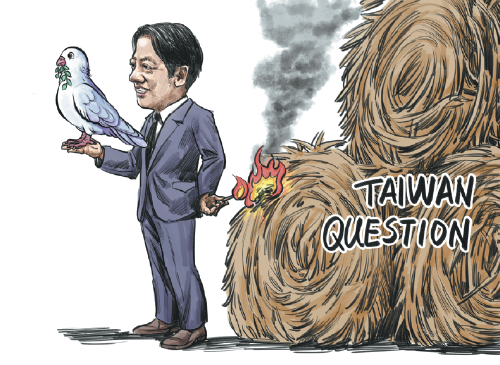
Since taking office in Taiwan more than a year ago, Lai Ching-te has been using the "democracy vs authoritarianism" narrative to challenge the Chinese mainland. Lai's narrative distorts the true nature of cross-Strait relations, and could drag the two sides of the Strait into perilous territory.
Taiwan has always been a part of China. In the late 19th century, after the Qing Dynasty (1644-1911) rulers lost a war against Japan, the Japanese forces occupied Taiwan, turning it into a Japanese colony. Following Japan's defeat in World War II in 1945, Taiwan was returned to China. And after Kuomintang lost the Chinese civil war in 1949, its leaders retreated to Taiwan.
The relationship between the mainland and the island today is that of two divergent regions of one country. The central government's policy is to peacefully resolve this issue and achieve national reunification, while maintaining Taiwan's existing political, economic and social systems, as much as possible after unification, and ensuring that the lifestyle of Taiwan residents remains unchanged.
And yet after coming to power, Lai not only rejected the 1992 Consensus that there is only one China and that Taiwan is an integral part of China but also defined the mainland as a hostile "foreign force".Like any other government, the central government has issued warnings and taken countermeasures against such separatist behavior. Hence, the matter is about separatism versus anti-separatism — not "democracy" versus "authoritarianism".
Lai was elected in January last year with only a slim majority, with his Democratic Progressive Party losing control of the "Legislative Yuan". To cover up for his weak political foundation and avoid the questioning of opposition parties, Lai has taken various undemocratic measures to reverse the situation. In terms of cross-Strait relations, he has fabricated a "two-state theory" while promoting the "democracy vs authoritarianism" narrative to provoke the mainland, raise cross-Strait tensions, and incite hostility among Taiwan residents toward the mainland, in order to appease his narrow base and regain the support of increasingly discontented young voters.
And to change his unfavorable position — of leading a minority government — Lai has launched an initiative aimed at overturning the results of the January 2024 legislative elections, by expelling key Kuomintang legislators and thus forcing a re-election and regaining control of the legislature.
On the pretext of safeguarding against the "mainland's infiltration", he has restricted opposition party members' travel to or engagement with the mainland, limited civil servants and university faculty from visiting the mainland, issued veiled threats to pro-reunification Taiwan celebrities and online confluences working on the mainland, and imposed various restrictions on mainland men and women with Taiwan spouses — including deporting those who support reunification.
Such measures, apart from creating an atmosphere of fear and deepening the social divide on the island, are a clear violation of democratic principles. In fact, opposition politicians have compared his actions to those of fascists.
Yet Lai's predicament has not changed. Latest polls show his approval ratings have dropped significantly, and the DPP is unlikely to reverse the unfavorable balance of power in next year's local elections.
The waning support for Lai and the DPP, aside from their unpopular and anti-people moves, can also be attributed to US President Donald Trump's actions. After assuming office in January this year, Trump forced Taiwan-based chip manufacturer, Taiwan Semiconductor Manufacturing Company, to invest in the United States, sparking concerns over the hollowing-out of Taiwan's chip industry.
Realizing that the US only values the chips made in Taiwan and disillusioned with Trump for the way he has been treating US allies by indiscriminately imposing punitive tariffs on their goods, more than half of Taiwan residents now believe the US will not support Taiwan in the event of a cross-Strait conflict.
All signs indicate that, facing growing internal and external pressure, Lai has come to increasingly rely on the "democracy vs authoritarianism" narrative to intensify the crackdowns on the opposition parties and provocations against Beijing to consolidate his position. But, to be sure, the mainland will broaden its countermeasures, because it is wary of Lai's reckless adventurism under the cover of deceptive narratives.
The author is director at the Institute for Taiwan Studies, Tsinghua University.
The views don't necessarily reflect those of China Daily.





Today's Top News
- China reports 20% rise in inter-regional trips on first day of holiday
- China rebuffs criticism over drills around Taiwan
- Mainland pledges deeper cross-Strait integration in 2026
- Lai's 'separatist fallacy' speech rightly slammed
- Xi's message for New Year widely lauded
- Swiss bar fire kills around 40, injures more than 110