New battery innovation boosts humanoid robot performance in China







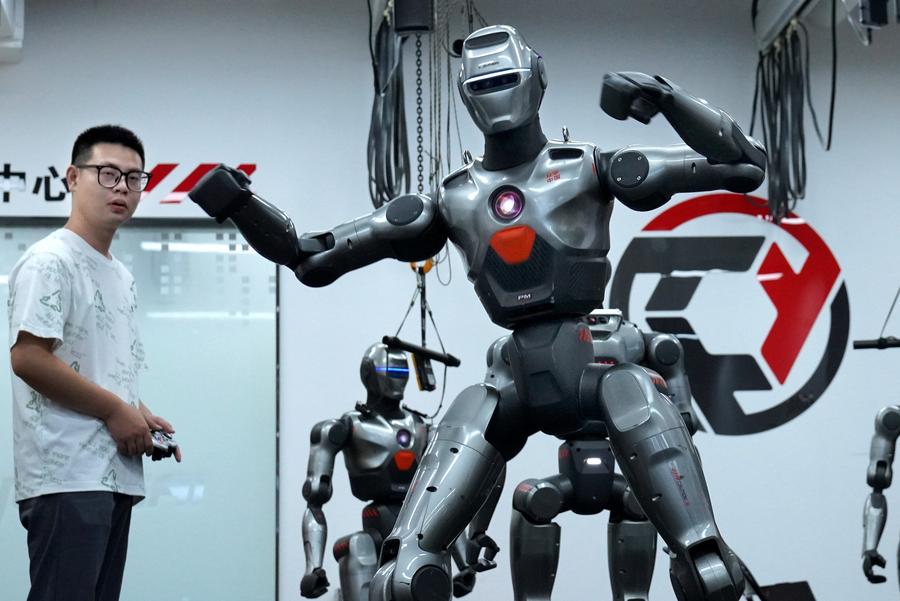
SHENZHEN -- With China's humanoid robot industry booming, battery technology has emerged as a limiting factor in performance, prompting some tech companies to develop more advanced batteries tailored to robotic needs.
Humanoid robots are venturing into diverse areas of our lives, from transporting parts in factories and participating in marathons to playing football and even boxing in the ring.
However, with a current endurance of just around two hours, humanoid robots fall significantly short of meeting the demands of more complex future tasks.
According to the Institute of Physics under the Chinese Academy of Sciences, the energy consumption of robots mainly comes from mechanical movement, especially the lifting in the vertical direction and the rapid acceleration movements.
For example, when a robot performs a backflip, it may appear effortless, but it actually demands exceptionally high battery performance. The instantaneous discharge rate required can exceed 100 times that of ordinary batteries in daily use.
An insufficient discharge rate affects the robot's performance, while a heavy battery reduces its flexibility, and low capacity limits its practical use. These issues have become significant challenges for robotics companies.
EngineAI Robotics Technology Co., Ltd., located in South China's tech hub Shenzhen, released an impressive robot dance video in March this year. In the video, the company's PM01 robot flawlessly performed the Axe Gang Dance from Stephen Chow's classic film "Kung Fu," capturing the dance's spirit with remarkable accuracy.
Zhang Nan, a hardware engineer at EngineAI, said that ternary lithium batteries are currently widely used in humanoid robots, and several existing products of EngineAI robots are also equipped with such batteries.
However, such lithium batteries have poor performance in thermal stability. With the development of humanoid robots, solid-state batteries with higher energy density, smaller size and better safety may be the future. "EngineAI is currently in contact with solid-state battery manufacturers for preliminary research," Zhang said.
X Square Robot also faces similar challenges. Wang Qian, founder of the company, said that the company's goal is to have robots take over simple and tedious physical tasks, from electronic assembly work in factories and restaurant service to everyday household chores, making general-purpose robots an indispensable part of people's lives.
The batteries currently used by X Square Robot include ternary lithium batteries and lithium iron phosphate batteries. Their common problem is the low energy density, which affects the overall endurance of the robots. For robots to enter homes and other future application scenarios with high activity levels, they need batteries with higher energy density and, most importantly, maximum safety, Wang explained.
This year's government work report outlined plans to develop future industries like embodied intelligence, highlighting the humanoid robot sector as a key focus. According to the Chinese Institute of Electronics, by 2030, the market size of China's humanoid robots is expected to reach about 870 billion yuan (about $121 billion).
The swift response has come from tech companies, which are becoming the driving force behind innovation in the country. Some battery manufacturers have recognized this emerging demand and have already partnered with humanoid robot companies for research and development.
For instance, in June, battery giant CATL invested in Beijing-based Galbot, aiming to develop batteries for humanoid robots and to introduce robots into its production lines to achieve factory production automation.
BTR New Material Group, a Shenzhen-based battery supplier, in May launched the FLEX semi-solid and GUARD all-solid-state batteries tailored for humanoid robots. The company has achieved a balance between high performance and lightweight design through two major strategies: material innovation and structural optimization.
For instance, the FLEX series' high-nickel ternary cathodes use molecular-level in-situ coating technology, which can effectively increase the energy density. The GUARD series uses a lithium-rich manganese-based cathode and a lithium metal anode design, which significantly increases the energy density of the individual cell.
According to Li Zikun, director of the company's research institute, the mainstream ternary lithium batteries have shortcomings in terms of energy density, safety and stability, and high-rate discharge performance for humanoid robots. Solid-state batteries can better meet these needs.
Li believes that batteries for future humanoid robots should meet three key requirements: a balance between high energy density and safety, optimized fast charging and discharging efficiency, and stability and reliability under special working conditions.
The all-solid-state battery eliminates the risk of leakage and fire associated with traditional liquid electrolytes, providing a safety guarantee for use under extreme conditions, he said.
These high-energy-density designs can not only support the long-endurance needs of humanoid robots, but are also particularly suitable for increasing the payload in special application scenarios such as aerospace, Li added.





- Chinese scientists set world record with magnetic field 700,000 times Earth's
- State Council appoints, removes Macao SAR govt officials, prosecutor general
- China's top legislator urges stronger role for people's congresses
- Think tank report on new vision of civilizations sparks discussion among scholars
- Taipei Confucius Temple holds annual ceremony marking Confucius' birth
- Former agricultural minister sentenced for bribery