China's marine economy rides tide of innovation into greener seas







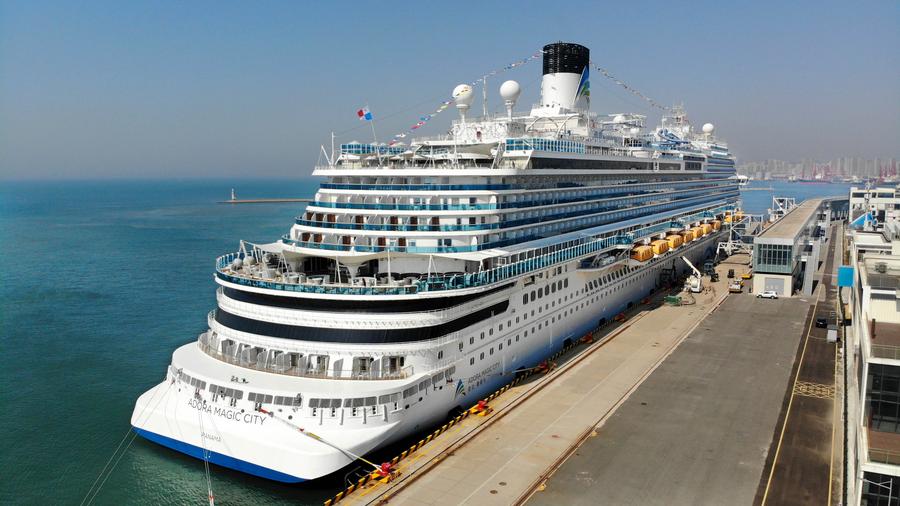
BEIJING -- With strong tides of innovation and a deepening drive for sustainability, China's marine economy is surging forward as a fast-growing engine of "blue" growth.
Now a more than 10-trillion-yuan ($1.4 trillion) powerhouse accounting for around 7.8 percent of China's GDP, the marine economy expanded by 5.9 percent year-on-year in 2024, outpacing overall economic growth, and is increasingly serving as a testbed for technological innovation and sustainable development.
Building on this momentum, China has placed the marine economy firmly on the national agenda. At a high-level meeting in early July, Chinese leadership stressed that advancing Chinese modernization requires "promoting the marine economy's high-quality development" alongside a "Chinese path of leveraging marine resources to achieve strength."
Policymakers highlighted five areas of focus: innovation-driven growth, efficient coordination, industrial renewal, harmony between human and the sea, and win-win cooperation.
These strategic directions align with the country's sustained efforts to pursue a smarter, cleaner growth model, which delivers high-value output, sustains livelihoods, and supports climate action.
Waves of innovation
From biopharma to offshore energy, innovation is powering China's high-quality development of the marine economy.
In China's eastern port city of Qingdao, researchers at the Marine Biomedical Research Institute of Qingdao are accelerating the development of drugs from ocean-derived compounds. A new anti-tumor drug, BG136, has entered Phase II clinical trials.
According to Guan Huashi, an academician with the Chinese Academy of Engineering and honorary director of the institute, local authorities are actively supporting innovation teams and promoting the "blue medicine bank" initiative, which aims to build a full-chain R&D and commercialization system for marine pharmaceuticals.
According to the 2025 China marine economy development index, value-added output of emerging marine industries grew 7.2 percent year-on-year in 2024, with sectors such as marine medicine, bioproducts, and high-end offshore equipment manufacturing gaining strong momentum this year.
From the lab bench to the power grid, technology is reshaping how the country taps its ocean resources.
On the shores of the Beibu Gulf, over 80 offshore wind turbines now rise from the waves, capturing steady sea breezes to generate clean electricity. In December last year, Guangxi's first offshore wind power plant, the Fangchenggang demonstration site, was fully connected to the grid.
Intelligent systems have improved inspection efficiency and are driving a shift toward unmanned, intelligent operations, said Xie Hailong, a maintenance manager.
Green tides, global ties
Hand-in-hand with its tech boom, China's marine economy is undergoing a green transformation, as reflected in sectors such as shipbuilding, which remains a vital pillar of maritime development.
In June, Guangzhou Shipyard International commenced construction of a 230-meter-long LNG dual-fuel car carrier for a client in the Republic of Korea. Among the world's largest of its kind, the vessel will run on both fuel oil and natural gas.
According to General Manager Zhou Xuhui, 80 percent of the company's over 90-vessel order book consists of high-tech, high-value-added green ships, with deliveries scheduled through 2028.
Nationwide, the trend is gaining traction. A marine economy bulletin released in February by the Ministry of Natural Resources noted significant progress in the shift toward smarter and greener shipbuilding, with newly secured orders for green vessels last year accounting for 78.5 percent of the global market share.
The transformation underway in shipyards is mirrored along the coast, where cities are adopting digital technologies to monitor and protect marine ecosystems.
In Dongying, Shandong province, authorities have established a digital registry for all 629 coastal discharge outlets, utilizing aerial mapping, remote sensing, and real-time inspections.
In Shenzhen's Dapeng Bay, drone-based spectral imaging enables water quality monitoring. In Xiamen, AI-powered video systems track floating marine debris, making clean-up more timely and targeted.
These efforts are showing results. According to the Ministry of Ecology and Environment, 83.7 percent of China's coastal waters met the good water quality standard in 2024.
At the community level, the "Blue Circle" marine plastic recycling program, launched in Zhejiang in 2020, offers a tech-enabled model for marine plastic recovery. Utilizing blockchain and the Internet of Things, the program tracks plastics from collection to resale, having recovered over 19,200 tons of waste.
With support from more than 60,000 participants, the project won the UN's Champions of the Earth award in 2023.
On the global stage, China is expanding its role in marine cooperation. At the UN Ocean Conference held in Nice, France, this June, the country's marine conservation efforts drew praise for advancing international collaboration and sharing environmental expertise.
Jack Hurd, executive director of the Tropical Forest Alliance at the World Economic Forum, called China's efforts "fantastic," citing its progress in marine protected areas, wetland conservation, coastal patrols, and investment in ecological restoration and sustainable practices.
"So I think it's fantastic what the Chinese government has done over the years, not only in the ocean, but also on the land," he said.