Easier finance funding consumption
Cheap loans, credit cards, low interest rates raise desire to start spending







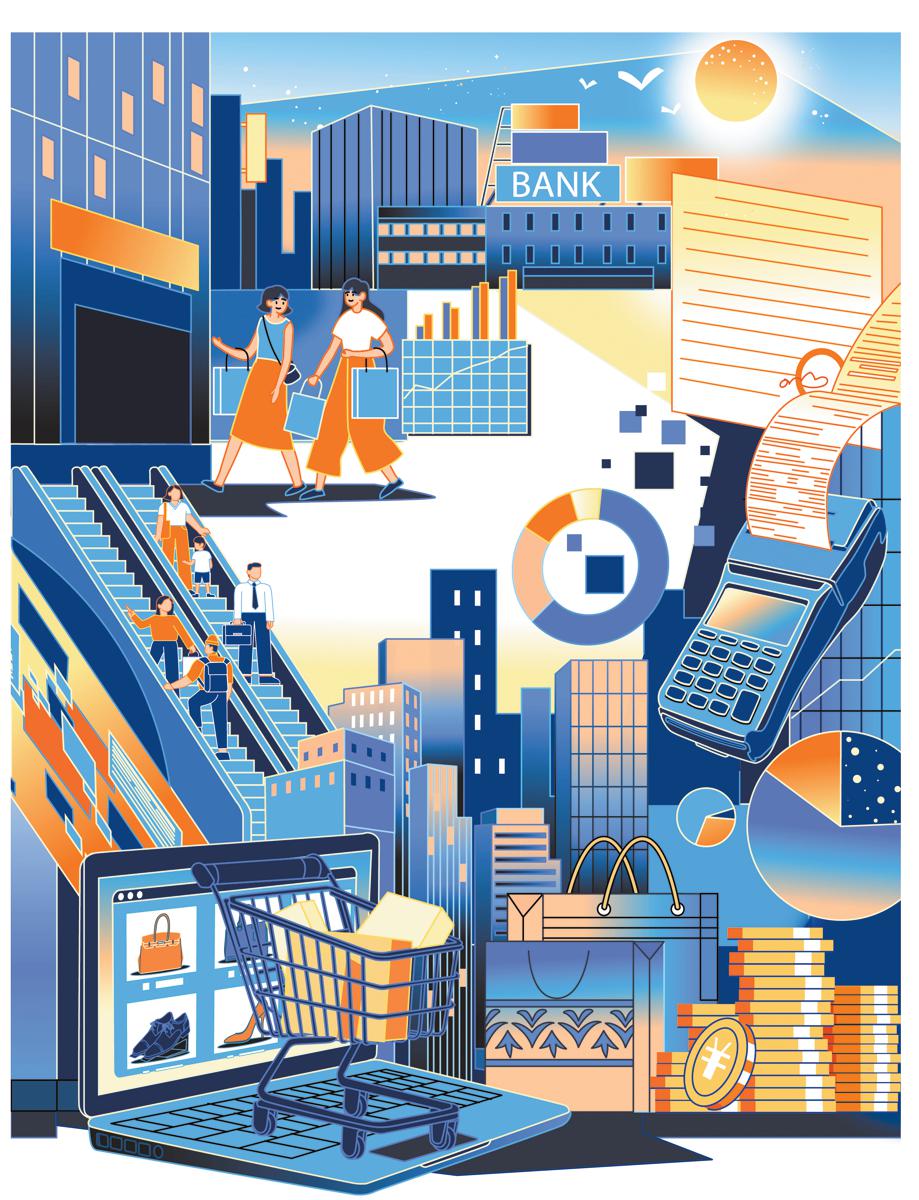
China has charted a clear road map to provide more targeted financial services to shore up consumption, which analysts said will better help the world's second-largest economy to steady its growth in the face of external pressures.
As the country has put consumption-boosting initiatives at the top of its economic work agenda this year, financial institutions have stepped up to the plate, introducing a diverse array of consumer-friendly products and services to stimulate spending, from instant loan approvals to discounted credit card payments and interest-free installment plans.
China's consumer spending in May posted its strongest growth in nearly 18 months, with retail sales of consumer goods expanding 6.4 percent year-on-year for the month, a 1.3-percentage-point increase from April, data from the National Bureau of Statistics showed.
In the latest step to further expand financial support for the consumption sector and unlock the spending potential of households, the People's Bank of China, the country's central bank, along with five other government departments, unveiled a guideline on improving financial support for expanding consumption in late June.
The document calls for stronger financial support for both goods and services consumption, as well as new types of consumption.
"The trade-in initiative has provided a major boost to durable goods consumption, as consumers embrace the opportunity to upgrade their products at cheaper prices," said Dong Ximiao, chief researcher at Merchants Union Consumer Finance Co.
The latest guideline, by focusing on tailoring financial products and services to specific consumption scenarios and consumer segments, aims to unlock the full potential of the goods consumption market.
In particular, the guideline emphasizes the need to continue providing financial services for consumer goods trade-in programs.
Dong noted that the service consumption sector remains relatively underdeveloped, presenting substantial growth potential. Last year, service consumption accounted for only 18 percent of China's GDP, while developed economies usually see this figure exceed 40 percent.
"The service consumption sector still has ample room for expansion, as rising household disposable incomes fuel greater demand for services," Dong said.
"As consumers' purchasing power continues to grow, the demand for new and innovative consumption models is also gaining significant momentum," he added.
To this end, the guideline calls for increased financing support for operating entities in sectors such as wholesale and retail, catering and accommodation, household services, and elderly and child care services, to unlock the potential of basic service consumption.
The guideline also emphasizes the need to innovate financing models in areas like culture, tourism, sports, entertainment, education and training, and residential services, with the goal of invigorating the demand for upgraded service consumption.
Prior to the guideline, in May, the People's Bank of China established a 500 billion yuan relending facility specifically aimed at supporting service consumption and elderly care, with a focus on scaling up financial support for sectors such as accommodation and catering, cultural and sports entertainment, household services, elderly and child care, education and tourism.
Xu Hongcai, deputy director of the economic policy commission at the China Association of Policy Science, said that to drive consumption in major spending scenarios such as automobile purchases and travel, businesses could accelerate cooperation with commercial banks and consumer finance companies to introduce a variety of consumer credit products.
"By lowering the barriers to entry for these big-ticket consumption scenarios through diverse consumer credit offerings, we can enhance consumer purchasing power and improve their overall consumption experience," Xu said.
In addition, the guideline highlights the exploration of effective channels and methods to leverage financial support for the development of new consumption trends, such as digital consumption, green consumption and health-conscious consumption.
In recent years, China's consumption market has witnessed the emergence of new consumption models such as livestreaming e-commerce, instant retail, the silver economy, the debut economy and the low-altitude economy.
"Going forward, financial institutions need to shift their mindset from 'what they can provide' to 'what financial consumers need'," Xu said. "By tailoring their offerings to the evolving needs and preferences of consumers, financial institutions can better cater to the diverse demands in the rapidly changing consumption landscape."
Amid heightened external uncertainties, consumption has emerged as a crucial engine for accelerating the establishment of a new development paradigm and promoting high-quality growth in China.
Lou Feipeng, a researcher at the Postal Savings Bank of China, said that the recently issued guidance clearly outlines the direction and priorities for financial support to bolster consumption growth, aiming to establish a comprehensive multitiered financial service system to aid the revival of consumption.
China has built a relatively comprehensive multi-tiered consumption finance service system, with credit support playing a pivotal role as the primary channel, while diversified financing avenues such as bond and equity financing are also coming into play, providing vital financial backing for the stable development of the consumption market.
To strengthen the service capabilities of financial institutions and broaden the supply of consumption-oriented financing offerings, the guideline stresses increasing support for first-time loans, renewal loans, credit loans, and medium- and long-term loans to enhance the convenience and sustainability of consumer finance services.
The guideline also supports qualified financial institutions in issuing financial bonds and credit asset-backed securities to boost their consumption credit supply capacity. It encourages eligible service consumption enterprises in sectors like culture, tourism and education to issue bonds, and supports qualified science and technology startups in raising funds through the bond market.
Wen Bin, chief economist at China Minsheng Bank, said that the consumption sector is home to a large number of individual business owners who are widely distributed and closely connected to people's livelihoods, making them a fundamental and relatively active economic entity.
When these businesses face operational difficulties, especially cash flow challenges, financial institutions should avoid one-size-fits-all loan withdrawal, and instead, take a long-term perspective to help enterprises secure more time to overcome the difficulties, within the bounds of legal and regulatory compliance, Wen said.
The progress of financial technology provides the necessary foundation to achieve the goals outlined in the recently issued guideline, experts said.
The guideline specifically notes promoting the integration and application of technologies like the internet and big data in consumption finance, as well as optimizing the online application, approval and disbursement processes for consumer credit products to enhance the convenience of consumption financing.
Going forward, financial institutions can further enhance the accessibility and convenience of their products and services by embracing the principles of digitalization, mobilization and openness, the guideline said.
wangkeju@chinadaily.com.cn






- Macao SAR's broad money supply expands in July
- China's landmark trade corridor freight tops 1m TEUs in 2025
- Shandong-Taiwan trade fair held in Weifang
- China's CERES 1 rocket launches new satellites
- Better regulation of tipping behaviors urged to boost livestreaming sector
- China premieres first 8K documentary on manned spaceflight mission