US threat of Russia tariffs can upset world economy







The United States administration's announcement of military aid to Ukraine and threats of tariffs on Russia signal an abrupt change in US policy on the Russia-Ukraine conflict, experts said, warning that the threat of secondary tariff sanctions could disrupt global energy markets and economic stability.
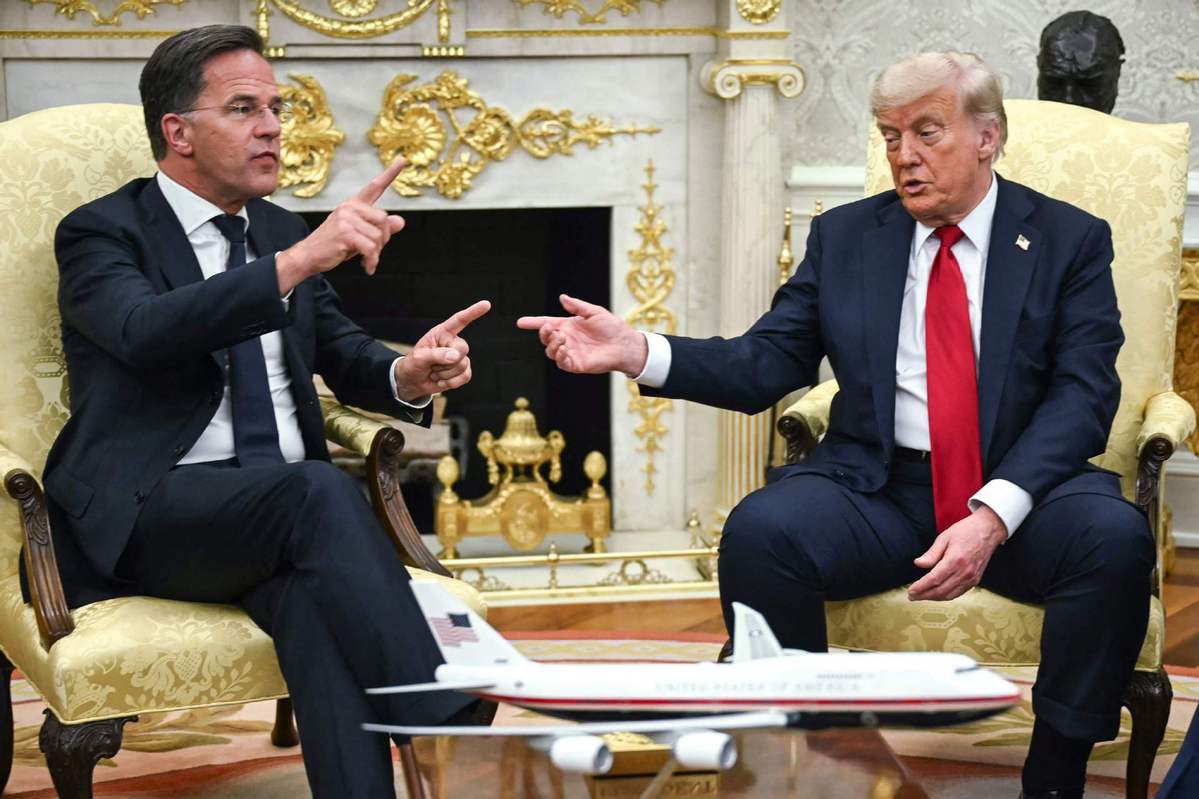
On Monday, while meeting with NATO Secretary General Mark Rutte at the White House, US President Donald Trump announced a new agreement with NATO regarding weapons to assist Ukraine. Trump said the plan was to rapidly provide Ukraine with the most sophisticated air defenses and precision missiles.
Zhang Hong, a researcher at the Chinese Academy of Social Sciences' Institute of Russian, Eastern European and Central Asian Studies, noted that Trump's move reflects a broader recalibration of US strategy on the Russia-Ukraine conflict.
"At the start of his presidency, Trump extended an olive branch to Russia, seeking to broker a ceasefire in Ukraine through strategic engagement," Zhang said. "But after failing to secure major concessions from Moscow or a lasting peace, he has pivoted to a tougher approach, mixing threats of sanctions with diplomatic outreach."
Experts attribute the US policy shift to domestic and geopolitical realities. "The Russia-Ukraine conflict remains an unavoidable election issue in the Western world. With the US midterm elections approaching, Republican prospects could suffer if the party fails to take action on the Ukraine front," Zhang said.
Qian Feng, director of the research department at Tsinghua University's National Strategy Institute, underscored the effect of a prolonged stalemate in Ukraine-Russia negotiations. With both sides deadlocked over territorial disputes and NATO expansion, Trump has turned to military aid as leverage, said Qian.
Despite agreeing to military aid for Ukraine, Trump emphasized that the cost would be borne by NATO allies. Under the US agreement with NATO regarding weapons to assist Ukraine, the governments of Germany, Finland, Denmark, Sweden, Norway, the United Kingdom, the Netherlands and Canada will finance bulk purchases from US manufacturers and ship the equipment directly to Kyiv.
Qian said that the Trump administration's focus on getting allies to pay for the military aid highlighted its "America First" policy.
"This approach, where Europe foots the bill while the US provides the support, lets the US arm Ukraine without spending its own money. Furthermore, it strengthens NATO's dependence on American leadership and benefits US defense companies, creating both political leverage and economic advantages for the US," he said.
Beyond military aid, Trump also threatened "severe tariffs" targeting Russia, including imposing 100 percent secondary tariffs on countries that buy Russian oil, natural gas and other products, if a ceasefire deal is not reached in 50 days.
While the immediate economic impact of these tariffs on Russia might be limited, Qian suggested that "secondary tariffs could eventually strain Russia's wartime economy by forcing third-party nations to curb energy imports".
Zhang of the CASS' Institute of Russian, Eastern European and Central Asian Studies, highlighted the diplomatic nuance in Trump's tariff threat, which provides a window for negotiation while applying pressure. He also elaborated on the potential global impact of these secondary tariffs.
"Unlike past direct sanctions, secondary tariffs extend US reach globally, targeting Russia's trade partners. If enforced, they could affect at least 30-40 percent of Russia's oil sales, destabilizing its economy and rippling through global energy supplies," he warned.
The move, Zhang added, embodies the US' "hegemonic grip on global finance and trade", suggesting that the Trump administration may exploit the Ukraine conflict to justify broader trade wars, potentially targeting emerging economies reliant on Russian energy.
Kremlin spokesperson Dmitry Peskov acknowledged Trump's statements on Tuesday, calling them "very serious". "We certainly need time to analyze what was said in Washington," he added.
Qian predicted heightened tensions in the short term due to the tariff threat and military aid.
However, he believed that both nations would strive to avoid direct confrontation, opting instead for a relationship characterized by "strategic competition and limited cooperation".
Echoing this sentiment, Zhang stated that while Trump's policy shift makes normalized US-Russia relations unlikely, it won't spiral into outright conflict. "In Trump's second term, the US-Russia relations may remain stuck at 'low-temperature'," he said.
Agencies contributed to this story.