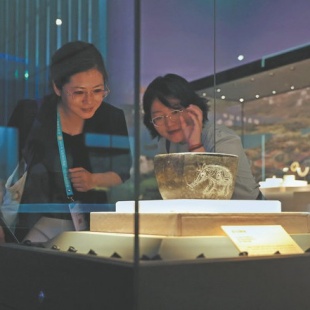



Exhibition zooms in on Yangtze's tide of history








Perhaps most revealing are bronze items from a tomb of a Qin (221-206 BC) general found in Yunmeng county, Hubei province.
He was buried with both northern-style tripods and Chu-style (a vassal state over 2,000 years ago) gui ritual bronze vessels.
"The hybrid motifs blended Qin militaristic imagery with Chu shamanistic symbols — illustrating how bronze objects facilitated cultural (interactions) during the turbulent Warring States Period (475-221 BC)," Fang notes.
The third chapter, Magnificent Momentum, explores the Yangtze River's transformative influence from the Song Dynasty (960-1279) onward. This period saw the region emerge as a nexus of political thought, educational reform, commercial expansion and cultural expression. From renowned academies and thriving textile industries to imperial examination records and theatrical art, the Yangtze River Basin became a dynamic engine of imperial innovation.
Following the Southern Song Dynasty (1127-1279)'s relocation of the capital to Lin'an (in modern-day Hangzhou, Zhejiang province), the Yangtze River Basin began to assume increasing importance, as a hub of political thought and statecraft, says Wang.
"This prominence was further solidified in the early Ming Dynasty (1368-1644), when Zhu Yuanzhang established the Ming capital in Nanjing. The Yangtze region thus became the administrative and institutional heart of the empire."
Several artifacts speak powerfully to this ascendancy. A cloud-scroll patterned stone column head from ruins of Ming royal palace in Nanjing exemplifies how southern palace architecture influenced the later construction of the Forbidden City in Beijing, Wang says.
"Although the Nanjing palace now exists only in fragments, its layout and ornamentation set precedents that were later expanded upon in the northern capital," he says.
Likewise, a set of imperial roof tiles and drip tiles from the Xiaoling Mausoleum of the Ming Dynasty reflects the symbolic authority vested in imperial design.
"The yellow glaze and five-clawed dragon motifs conform to the strict sumptuary codes of the Ming dynasty, underscoring the ceremonial power radiating from the Yangtze region at that time," Wang says.
Another highlight is a floor tile known as a "golden brick", produced in Suzhou, Jiangsu province, and used exclusively in royal architecture. Remarkable for its metallic resonance when struck, this brick included engraved details such as the name of the craftsman and date of manufacture, offering rare insights into the regulated production systems that underpinned imperial infrastructure.
Beyond politics, the exhibition also sheds light on the refinement of textile craftsmanship, as seen in a Ming-era Yun brocade sample and a model of a Song Dynasty loom from the lower reaches of the Yangtze River. As Chinese silk and embroidery flooded global markets during the Ming and Qing (1644-1911) periods, the Yangtze region became an economic engine powering both domestic and international exchange, Wang says.
"These insights help decode the river's significance not only as a geographical feature, but also as a historical force that shaped identity, governance and creativity," he says.
Ultimately, the Yangtze exhibition invites viewers to reflect on the deep currents of history flowing through this vital waterway and calls for renewed public engagement in protecting and studying this civilizational artery, especially as modern development increasingly intersects with cultural heritage conservation, he adds.