Japan's right-wing gaining ground
Upper house election indicates shift toward conservatism, analysts say







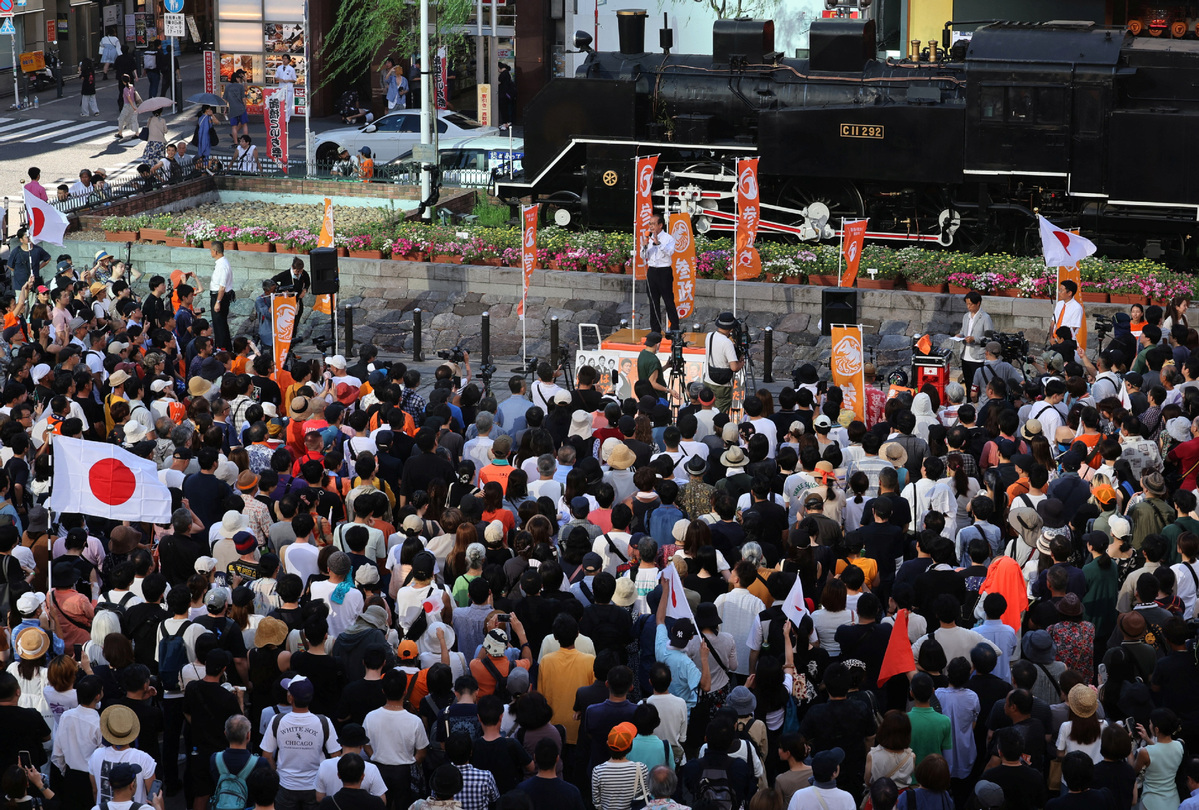
The notable gains made by Japan's right-wing and exclusionary parties in Sunday's upper house election show these forces are capitalizing on growing public dissatisfaction and tapping into nationalist and anti-immigrant sentiments to expand influence nationwide, according to analysts.
Vote counts on Monday showed the center-right Democratic Party for the People, or DPFP, won 17 seats, and Sanseito, which campaigned on a "Japanese First" platform but advocates far-right policies, including anti-immigrant and going for constitutional amendments, ballooned their seats from 2 to 14.
Kumiko Haba, distinguished professor at Josai International University in Tokyo, noted that both the DPFP and Sanseito were effective in using social media to appeal to younger voters, particularly those who were previously disengaged from politics or unaffiliated with any party.
According to a voter analysis by Nikkei Asia, in the proportional representation portion of the election, the ruling Liberal Democratic Party, or LDP, secured most votes among people aged 50 and above. In contrast, younger generations demonstrated a clear preference for opposition parties.
Sanseito gained significant support from voters in their 40s and 50s — a group often referred to as Japan's "lost generation", which entered the workforce between 1993 and 2004 amid economic stagnation and a frozen job market.
Haba said many voters who have become disillusioned with the LDP have been drawn to right-wing and anti-immigrant parties, resulting in a pronounced shift toward conservatism in Japan's political landscape.
"This is something neither the LDP nor the left has been able to achieve," she said. "In that sense, Japan's elections have entered a new era."
During the election, Sanseito leader Sohei Kamiya said the party would decide on cooperation with the ruling coalition on a case-by-case basis, emphasizing that the party aims to secure 50 to 60 seats in the next lower house election and form a coalition government.
Rising costs
Ukeru Magosaki, director of the East Asian Community Institute and a former senior official at Japan's Ministry of Foreign Affairs, also pointed to rising living costs as a key source of social anxiety.
"Japan is a highly homogeneous society, and as the number of foreign workers continues to increase, dissatisfaction toward them will gradually become more common in daily life," he said.
Noriyuki Kawamura, emeritus professor at Nagoya University of Foreign Studies, said the Japan Conservative Party, which calls for the restoration of the emperor-centered political order, won two seats in the upper house for the first time.
"While the party's overall support remains low at around 1 percent and its extreme agenda lacks broad backing, it has undeniably gained support from nationalist circles," he said.
Kawamura said while Sanseito's campaign emphasized "Japanese First" and called for tighter restrictions on foreigners, which helped expand its support, it cannot be "unequivocally classified as right-wing". However, given the exclusionary nature of some of its policies, the party has faced criticism from both pro-integration political groups and some Japanese media outlets.
Haba also highlighted the declining influence of Japan's traditional left-wing parties, noting that the Japanese Communist Party secured just three seats while the Social Democratic Party managed to get only one, bringing them close to the fringes of political relevance.
"This signals a significant shakeup of leftist forces in Japan," she said.
She also said the LDP has failed to address long-standing issues such as money-driven politics and the neglect of younger generations. Instead, the government is shifting toward what she described as "reckless and dangerous" policies — excluding foreigners, focusing narrowly on boosting young people's incomes, and pushing the elderly to shoulder the costs of expensive medical care and life-prolonging treatments.
"This shows that Japanese politics is undergoing a serious rightward shift," Haba said.
houjunjie@chinadaily.com.cn