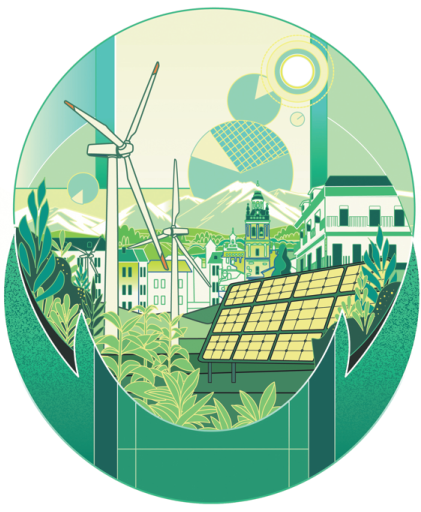
China leads boldly in global energy transition







China has invested trillions of yuan in the clean energy equipment manufacturing sector over the past few years, but returns will depend on the success of clean energy transition both in China and the rest of the world.
In 2024, clean energy industries contributed to more than 10 percent of China's GDP, generating an estimated $1.9 trillion in economic output, becoming a key driver of economic growth and overtaking the real estate sector in sales value. Chinese companies exported an estimated $177 billion worth of clean energy technologies and committed at least $60 billion to building new factories abroad. Once completed, these facilities could generate output worth $110 billion a year.
The export of affordable solar photovoltaic panels, electric vehicles (EVs) and batteries from China is already helping many countries transition to clean energy. The regions where China's exports are having the biggest impact are the Middle East, North Africa, sub-Saharan Africa, South Asia and Europe.
China's clean energy exports are broad-based: since 2023, China exported clean energy equipment such as wind power products and photovoltaic products to more than 200 countries and regions.
In particular, solar power combined with batteries has become a cost-competitive and reliable source of energy much faster than expected because Chinese manufacturers succeeded in drastically reducing the cost of production. The solar power boom in Pakistan and South Africa are some of the more prominent examples. Similarly, lower-cost batteries are making EVs more attractive than fossil fuel-driven vehicles. In fact, in emerging markets, Chinese-made EVs account for about 75 percent of the growth in EV sales.
China's clean energy footprint across the world is set to expand significantly, especially if the global energy transition accelerates in line with the International Energy Agency's road map for realizing net-zero emissions by 2050. To reduce global emissions in accordance with the Paris Agreement, while meeting the growing energy demand, especially in emerging economies, investments in solar and wind energy sectors beyond China need to more than double from the 2024 level and the global market for EVs needs to grow 12-fold in the next decade.
This can happen only with support from China's manufacturing.
In such a scenario, global demand could propel China's clean energy and technology exports to $1.1 trillion by 2035, with emerging and developing economies accounting for the majority of China's clean technology exports: about 70 percent in solar PV panels and 60 percent in wind and battery storage.
Some may be concerned that China's strength in clean energy manufacturing could limit economic opportunities for other countries. But that's not true, as China is now focusing on upstream manufacturing. After all, solar panels and batteries now account for just a quarter of the value of a typical solar power generation project, and a consumer EV.
This means three-quarters of the value of China's solar panel and battery exports are enjoyed by the importing countries. When the supply of low-cost clean energy results in the development of new industries or other economic activity in the destination country, the downstream value is far larger. And as clean energy use continues to grow globally, there is huge potential for Chinese enterprises to boost their participation in downstream activities, including infrastructure development, operations and maintenance, in order to capture a larger share of the value-added market abroad.
However, some economies have raised supply security concerns over China's central role in global supply chains, with many of them taking steps to diversify their sources of key components like solar panels, EVs and batteries. The European Union and India, for instance, are trying to develop their own clean energy manufacturing sectors, but they have a lot of work to do to even meet their domestic demand, let alone exporting such products.
To redress those economies' genuine concerns over supply chain security, Chinese manufacturers should work with them to make supply chains more resilient and universally beneficent. Nevertheless, given the scale and cost advantages of China's clean energy manufacturing sector, its products are likely to comprise a large part of the global clean energy landscape in the near future.
China has every reason to help expedite global energy transition, including initiatives such as tripling global renewable energy capacity from 2022 to 2030. As a matter of fact, China's clean energy industries could double their value by 2035, adding 15 trillion yuan ($2.09 trillion) to the economy if the energy transition in China and the rest of the world continues.
Many Chinese enterprises have increased their investment and financing overseas, but a lot more needs to be done. And China's role in advancing the clean energy sector suggests a potential shift toward proactive global positioning on climate and clean energy.
By providing easier and relatively inexpensive access to clean technologies, coupled with investments in clean energy and related infrastructure projects and production facilities, including technology transfer, China could play a key role in driving the global energy transition, while exploring lead markets for its key technologies.
The views don't necessarily reflect those of China Daily.





Today's Top News
- Key quotes from President Xi's 2026 New Year Address
- Full text: Chinese President Xi Jinping's 2026 New Year message
- Poll findings indicate Taiwan people's 'strong dissatisfaction' with DPP authorities
- Xi emphasizes strong start for 15th Five-Year Plan period
- PLA drills a stern warning to 'Taiwan independence' separatist forces, external interference: spokesperson
- Xi, Putin exchange New Year greetings