State Grid's recycling centers forge sustainable path
Utility company's innovative solutions bring environmental, economic benefits, Hou Liqiang reports from Chongqing






Editor's note: China Daily is publishing a series illustrating the country's efforts to achieve its carbon peak and carbon neutrality goals.
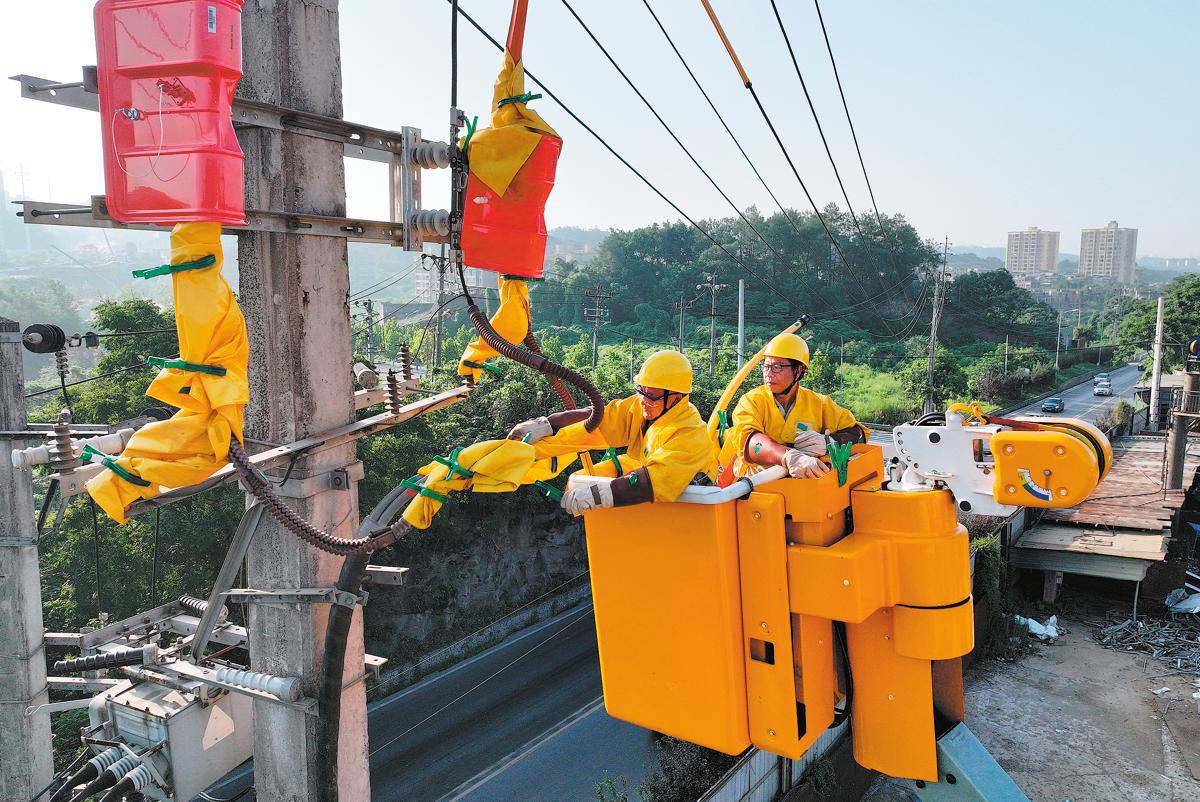
At a nondescript industrial estate in Chongqing, Southwest China, transformers formerly used in the municipality's electricity grid are being dismantled piece by piece, recycled, and potentially hazardous waste is disposed in an environmentally friendly way.
Such has been the case since 2022, when State Grid Corporation of China, the world's largest utility enterprise, established the first of 14 recycling centers across the country to contribute to the national climate targets of peaking carbon dioxide emissions before 2030 and going carbon neutral before 2060.
The recycling of transformers is a tricky process as they contain hazardous waste oil and sulfur hexafluoride, or SF6, a potent greenhouse gas.
"Last year alone, roughly 5,000 transformers, collected all across Chongqing municipality, were dismantled. Their materials were specifically categorized for recycling here in Yongchuan district," said Yang Zhigang, a recycling technician at the center.
Yang, clearly proud of his work, gestured toward the dismantling facility and said, "The ground is immaculately clean, devoid of any grease or dirt."
He has every reason to be proud. The center, the first of its kind operated by State Grid, began from the ground up without any specialized equipment available for the disposal of transformers and other waste products from the power grid available on the market.
The center provides a microcosm of how the power supply sector in China as a whole is promoting the recycling economy and contributing toward sustainability.
Transformer oil has high recycling value and can be used to produce lubricating oil. Previously, collectors had to individually go to different power stations with retired transformers to collect the oil, resulting in not only oil leakage but also SF6, Yang said.
The emission of 1 metric ton of SF6 is equivalent to the emission of over 20,000 tons of carbon dioxide. To date, the center, by comprehensively disposing of solid, liquid and gas waste, has reduced SF6 emissions by roughly 21 tons, it said.
The contributions of the center to reducing carbon emissions go far beyond that figure, Yang added.
Standing beside an automated machine for dismantling high-voltage electrical cables, he detailed how different parts of the line are classified and recycled. Thanks to centralized disposal efforts, many components of a cable, previously burnt to extract the copper within, can now be effectively recycled, he said.
The cable casing, for example, is purchased by a local company for approximately 2,000 yuan ($278.7) per ton to produce pelletized lubricants. Following the pelletization process, the material's value skyrockets to 15,000 yuan per ton.
The pelletized lubricants can be used to enhance the surface finish of cast parts for automobiles, achieving a mirror-like effect by improving their smoothness from 98 percent to 99.9 percent, Yang said. It can significantly extend the life span of automotive cylinders or structural components subject to constant friction.
"Through our practical experience, we have grasped that what we once considered garbage polluting the environment is, in fact, merely resources misplaced," he said. "It may come as a surprise to many that the waste once incinerated is now entirely recycled here."
This equipment is also capable of disassembling and categorizing steel and aluminum wires from within electric cables.
The aluminum within the cable lacks adequate strength, requiring the addition of steel wires to ensure secure suspension. To facilitate recycling, proper classification is essential. Otherwise, they will be refused by the recycling companies, he said.
He said the steel wires in the cable are corrosion-resistant and are highly welcomed by recycling companies as they are cheap and can be used to make a large variety of products, including nails, umbrellas, clothes hangers, shrimp and fish cages, as well as fencing.
The price of steel wires from the center only costs around 4,000 yuan per ton, compared to over 10,000 yuan per ton when they are new, he added.
According to Yang, since its commissioning in August 2022, the center has dismantled over 4,840 tons of electrical cables.
Wang Kaicai, director of the dismantling workshop, described the research and development process for the equipment that dismantles electric cable as akin to crossing a river by feeling the stones one step at a time.
Initially, the center adopted a process of crushing and then using a magnetic separator to extract the steel wires, he said. The center soon found, however, that no matter how strong the magnetic properties of the separator were, it could not successfully extract all the steel components from the crushed material, leading to impurities in the aluminum and rejection by recycling companies.
The center's current equipment was inspired by a device they came across on the popular short-video platform Douyin. This equipment utilizes a wire drawing method to extract steel wires. However, as more wires were drawn out, the device became increasingly heavy, posing a safety risk.
To address this issue, they enhanced the equipment by implementing a mechanism that automatically cuts off the steel wire once it reaches a specific length, effectively eliminating the safety hazard.
"We are constantly refining the devices we use as we put them to the test in production," Wang said.