AI meets anime in daily life







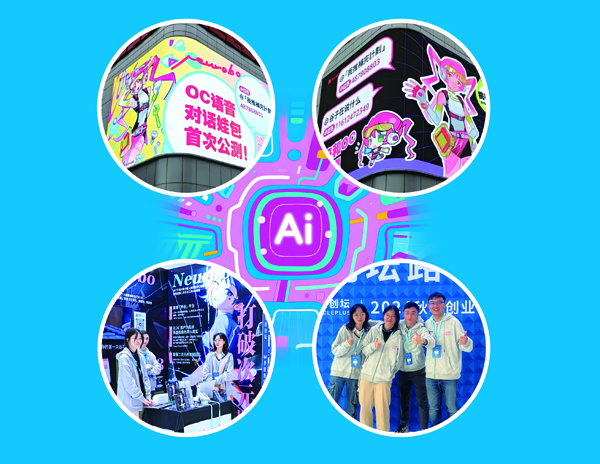
Blending fandom with technology, young creators are redefining how people connect — with their favorite characters and with themselves.
On her way to work, a young woman hears a familiar voice coming from inside her backpack: "Mom, do we really have to go to work today? Can't we just go home and have some snacks?"
The voice doesn't belong to a child, but to a doll of her favorite anime character tucked inside a smart doll bag.
This real-life moment was shared by a user of Neurobo, a Shanghai-based startup that develops AI-powered interactive fan bags.
These innovative devices allow anime fans to bring their favorite characters into their daily lives, engaging with them through real-time dialogue and emotional interaction.
"We wanted to create a product that bridges the gap between the virtual and the real world," said Guo Yijie, 29, the founder of Neurobo.
Powered by built-in sensors, a proprietary context-aware interaction system, microphones, and speakers, the doll can detect its owner's behavior and emotions and adjust its responses accordingly.
For example, if the system senses the user is near their favorite hotpot restaurant, the doll might ask, "Are you thinking about having hotpot today?"
Smart fan gear
Guo's inspiration came from his close observation of a major shift in China's anime merchandise landscape — commonly referred to as the guzi market — which is dominated by character-themed items like figurines, badges, and standees.
"When I was in junior high school, anime fans mostly watched Japanese shows and bought Japanese merchandise," he said.
"Today's fans are no longer solely focused on official Japanese IPs. They're creating their own characters and stories, and guzi has become a tool for self-expression and emotional storytelling."
Guo also noted that China's agile and flexible manufacturing supply chains — especially in cities like Dongguan in Guangdong province and Yiwu in Zhejiang province — have made it possible to rapidly develop and iterate physical products.
In 2024 alone, he estimates that the guzi economy reached a market value of 160 billion yuan ($22 billion), with an increasing number of fans turning to custom creations such as fan-made posters, badges, and dolls.
With a master's degree in interactive robotics from Japan, Guo saw an opportunity to blend this cultural trend with emerging technologies.
"In our graduate program, we were trained to design robots based on specific user needs," he said. "Once you get used to that mindset, it's only natural to want to bring your creations to the consumer market."
A longtime anime fan himself, Guo said his personal connection to the community helped him stay closely attuned to its tastes and expectations.
"We're designing products for a group we truly understand," he said. "That makes all the difference."
To refine his startup concept, Guo returned to China and pursued a PhD in information arts and design at Tsinghua University, where he received a non-equity startup grant. This support allowed him to quickly develop prototypes and test them with real users.
One standout example — shared at the beginning of this story — came from a user whose doll was modeled after a character from Himouto! Umaru-chan, a Japanese anime series about a lazy, stay-at-home girl.
"She wanted her doll to complain about going to work every morning," Guo recalled. "For her, it was a way to relieve stress and find emotional comfort."
To better understand these emotional needs, Guo's team conducted a survey of more than 1,400 respondents. The results revealed that the most popular application scenarios included watching the sunrise with a doll on a mountain and bringing dolls to social activities, such as chatting with others during a walk.
"The findings surprised us and gave us a new perspective on the relationship between humans and robots," Guo said. "People aren't just seeking one-on-one connections with their dolls; they also want to share experiences that involve both humans and robots."
Guo believes that such interactions could redefine social dynamics, with AI-powered companions becoming an integral part of people's lives and enriching the way they connect with their favorite fictional worlds.
"In the future, it may not just be a person and their social companion," he said. "It might be a person, their friends — and all of their robots."
At the heart of this innovation is a simple truth. "Everyone wants emotional connection," Guo said. "Fans just seek it in more imaginative ways — and we're building the tools to make that possible."