Debate flares over safety of kid influencers
China's viral child stars raise growing alarm over privacy, informed consent







Experts are calling for stronger legal, privacy and psychological protections for China's child social media influencers following renewed debate over the risks they face after a widely followed young internet star returned to the spotlight.
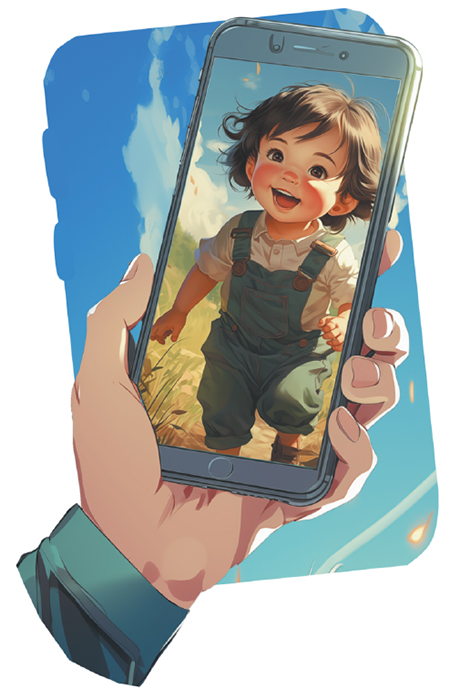
In late June, 4-year-old "Yaoyiyao Xiaoroubao", an influencer with more than 20 million followers on short-video platform Douyin, donated 100,000 yuan ($14,000) to Rongjiang, a flood-hit county in the southwestern province of Guizhou. The gesture revived public attention to her case, months after an earlier controversy raised concerns about the well-being of children in the influencer economy.
Yaoyiyao, whose real name has not been disclosed officially, is a native of Guizhou. Her Douyin account, managed by her parents, features videos of her daily life and has garnered over 610 million likes. Her chubby cheeks, playful expressions and innocent charm have won over audiences nationwide.
But a video posted in February triggered backlash after showing Yaoyiyao falling to the ground while her mother continued filming and laughing instead of helping her. Many netizens questioned whether the fall had been staged for views and accused the parents of exploiting their child for profit, without regard for her privacy or dignity.
Following the incident, her parents suspended the account and removed all product-related listings. Reports by media outlets, including Shanghai-based The Paper, revealed that the account charged 400,000 yuan for ads lasting from 1 to 20 seconds, and 550,000 yuan for videos over 60 seconds.
In a February statement, Yaoyiyao's parents denied mistreating their daughter, barring her from school or forcing her to pose for commercial deals. They resumed posting content from mid-to-late March.
"Children's pure, innocent behavior naturally evokes empathy, and some of their talents, like language skills, also attract followers," said Ye Mingrui, deputy dean of the Television School at the Communication University of China in Beijing.
He said most parents begin by sharing videos for fun, but positive feedback and advertising offers may tempt them to commercialize their children's image.
While China has not released official data on the number of child influencers, the growing internet use among children and the rise of short video trends such as makeup tutorials and mukbangs — videos where audiences watch people eat large quantities of food — have prompted public concern over their right to privacy, mental health and exposure to cyberbullying.
Yao Junchang, from W&H Law Firm in Beijing, said using children to gain online popularity and earn income amounts to turning them into child laborers. He noted that China currently lacks specific laws targeting child influencers, though some government regulations apply.
In January, the Office of the Central Cyberspace Affairs Commission released a draft regulation for public comment that would bar multichannel networks — companies that support content creators — from profiting off child celebrities. The draft regulation finished collecting public opinion in February.
The Ministry of Culture and Tourism in 2021 issued a guideline urging governments at all levels to prohibit the monetization of child influencers. It called for stronger oversight of children's participation in online performances and punishment for accounts that involve minors in indecent or suggestive marketing content.
Experts have also expressed concern about the mental and emotional toll such exposure can take on children.
"Children are still developing their sense of identity," said Wang Wenda, director of psychological health education at Xinhua College of Ningxia University. "If they are intentionally trained to become internet celebrities, they may struggle to distinguish reality from cyberspace, or develop histrionic personalities."
He said that children often lack the ability to regulate emotions under online pressure, which could lead to anxiety or depression. Family dynamics may also suffer if parents shift from caregivers to business managers, prioritizing commercial opportunities over the child's wishes and privacy.
Ye, from the television school, said protection efforts remain incomplete and that many parents fail to understand that a child's digital footprint is permanent — potentially resurfacing later in life with lasting consequences.
"It takes effort from government, platforms, families and every adult around the child," he said. "Authorities should work closely with platforms to supervise influencer accounts and educate parents on how to protect their children effectively."
He added that platforms could encourage users to report content that exploits children, and teachers should intervene when signs of distress are detected.




- China launches 14th group of low-orbit internet satellites
- Hangzhou Normal University apologizes for false recipients' list
- Chinese firms should promote human rights in global business sector, expert says
- New university in Dongguan to provide talent support for GBA
- Taiwan is inalienable part of China's territory: SCO Secretary-General
- Vice president of China's PICC under probe