Gen Z's craze for guzi turning into sizzling biz







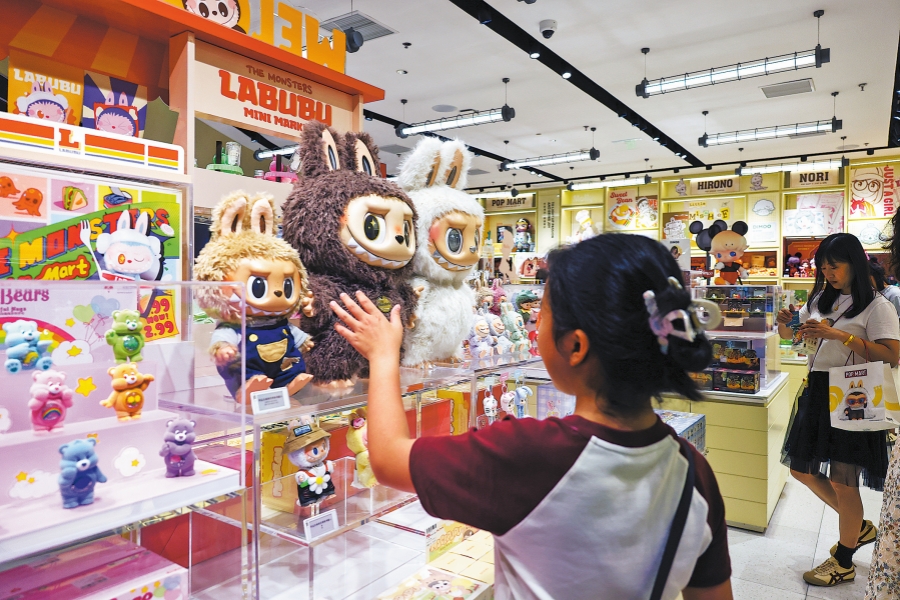
Driven by emotional resonance and the pursuit of personal interests, China's "emotional economy" is fast evolving from an emerging consumer trend into a powerful engine for growth, said industry experts.
As the 22nd China Digital Entertainment Expo and Conference, also known as ChinaJoy, wrapped up in Shanghai last week, the gaming extravaganza was widely hailed as a catalyst for boosting related local industries.
The four-day event drew about 410,300 visitors, with around 61 percent coming from outside the city. The influx of ChinaJoy attendees generated roughly 661 million yuan ($92.02 million) in spending on dining, retail, accommodation, transportation and other services, according to the organizer.
One of the main draws for young visitors is the chance to "eat guzi" — a term that may sound niche but is moving steadily into mainstream consumption.
"I came to Shanghai with my best friend mainly to pick up my favorite guzi," said a visitor surnamed Lin. "I even brought an empty suitcase just for the show — hoping to leave with it full."
At anime and gaming exhibitions, "guzi" refers to merchandise derived from popular cultural IP, such as anime, comics, games and novels. These derivative products can include posters, badges, cards, keychains, figurines and plush toys, while "eating guzi", or chigu, describes the act of purchasing them.
Data from marketing consultancy iiMedia Research showed that the guzi economy in China reached a market size of 168.9 billion yuan in 2024, up 40.63 percent from 2023, and is expected to surpass 300 billion yuan by 2029.
Young consumers remain the main force in consuming guzi. According to goods trading platform Xianyu's report, more than 70 percent of transactions for guzi on the platform were made by users born after 1995.
"Generation Z (those born from the mid-1990s to the early 2010s) consumers tend to seek products that align with their personal values and aesthetics," said Sun Jiashan, an associate researcher at the Central Academy of Culture and Tourism Administration. "The core driving force of this kind of 'emotional economy' is the younger generation's strong desire for self-pleasing and interest-driven spending."
A report by Future Marketing noted that since 2013, emotional-consumption related industries have seen an average compound annual growth rate of 12 percent and the Chinese market is expected to exceed 2 trillion yuan by the end of 2025. The rise of the internet and social media, along with innovative marketing strategies, has fueled the growth of the sector, it said.
"Today's consumers care more about consumption scenarios and experiences, which calls for the market to encourage more integrated and innovative product formats," said Wei Pengju, head of the institute of cultural economics at the Central University of Finance and Economics.
"When sectors such as film, performances, anime, tourism and dining join forces, the combined appeal and driving force can far exceed that of any single industry."
An emerging example of the combination is the traditional commercial complexes embracing the guzi economy to bring in fresh streams of visitors.
A slew of established malls, such as Bailian ZX in Shanghai, Intime Department Store in Xi'an, Shaanxi province, and Aqua City in Nanjing, Jiangsu province, have seen a surge in foot traffic after being revamped into guzi-themed shopping venues.
Take Bailian ZX for example, in 2024, it hosted nearly 700 events, with sales climbing 70 percent year-on-year to 510 million yuan and visitor numbers rising 40 percent to 13.3 million.
From a business perspective, capitalizing on the emotional economy requires sharp observations of consumer trends. According to Zhu Keli, founding director of the China Institute of New Economy, the first step is to deeply understand consumers' emotional needs, identifying how different groups respond in different scenarios, which lays the foundation for developing targeted products.
"Given the rapid shifts in emotional consumption trends, companies must remain agile and adjust strategies promptly to stay ahead of the market," Zhu said.
lijiaying@chinadaily.com.cn