Nation driving global green investments
Over past decade, China's share of world's clean energy capital has surged from one-quarter to one-third, underpinned by solar, wind, hydropower, nuclear, batteries and electric vehicles







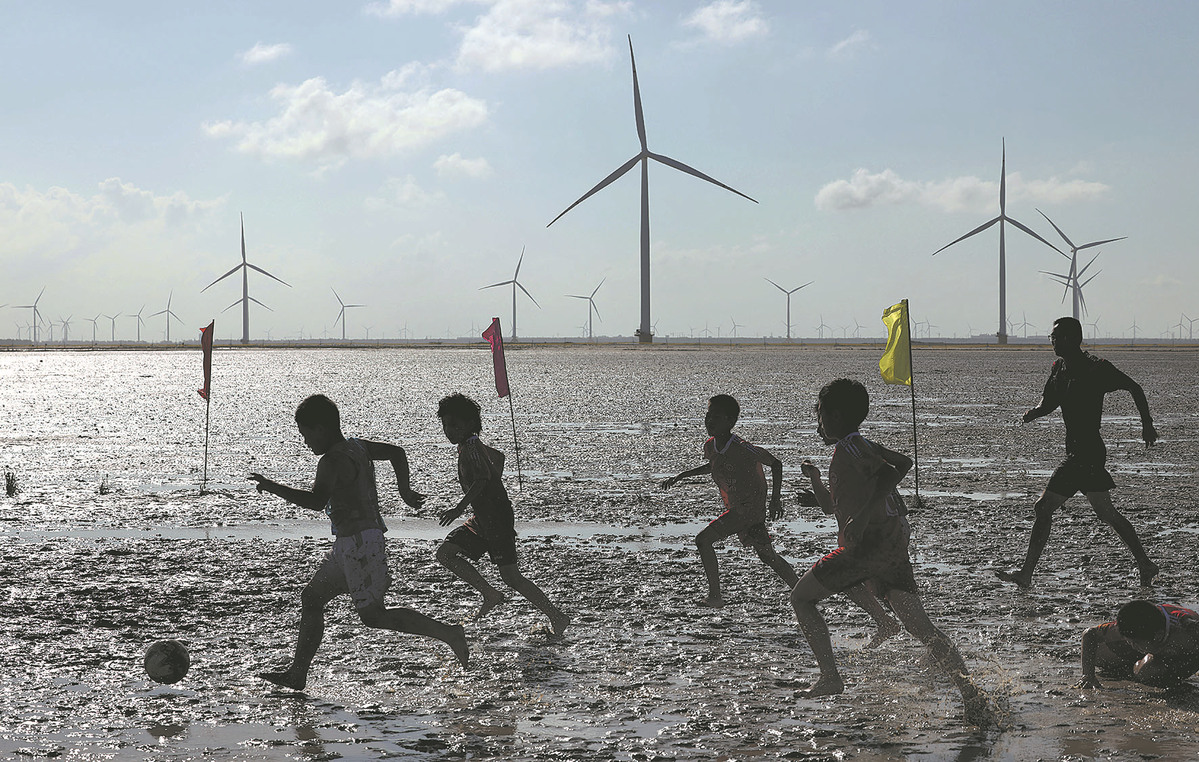
China has recently begun construction of a hydropower project in the lower reaches of the Yarlung Zangbo River, consisting of five cascade hydropower stations with a total investment estimated at around 1.2 trillion yuan ($167.8 billion).
China Yajiang Group Co has been tasked with the smooth construction and operation of the hydropower project, which will primarily deliver electricity for external consumption while also addressing local demand in the Xizang autonomous region.
The project will leverage the Yarlung Zangbo River's extensive hydropower resources, simultaneously boosting solar and wind energy development in nearby areas to create a complementary hydro, wind and solar power base, marking a significant step in China's green energy transition.
This national push for green development is also demonstrated at the local level.
Anji county, nestled in a mountainous northern region of Zhejiang province, serves as a prime example of how China's "lucid waters and lush mountains are invaluable assets" philosophy is being translated into tangible results.
Anji has made significant strides in energy transition, with its renewable energy consumption now accounting for 30.2 percent of its total primary energy consumption, and 85 percent of its new energy consumption coming from renewables.
During the 14th Five-Year Plan (2021-25) period, Anji added 173 megawatts of PV capacity, marking a 35.3 percent growth rate.
A 115-MW agricultural-PV hybrid power project in Anji, for instance, is expected to generate 150 million kilowatt-hours annually, saving 52,500 metric tons of standard coal and reducing 104,500 tons of carbon dioxide emissions — equivalent to planting over 300,000 trees.
The benefits of this green transformation extend to ordinary citizens.
In Yucun village of Anji, the birthplace of the "Lucid waters and lush mountains are invaluable assets" theory, also known as the Two Mountains theory, residents are now fully covered by a PV carbon inclusive program, allowing them to convert rooftop solar power generation into carbon emission reductions.
These credits are then collectively traded on the carbon market, providing an average of over 400 yuan in green income per household.
This initiative, among others, underscores how the "green waters and green mountains" concept is fostering a sustainable lifestyle and shared prosperity at the grassroots level.
These comprehensive, multifaceted efforts, from local pilot programs to national policy directives, are emblematic of China's broader commitment to its green transition, a commitment that is increasingly shaping the global clean energy landscape.
Zhang Huiyong, executive director of international cooperation at Energy Foundation China, highlighted China's status as the world's largest clean technology investor, making energy investment particularly crucial for the country.
China's extensive experience in expanding renewable energy investment, advancing its ambitious goals of achieving carbon peak before 2030 and carbon neutrality before 2060, and navigating complex challenges, all contribute to driving global energy transformation, said Zhang.
The report also indicated a diversification in China's energy investment capital structure, with private capital increasingly flowing into the energy sector, while overseas investments are also becoming more focused on clean energy projects.
The agency predicts that global clean energy annual investment will reach $2.5 trillion by 2035, with China retaining the largest share.
As Chinese enterprises strengthen their share of overseas energy investments, particularly in the clean energy sector, "Chinese power" continues to become more prominent, it said.
Data released in the report reveals that Chinese EV and battery manufacturers have announced approximately $80 billion in investment plans over the past five years, establishing manufacturing plants in multiple countries worldwide.
Concurrently, China is also a significant investor in the global PV supply chain, with its PV industry presence becoming a crucial force in advancing global clean energy development.
Globally, energy sector investment is projected to increase by about 2 percent this year, reaching $3.3 trillion, it said, with one-third of this expected to flow into oil, natural gas and coal fossil fuels, with the remainder directed toward clean and low-carbon energy sources.
zhengxin@chinadaily.com.cn