Chinese solutions taking on global fight against desertification
Models developed in Inner Mongolia autonomous region are being implemented across country and beyond







In the depths of the Kubuqi Desert, along the northern edge of Ordos in Inner Mongolia autonomous region, a remarkable transformation is unfolding. What was once a dry, desolate riverbed can now be seen as shallow streams, weaving between banks of tidy checkerboard plots of grass and newly planted trees. It's the thriving face of the Heilaigou sand control project.
Backed by an investment of 29.75 million yuan ($4.14 million) and covering approximately 667 hectares, the project is expected to be completed by October.
"We're not simply stopping the desert spread," said Wang Shuangxi, a senior engineer with the forestry and grassland bureau of Dalad Banner. "We're reshaping both the environment and the economy that depends on it."
The project is part of a broader effort to manage the autonomous region's 10 seasonal flood gullies, known locally as kongdui, a Mongolian term meaning "mountain torrent gully". These channels slice across the Kubuqi Desert, feeding into the Yellow River. For most of the year, they're bone-dry. But when summer rains arrive, they can surge into violent torrents, dragging enormous volumes of sand and silt downstream.
At their worst, these gullies used to dump as much as 27.11 million metric tons of sediment annually into the Yellow River — more than 10 percent of its total sand — and were a major cause of riverbed siltation and industrial disruption.
In 1998, Xiliugou, a seasonal firstlevel tributary of the Yellow River, unleashed a flood that created a sand dam so massive that it blocked the Yellow River, buried water intake systems at Baotou Iron and Steel Group, and temporarily brought one of northern China's industrial hubs to a halt.
Authorities in Ordos have since adopted a region-specific approach, applying targeted treatment measures for each gully based on its geographical features and ecological challenges.
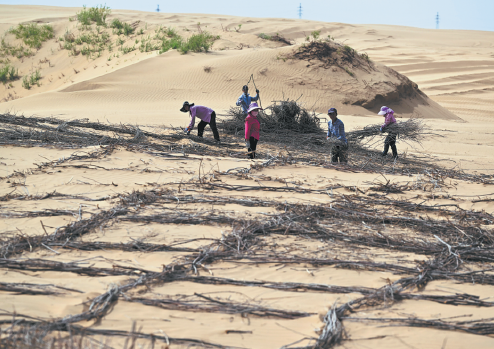
At the Longtouguai section of Xiliugou, engineers have installed sand barriers, gravel mesh and stone-filled gabions to stabilize riverbanks and prevent erosion. In comparison, the Heilaigou project relies more on natural solutions. At its Zhuobie Bay, drought- and salt-resistant species such as drought willow have been planted to form embankment forests. Sand dunes are stabilized using woven sand barriers made from desert willow branches, reinforced by shrubs like caragana and grass seeds.
"Effective sand control is never a one-size-fits-all solution," Wang said. "It comes from designing solutions that work with the land, not against it."
"Deserts also need protection as they're essential parts of our ecological system," he added.
The ecological results are already impressive. Sediment loads from the gullies into the Yellow River have dropped dramatically from 27 million tons to 4 million tons per year now, and the region has also seen notable gains in vegetation and soil stability.
"It used to flood every summer," said Bai Qilao, a local villager. "Now we're raising animals and growing crops where there used to be nothing but sand."
While the land is becoming greener, the region still faces a pressing challenge: water scarcity. Annual precipitation ranges between 200 and 400 millimeters, while evaporation can exceed 2,200 mm.
To keep the momentum going, Wang Lijun, director of the soil and water conservation office under Dalad Banner water authority, said the region is turning to infrastructure improvements and alternative water sources.
"We are actively exploring the use of treated wastewater and recycled mine water," he added.
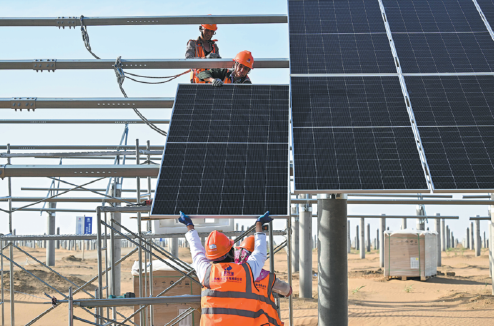
Beyond erosion and sand control, the Kubuqi Desert is also harnessing its harsh climate for energy innovation. Along the desert's edge, the "Photovoltaic Great Wall", a colossal green-energy initiative is taking shape. When completed in 2030, this solar belt will span 400 kilometers with an average width of 5 km, delivering up to 100 million kilowatts of clean power annually.
Kubuqi Desert's revitalization has also boosted local tourism. The Xiangshawan scenic area, a national top level tourist site, now receives around 1.2 million visitors annually, generating 340 million yuan in tourism revenue, according to local authorities.
Inner Mongolia is home to several large deserts such as the Kubuqi, Badain Jaran, Tengger and Ulan Buh. The autonomous region's success in taming desertification has been credited for the decrease in sandstorms in northern China.
As part of China's Three-North Shelterbelt Forest Program across 13 provinces and autonomous regions to combat desertification, the models developed in Inner Mongolia are being implemented across the country and beyond.
"The techniques have already been replicated in places such as the Xizang and Xinjiang Uygur autonomous regions and Gansu and Qinghai provinces," said Cui Guipeng, an associate researcher at the Chinese Academy of Forestry. "They are now being promoted in countries joining the Belt and Road Initiative, such as Saudi Arabia and Mongolia, continuing to contribute Chinese solutions to the global fight against desertification."




Today's Top News
- Confidence, resolve mark China's New Year outlook: China Daily editorial
- Key quotes from President Xi's 2026 New Year Address
- Full text: Chinese President Xi Jinping's 2026 New Year message
- Poll findings indicate Taiwan people's 'strong dissatisfaction' with DPP authorities
- Xi emphasizes strong start for 15th Five-Year Plan period
- PLA drills a stern warning to 'Taiwan independence' separatist forces, external interference: spokesperson