AI set for greater policy support
Government to hike investment for major projects in critical sector







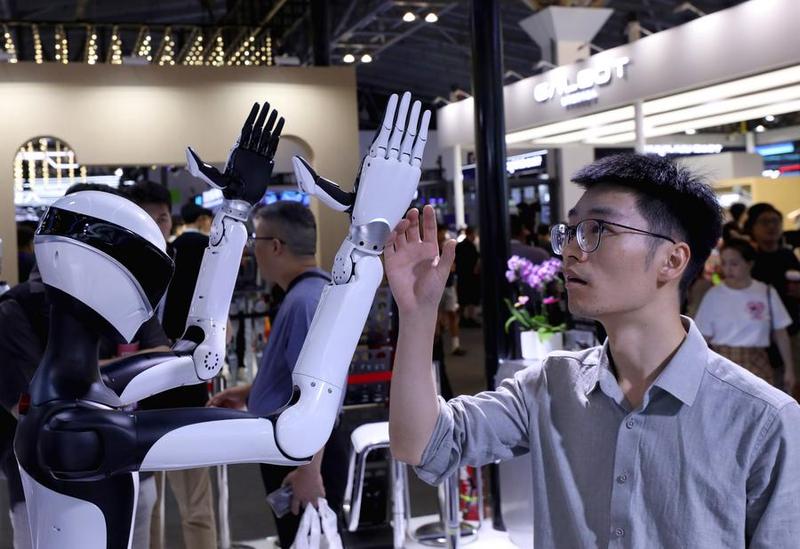
China will ramp up policy support for the artificial intelligence sector, as it plays an important role in boosting consumption and promoting high-quality economic development, officials and experts said.
The State Council, China's Cabinet, unveiled a guideline on deeply implementing the "AI Plus" initiative on Tuesday, aiming to promote the development and application of AI in multiple fields.
The government will increase investment support for major AI projects, Zhang Kailin, deputy director of the department of innovation and high-tech development at the National Development and Reform Commission, said at a news conference on Friday.
The government will make full use of policies for large-scale equipment upgrading and consumer goods trade-in, central budget investment and local government special bonds to bolster the development of AI, said Zhang.
China will continue to provide "AI vouchers" in fields such as computing power to lower R&D and application costs for innovation entities, while optimizing the allocation of resources.
Through the "AI vouchers" policy, the government utilizes funds from government bonds to pilot and facilitate a virtuous cycle between supply and demand in AI service resources.
"The establishment of common technology platforms, including pilot-scale application bases in key industrial sectors, will pool common and high-quality resources while lowering the barriers to applying new technologies," Zhang said.
For major strategic scenarios, Zhang noted that the government encourages joint research efforts to tackle bottlenecks and obstacles, enhance AI's capability to solve real-world problems, deepening its application in critical fields.
While referring to the popularization of smart devices, Zhang said that the government will continue to support AI-powered consumer products so as to make useful AI technologies and products accessible to the public.
The development and application of AI will help optimize consumption structure, said Huo Fupeng, an NDRC official.
New service consumption scenarios will be further expanded, as AI improves the quality of life in sectors such as culture and entertainment, e-commerce, elderly care and childcare, while extending experience-based and personalized consumption to meet residents' multilevel and diverse needs, Huo said.
New business models in product consumption will continue to emerge as a result, Huo said, adding that the rapid adoption of smart devices, such as smart home products and wearables, will build an all-scenario smart interactive environment.
Meanwhile, AI will accelerate its integration with cutting-edge technologies, such as low-altitude aviation, additive manufacturing and brain-computer interfaces, driving continuous innovation and the emergence of new products and forms, which will further unleash new consumption potential, Huo added.
China's current computing power development still falls short of effectively meeting market demand, said Zhou Mi, a senior researcher at the Chinese Academy of International Trade and Economic Cooperation.
Government-supported "vouchers" can help bridge this demand-supply gap, enabling computing power to play a more active role in AI, Zhou said.
China's accumulated experience in effective development and governance of AI can promote international AI collaboration, enabling the country to share the experiences of digital economic development with other nations, Zhou added.
"AI Plus" is becoming a crucial engine for industrial transformation and upgrading — not only enhancing the quality and efficiency of traditional sectors, but also fostering the growth of strategic emerging industries, said Zheng Nanning, a professor at Xi'an Jiaotong University.
Policies encourage leveraging AI to empower industrial production and accelerating the upgrading of high-end equipment, which help to advance the high-quality development of the industrial internet and smart manufacturing, enhance the core competitiveness of the manufacturing sector and drive the modernization of industrial and supply chains, Zheng said.