Xizang and Xinjiang have much to celebrate







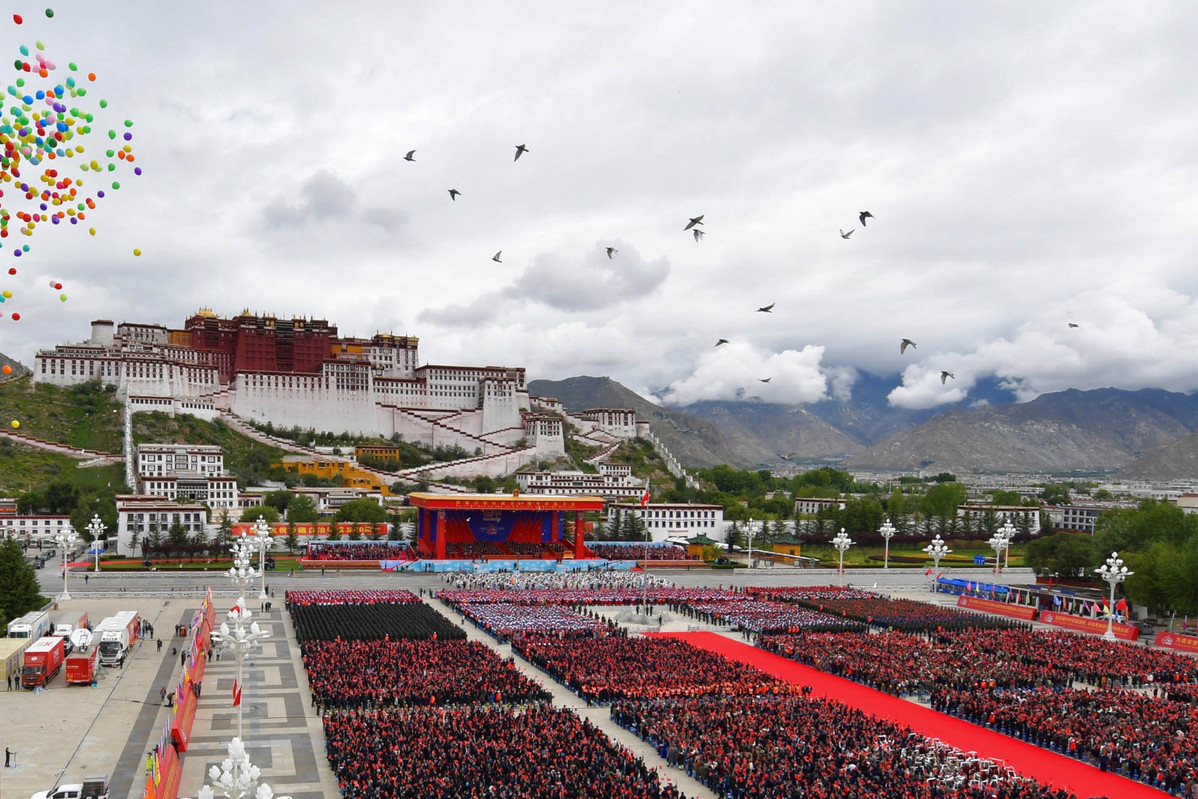
On Aug 20, President Xi Jinping led a central delegation to Lhasa to celebrate the Xizang autonomous region's 60th founding anniversary. The trip not only marked a significant milestone in Xizang's development but also underscored the central government's unwavering commitment to the region's prosperity. This year also marks the 70th anniversary of the Xinjiang Uygur autonomous region. Both regions have undergone remarkable transformations, standing as testaments to successful governance.
I have visited Xizang nine times, and on two occasions I drove to Metog county, the last county in China to have a road connection. The journey to Metog was a testament to the remarkable infrastructure development in Xizang. In the past, the region faced numerous challenges in terms of transportation, which severely hampered economic and social progress. However, today, a vast network of well-constructed roads crisscrosses the region. The once-isolated Metog is now accessible, opening up new opportunities for local people. The Qinghai-Xizang Railway, dubbed the "Sky Road", connects Xizang to the rest of the country more closely, facilitating the flow of people and goods.
The total length of highways has reached 124,900 kilometers, and the number of civil aviation routes has increased significantly, making transportation extremely convenient. The construction of the Sichuan-Xizang Railway and the Yarlung Zangbo River hydropower project are also in full swing, bringing new development impetus to Xizang. The local economy, which was once predominantly reliant on traditional agriculture and animal husbandry, has diversified. Tourism has blossomed, with visitors flocking to witness the breathtaking natural beauty and unique cultural heritage of the region.
Education has received great attention. In old Xizang, education was a privilege few people could enjoy, and the illiteracy rate was as high as over 90 percent. Since the establishment of the autonomous region, the government has continuously increased investment in education. Now, a modern education system covering preschool education, basic education, vocational education, higher education, adult education and special education has been established. Xizang took the lead in implementing 15 years of free education, and there are currently 3,618 schools of various levels and types, with a total of 970,000 students.
Medical and health conditions in Xizang have also improved significantly. The number of medical and health institutions has increased from 193 in 1965 to 7,231 in 2024. The average life expectancy has more than doubled from the early days of the autonomous region's establishment to 72.5 years.
Meanwhile, since its establishment 70 years ago, Xinjiang's economy has developed in leaps and bounds. In the past, Xinjiang was mainly an agricultural region with a single economic structure. Today, Xinjiang has formed a diversified economic structure that combines agriculture, industry and service industries. In 2024, Xinjiang's GDP reached a new high, and its industrial added value has also increased significantly.
I have made 12 trips to Xinjiang and have witnessed firsthand the leapfrog development of cities like Urumqi, Yining and Kashgar. In the past, Xinjiang's economic structure was relatively simple, mainly centered on agriculture and some basic industries. But now, it has evolved into a dynamic region with a booming economy. Modern factories have sprung up, and high-tech industries are taking root. The region has also become an important hub for international trade and cultural exchanges along the Belt and Road Initiative.
At major tourist attractions in Xinjiang, information is presented in Putonghua, Uygur and English, while in Xizang, it is presented in Putonghua, the Tibetan language and English. This not only showcases the two regions' cultural diversity but also their openness to the world. The government has made significant investments in education and healthcare, ensuring that people of all ethnic groups have access to quality services. As a result, the living standards of the local people have improved significantly, and a strong sense of happiness and fulfillment pervades the two regions.
The remarkable progress in socioeconomic development of both Xizang and Xinjiang can be attributed to the strong leadership of the Communist Party of China. The central government has implemented a series of targeted policies, provided substantial financial support, promoted infrastructure development, and facilitated education and healthcare improvements in these two regions. Moreover, the central government has always strived to ensure ethnic unity and facilitated mutual assistance among regions, creating a harmonious social environment where people of all ethnic groups live and work together in harmony. The achievements made in Xizang and Xinjiang have not only brought tangible benefits to the people in these regions but also contributed to the overall development and progress of the country.
The author is a former information coordinator of the Hong Kong Special Administrative Region government and a member of the Chinese Association of Hong Kong and Macao Studies. The views do not necessarily reflect those of China Daily.