Watching ordinary Chinese suffering under Nanjing Massacre left me in tears







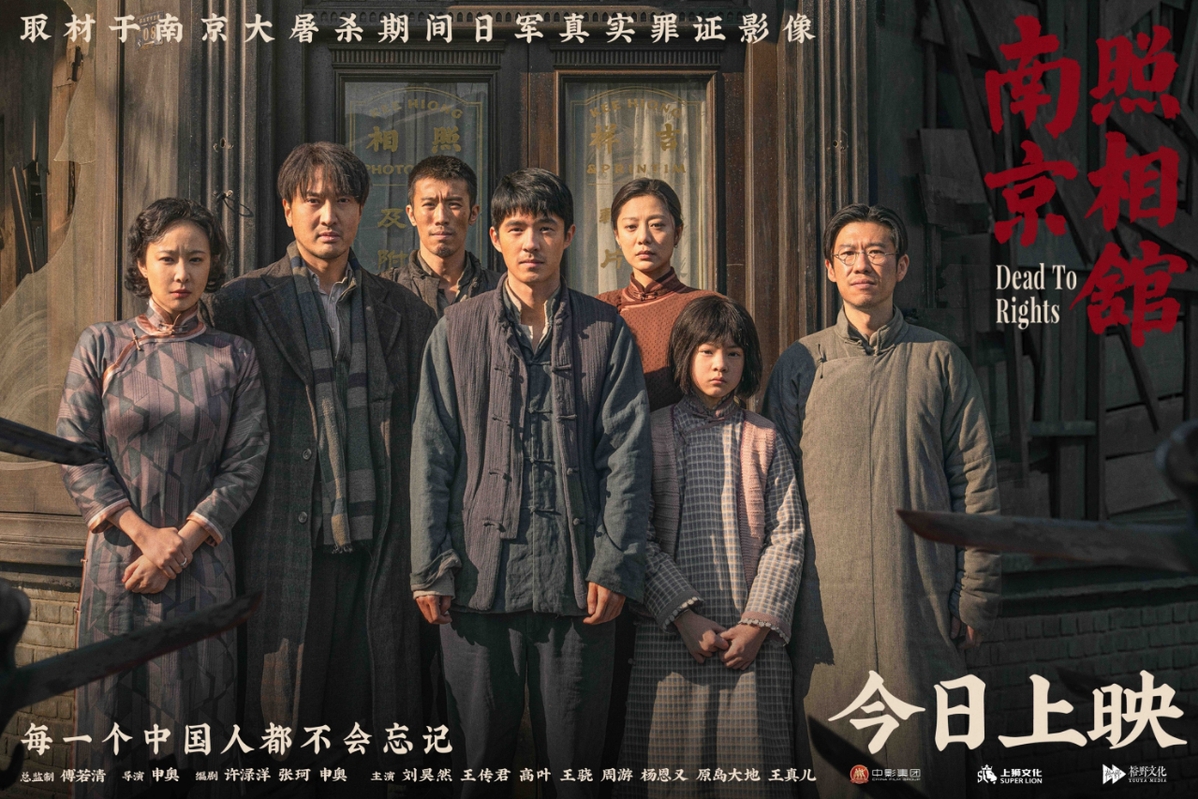
After reading some reviews on the recently released Chinese movie Dead to Rights (Nanjing Photo Studio 南京照相館 in Chinese), I could not wait to watch, it and so last week I rushed to a cinema hall near my college. I was more than eager to read the heartbreaking chapter of Chinese history from a new perspective.
Last year, when I completed reading the book The Rape of Nanking, authored by Iris Chang, I was totally moved, and, literally, my eyes had tears more than once. As I kept turning pages, a question kept haunting me - How can a man be so inhuman to another fellow man? It's an illustrative description of the Japanese attack on the then Chinese capital city Nanjing on 1937. Based on historical evidence and fieldwork, the author has underscored how the Japanese Fascist army unleashed atrocities upon innocent Chinese civilians, killing 300,000 people.
Before reading the book, I watched a movie, The Flowers of War, also based on the Nanjing Massacre, which shows the suffocating, dark weeks of Chinese history that changed the whole trajectory of Chinese history. Nonetheless, what I felt lacking in both of these works — The Rape of Nanking and The Flowers of War — was the stronger depiction of Chinese characters. Both works highlight the foreigners who were present in Nanjing during the Japanese attack and did what they could to ease the suffering in the city. I don't mean to underplay the contributions of those foreigners during those tough days. But again, how did Chinese people survive and fight against Japanese atrocities? This question is either not answered properly or is shadowed in both works.
After watching Dead to Rights, I felt that gap is fulfilled to a large extent. It has highlighted the story of struggle of ordinary Chinese people, trying to escape the "Holocaust" and save their families. Japanese attack fell on ordinary Nanjing people as an unexpected curse. Even if some expected that attack, no one could have expected such atrocities and endless bloodbath from Japanese soldiers. Not a single Chinese people, neither infant nor octogenarian, were spared by the Japanese sword and bullets. According to international law and morality, after any city surrenders, it's the responsibility of the victor to save the lives of the subjects. Even Napoleon did that when he attacked Moscow and won the war. But the Japanese, instead of protecting the subjects, killed as many Chinese as they could; they raped as many women as they could, crossing all lines of humanity.
Dead to Rights is a story of a postman and a family of photographers who spend a tough time during the Nanjing Massacre, trying to escape the death dance of arrogant Japanese soldiers, along with several other stories as minor stories. After Japanese soldiers occupied Nanjing, a young Japanese photographer arrives there to take "glorious moments" of Japanese soldiers, driven by his father's dream. Though he's an expert in taking pictures, he hadn't learned to develop them. It is among many coincidences in the movie that he met a postman boy who is mistaken as a worker of Nanjing photo studio because a photo album was found in his bag. Since Japanese photographer was in need of a man who can develop his negatives, he chooses the postman. Surprisingly, the owner of the Nanjing photo studio is hiding underground with his family — wife, daughter and a baby son. The owner of the studio teaches the postman to develop photos that save him and the whole family until the last tragic end where all of them (except the baby) are killed.
Later, a female artist and an injured policeman join them, and they together go through suffocating weeks waiting for the dawn of hope. But instead, the situation deteriorates, and, finally, their hiding place is exposed. After his senior advises him not to believe any Chinese person, the Japanese photographer learns to develop photos himself and plans to kill the postman. As a reward for helping him, the Japanese photographer provides two passes to the postman to escape Nanjing. But he refuses to go, leaving all others in the mouth of death. So, they decide to do a lottery to decide who should use those passes. The photographer's wife and daughter win the lottery, but unfortunately, fall into a Japanese trap and are killed. Finally, the female artist and photographer's son escapes death. She hands over the photographs of Japanese soldiers to a foreigner who mails them to the international press. Consequently, Japanese atrocities get exposed throughout the world. Those were photos the Japanese photographer clicked to record 'the glorious moments' of Japanese soldiers, killing Chinese as inhumanely as one can imagine.
In the movie, Chinese characters fight for pride even in the face of cruel death. They show love, compassion, sacrifice, and trust toward their countrymen during the difficult time. Regardless of how dangerous the time was, they stood together with a strong sense of unity. Of course, some Chinese characters are shown more loyal toward Japanese than their own countrymen, expecting some excuses from Japanese. But they get no better position than "dogs" that Japanese call other Chinese people.
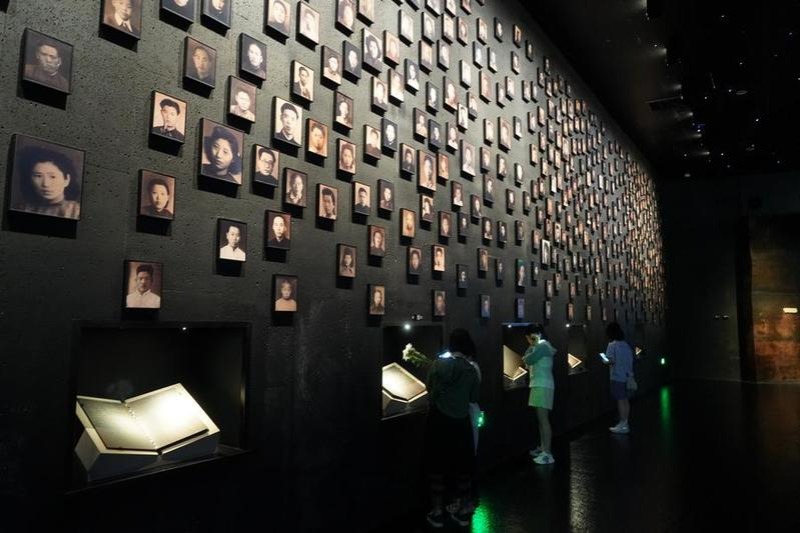
Scenes of Japanese atrocities, such as Japanese soldiers competing in killing Chinese people, massacring, arson, rape and inhuman insults, tell real stories of Nanjing Massacre. The river water turning red with thousands of dead bodies floating, people getting buried alive, and looting of any last thing left in the city describe the brutality of Japanese Fascism. There were no bricks left in Nanjing that did not have human blood and tear.
Certainly, times have changed. Neither Japan nor China is the same anymore today. But how can history be buried or forgotten? History, particularly the history of the oppressed written in blood and tears, cannot be buried or whitewashed, no matter how hard one tries. The Nanjing Massacre and the atrocities of Japanese soldiers are facts, and all should admit those facts. That doesn't necessarily mean contemporary relation between China and Japan must stand on hatred and avenge. Rather, history should be remembered so as not to repeat those dark days again. Man should always be aware of humanity being crushed again.
Though based on Chinese history, Dead to Rights is a common agony for the whole of humanity, and therefore it should be screened throughout the world, not to defame any country or people of any nation, but rather to make the whole world aware of how inhuman humans can be.
As China marks the 80th anniversary of the victory in the Chinese People's War of Resistance against Japanese Aggression and the World Anti-Fascist War, it is relevant to watch the movie Dead to Rights to remind the hardest days Chinese people experienced before they started the journey toward the global community with a shared future.
Niraj Lawoju is a Nepali student studying at the Sichuan University School of International Studies.
The views don't necessarily represent those of China Daily.
If you have a specific expertise, or would like to share your thought about our stories, then send us your writings at opinion@chinadaily.com.cn, and comment@chinadaily.com.cn.