Solar project helps the sun shine on Huzhu's economy







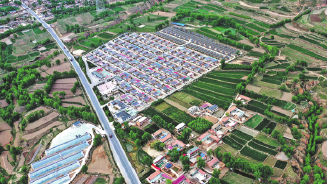
XINING — Bathed in radiant sunlight, the rooftops of Dongshan village on the Qinghai-Tibet Plateau gleam with solar panels that are helping transform local livelihoods while driving green development and rural vitalization across the region. Tucked away in the remote mountains of Huzhu Tu autonomous county, Haidong city, in Northwest China's Qinghai province, Dongshan enjoys abundant sunshine but has long been shadowed by poverty.
In recent years, Huzhu has harnessed the plentiful sunlight through the development of distributed photovoltaic energy, with villagers affectionately calling the solar panels their "sunshine bank accounts".
For a long time, the villagers here depended on farming and animal husbandry. However, the meager profits from these traditional industries forced more than half of the labor force to seek work elsewhere.
A few years ago, Wang Guofeng, Party chief of Dongshan, considered starting a clothing business to help villagers boost their incomes. However, his plans repeatedly fell through due to limited sales channels and inadequate venues.
A turning point came in 2021, when Dongshan was designated a distributed photovoltaic pilot village and nearly 200,000 yuan ($28,166) was invested in a 44.1-kilowatt rooftop solar power project. The installations prioritize meeting villagers' daily electricity needs, with any surplus fed back into the grid.
This project generates an annual income of over 20,000 yuan, Wang said. In addition, a state-funded photovoltaic poverty alleviation initiative launched in 2018 could provide the village with an annual dividend of 240,000 yuan, as the grid allocates a larger share of profits to local residents. Even better, the solar panels require minimal maintenance and occupy no arable land, making them a reliable and sustainable investment, Wang explained.
Banyan village is another pioneering community harnessing Huzhu's abundant sunshine, which offers up to 1,400 hours of usable sunlight annually. In the Tu ethnic language, "Banyan" means "a place of prosperity and bliss". Yet contrary to its name, the village, perched largely atop a hill, has long faced bitterly cold winters and arid farmland.
In 2016, under a poverty alleviation program, villagers formerly residing on mountain tops and rugged hillsides were relocated to the foot of the hill. After the relocation, the village turned its focus to solar energy, installing panels on rooftops, beside pigsties, and across the hillsides.
In 2017, Banyan village's 2-megawatt distributed photovoltaic poverty alleviation project began generating electricity. "With the solar panels installed, each household receives an annual dividend of 2,500 yuan, which is equivalent to the income from 10 mu (0.67 hectares) of land on the mountain," said Lyu Yourong, a local resident.
In 2023, the State Grid Haidong power supply company built a 200-kilowatt energy storage project for the village, along with four 7-kilowatt charging piles, creating an integrated "solar-storage-charging" parking lot.
The parking lot is part of the village's green power initiative. According to Jiang Shenghui from the power supply company, it helps address Banyan village's limited energy storage capacity while making the most of its abundant sunlight.
In general, the distributed photovoltaic system in Banyan generates 1.5 million kilowatt-hours of electricity annually, which is equivalent to saving about 460 metric tons of standard coal each year and reducing carbon dioxide emissions by approximately 1,200 tons. Today, villagers are not only benefiting from affordable green electricity but are also driving new energy vehicles as their standard of living rises.
In addition to installing distributed photovoltaic systems, Banyan has made significant strides in green transformation, becoming a certified zero-carbon village. This achievement is the result of numerous initiatives such as afforestation, the adoption of natural gas, and the replacement of grass-and-straw burning beds with electrically heated ones.
As of July, the total installed capacity of distributed photovoltaic systems in Haidong city had reached 113,500 kilowatts, covering 2,609 households, according to Jiang.
Xinhua






Today's Top News
- Spanish king on first state visit to China
- Japan must stop playing with fire on the Taiwan question: China Daily editorial
- The one who tied knot must untie it: China Daily editorial
- Xi congratulates Ouattara on re-election as president of Cote d'Ivoire
- Supercarrier to be put through paces
- Game changers for China's sports industry