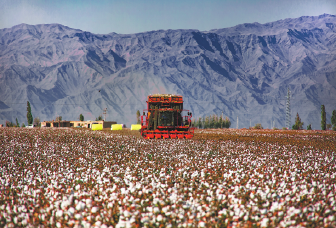
Xinjiang county's cotton fields fully mechanized







Earlier in September, in the vast cotton fields of Jinghe county in the Xinjiang Uygur autonomous region, no workers were seen bent under the sun. Instead, drones had just finished spraying defoliants to hasten boll opening and leaf fall.
In about 10 days, harvesting machines will roll in, completing a cotton production cycle that is now fully mechanized.
Jinghe, located in the Bortala Mongolian autonomous prefecture, is a major producer of early-maturing cotton in northern Xinjiang. In 2024, the county's demonstration fields produced 11 metric tons of cotton per hectare, setting a national record.
Ochirbat, head of the Bortala agriculture and rural affairs bureau, said mechanization in planting, managing and harvesting cotton in the county has reached 100 percent, greatly reducing labor needs.
In the past, tending 1,040 hectares of cotton in Shartur village, which is part of Jinghe, required large numbers of hired hands for irrigation, spraying and picking. Now, mechanization has shortened the harvest period from 20 days to just five, and planting efficiency has improved by 40 percent, Ochirbat said.
Combined with government subsidies for target price and premium cotton, farmers' average net income per hectare has doubled in five years, from 4,500 yuan ($632.20) to more than 9,000 yuan. Most of the 130 households in the village now earn at least 30,000 yuan more annually, according to the bureau.
"Many farmers lease their land to cooperatives and larger growers. Freed from heavy farm work, they are opening restaurants, shops and homestays, or working in textile enterprises at local industrial parks," Ochirbat said.
Some have joined the growing rural tourism and garden economy, planting vegetables and fruits in their courtyards and diversifying their income sources, he added.
"The biggest change is labor savings," said Xuan Baolin, a veteran operator with a farm machinery cooperative in Jinghe.
A high-horsepower tractor at the cooperative can sow far more in a day than manual labor ever could, while a harvester has replaced hundreds of pickers. As a result, labor costs have dropped by more than 60 percent annually, Xuan said.
"A decade ago, 4.67 hectares required a dozen people working 50 days to pick the cotton. This year, one harvester can handle at least 33.3 hectares in 10 hours."
Meanwhile, large-scale cotton farmers in the village are benefiting from intelligent technologies. The 10-hectare fields of Ding Hongshan are equipped with seeders guided by Beidou satellite navigation, smart water-fertilizer systems and drones for crop protection.
"In the past, it took five days of manual labor to irrigate once a week. Now I can control irrigation with a smartphone app, saving more than 30 percent of water and cutting labor costs," he said.
The yield of his fields in 2025 is expected to reach an above-average 7.5 tons per hectare, with 85 percent classified as high-quality cotton, giving him a net income of around 90,000 yuan after subsidies.
Technology upgrades have lifted village yields to more than 6 tons per hectare. Shartur's cotton output value is forecast to exceed 20 million yuan in 2025.
According to the bureau, the prefecture has planted nearly 106,000 hectares of cotton in 2025, and the total output of lint cotton is expected to exceed 220,000 tons, 18,000 tons more than in 2024.
Ochirbat said the region will further improve mechanized harvesting, enhance the quality of defoliation and picking, and promote domestically made harvesters.






Today's Top News
- Supercarrier to be put through paces
- Game changers for China's sports industry
- EU should not give platform to 'Taiwan independence' separatists
- Nation drives global energy transition
- Tariff-troubled US fears not-so-happy holidays
- 'Looking China' brings American youth closer to Chinese culture