Soybean industry 'disadvantaged' without crucial China trade boost







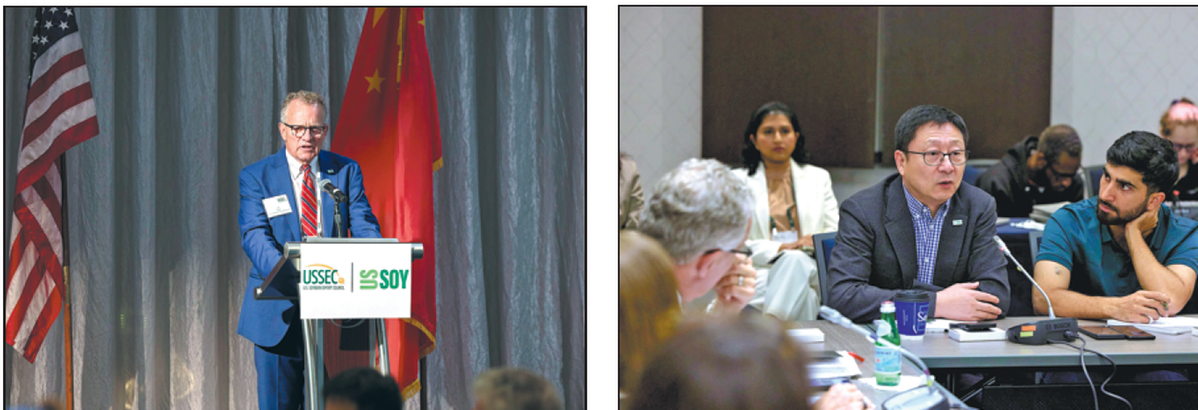
Following China and the United States' recent agreement to further extend the pause on tariff increases, US soybean industry representatives expressed their eagerness to see the resumption of soybean trade with China to continue the two countries' soybean trade partnership.
"Unfortunately, right now, our farmers and exporters are being disadvantaged," said Jim Sutter, CEO of the US Soybean Export Council. He praised the cooperation between Chinese partners and US soybean farmers and exporters, which used to be a win-win deal, but said today's situation is a "lose-lose".
China's share of US soybean exports fell to 44.6 percent last year, down from its peak of 62.4 percent in 2011, according to data from the US Department of Agriculture and China's General Administration of Customs.
This year, the US has significantly increased tariffs on imports from many of its trading partners. In response, China has implemented measures to protect its interests, such as imposing higher tariffs on soybean imports from the US. Consequently, Chinese importers have turned to Brazilian soybean suppliers.
Sutter said the current situation is very "disappointing" as US farmers are the "target" of this escalating trade tension.
"When our farmers planted their soybeans in the springtime in April and May, they had every intention of being able to supply China. They believed that their No 1 customer would continue to be their No 1 customer.
"But now, Chinese consumers are paying more, our farmers are selling for less," Sutter said.
The USSEC, representing the entire US soy supply chain, has been working to attain market access for the use of US soy for human consumption, aquaculture and livestock feed in more than 80 countries worldwide. It has been working in China for 43 years, and in the past five to 10 years, USSEC has been making every effort to maintain the long-standing China-US soybean trade.
Commenting on the potential recovery of the China-US trade deal, Sutter said: "I just can't imagine that we will never trade again. So I think it's important that we continue to do our work and build these relations, maintain them and build them for the future."
Greater China Regional Director of USSEC Zhang Xiaoping emphasized the mutual benefits of China-US trade. "The complementarity of the two nations in the agricultural sector is too strong. The US has rich agricultural resources while China has a huge market."
"Soybeans have been regarded as the most cost-effective protein ingredient in animal feed because of higher digestibility. Relying on its vast fertile land, US farmers can sustainably produce high-quality soybeans on a large scale to support the modernization of China's livestock, poultry, agriculture and food industries," Zhang said, adding that the high digestibility also means much lower waste, leading to positive effects on the environmentally friendly development of Chinese industries.
A collaborative program between USSEC and its Henan provincial partners, focusing on a soybean innovation center, is advancing steadily with three main initiatives — innovative solution training, demonstration and promotion.
Back in early 1990s, USSEC began to introduce practical solutions to help upgrade the Chinese industry. In recent years, USSEC introduced an In-Pond Raceway System with multiple benefits.
Based on practices from US farms, USSEC created the Soy Sustainability Assurance Protocol, which pledges to issue a sustainability certificate on each individual shipment out of the US for free. "This can be interpreted as support for China's achievement in sustainable food security, as the effort can make soy-related foods more affordable," Zhang said.
Normally, October is the main season for US soybeans being shipped to China. "We had pretty good shipments to China last year and we haven't really missed any shipping seasons yet. We are looking forward to being able to ship our soybeans to China very soon," Sutter said.




Today's Top News
- Supercarrier to be put through paces
- Game changers for China's sports industry
- Nation drives global energy transition
- Tariff-troubled US fears not-so-happy holidays
- 'Looking China' brings American youth closer to Chinese culture
- National Games start new chapter