Building AI bridges across regions
China-ASEAN youth leverage AI to innovate, address common challenges, and strengthen ties within a forward-looking regional community.








From Sept 17 to 21, the Nanning International Convention and Exhibition Center in Guangxi Zhuang autonomous region was alive with energy as young innovators, scientists, and entrepreneurs from China and ASEAN countries came together for the 22nd China-ASEAN Expo (CAEXPO).
Since its launch in 2004, CAEXPO has played a pivotal role in strengthening ties between China and ASEAN.This year, the expo expanded its reach with a 10,000-square-meter AI pavilion and a series of AI-focused forums and exchanges, designed to connect industries and cultures across the region through innovation.
At a roundtable on AI held on Sept 18, Wang Changlin, deputy head of the National Development and Reform Commission, highlighted the vast potential of regional AI cooperation. "Abundant data resources and diverse application scenarios have created favorable conditions for AI to empower economic and social development," he said.
Huang Junhua, vice-chairman of the Guangxi Committee of the Chinese People's Political Consultative Conference, emphasized the key role of young talent in the AI sector.
"Young scientists, whether engaged in cutting-edge research or applying technologies, are the backbone of future development," he said during a young scientists' dialogue on AI on Sept 19. "Your wisdom and creativity will be instrumental in addressing regional challenges and driving progress."
Educators from Thailand are already envisioning new possibilities. Jetsada Arnin, assistant to the president for education at Mahidol University in Bangkok, noted that AI is set to transform cooperation in both healthcare and education.
"I've seen Chinese medical companies using AI for diagnostics — for example, detecting lung cancer — helping doctors act faster than traditional methods," he said. "At the same time, China's promotion of AI education in schools offers a model we would like to adapt. For universities like Mahidol, we aim to stay aligned with AI's progress and apply it to teaching and learning support."
He emphasized that cooperation is not about competition, but about "walking together". "Here in Nanning, I see many opportunities for China and ASEAN to collaborate — not just to build capacity but also to deepen mutual understanding," he said.
Li Xuan, deputy secretary of the Thai-Sino Association of Science and Technology, noted that Thailand faces a pressing demand for AI technologies but still lags in research and development. "Many Thai enterprises rely on foreign platforms because we are still in the early stage," he explained. "Cooperation with Chinese companies can help fill this gap, especially in energy, healthcare, and e-commerce."
Among the entrepreneurs at CAEXPO was Duan Fengyuan, vice-president of the Shenzhen Artificial Intelligence Industry Association and founder of echOS, a Shenzhen-based company using AI to drive industrial upgrading.
The company has developed decentralized agentic AI platforms to enhance efficiency in industrial transactions, helping enterprises reduce costs and boost productivity. The multi-agent AI system is already in use — in Malaysia, for example, a partner completely rebuilt its hardware platform on echOS' AI system, which is expected to become the country's largest AI-driven platform in its sector.
On the academic front, Guilin University of Electronic Technology in Guangxi is also contributing.
Professor Jiang Ming highlighted the importance of high-quality datasets. "General-purpose data has been mined extensively, but industries such as healthcare, traditional Chinese medicine, and advanced manufacturing require new, specialized datasets," he said.
"Guangxi, with its large student population, has the resources to help build these databases and improve industry-specific AI models," he added.
Pakpoom Buabthong, assistant professor at Nakhon Ratchasima Rajabhat University in Bangkok, stressed the importance of academic exchange. "The first step is to improve communication among researchers," he said. "Platforms like CAEXPO are exactly what we need to build these networks."


A youth-led perspective
Young innovators are showing how AI can drive business and trade. Zhang Yuxin of Taoshu Technology explained that navigating China's complex market can be challenging for ASEAN investors. To address this, her team developed industrial knowledge graphs that map enterprises, talent, and policies across supply chains.
"Our AI-driven analysis provides insights into local policies, industrial strengths, and regulations, helping build trust and making investment decisions more effective," she said.
She added that Chinese companies expanding abroad also need to grasp host-country conditions, including trade laws, tax policies, and technical standards — and AI can help them do just that. "With large AI models, we can bridge cross-cultural and cross-language gaps, enabling companies to navigate local environments more efficiently," Zhang said.
Duan, a participant in the China-ASEAN Young Leaders' Growth Program, reflected on guidance from Chen Gang, secretary of the CPC Guangxi Committee, who encouraged young innovators to strengthen three key abilities: cross-border learning, resource integration, and understanding the physical world.
"These qualities are vital for young leaders in the AI era," Duan said. "AI tools allow us to develop these abilities faster and share them more widely."
He was also impressed by the enthusiasm of peers from across the region. "Through exchanges with young leaders from Singapore, Cambodia, and Malaysia, I saw how much ASEAN partners value AI as a tool to tackle real business challenges, from agricultural exports to cross-border trade," he said.
"China's AI technology is evolving, and ASEAN countries have concrete needs," Duan added. "By combining these forces through the energy of young leaders, we are not only driving industrial innovation but also strengthening the bonds of a community with a shared future."
guojiatong@i21st.cn



Today's Top News
- China's consumer prices creep up in October
- Fresh opportunities seen in China
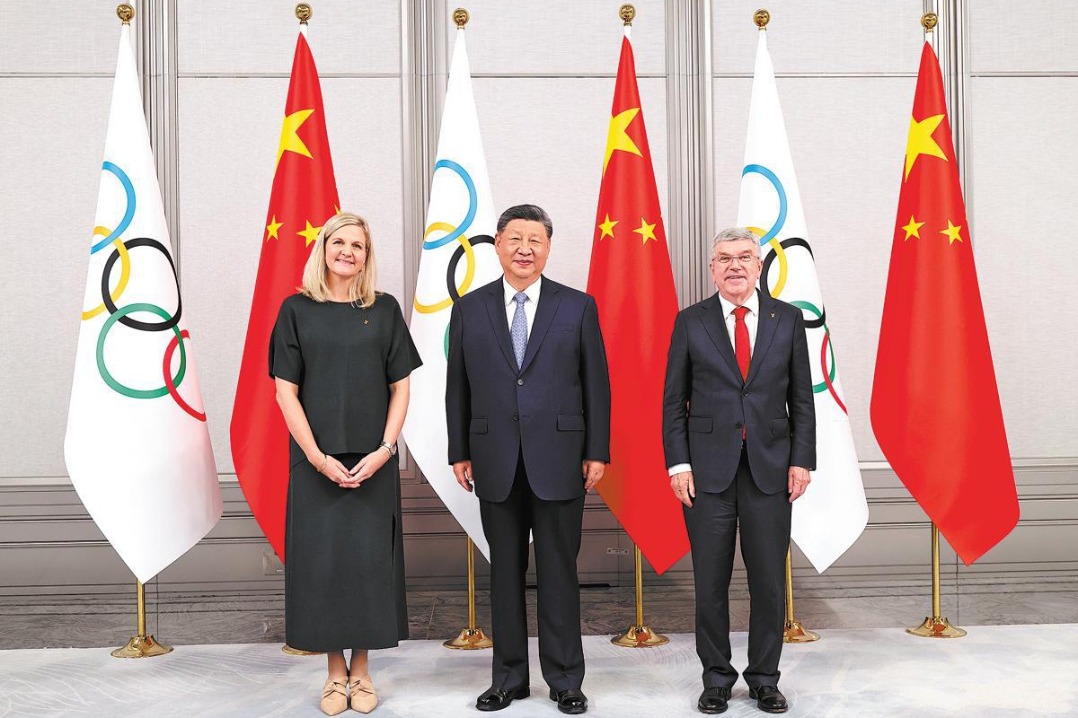
- Xi meets IOC chief and its honorary president
- National Games an embodiment of China's strength, unity and progress
- Xi declares 15th National Games open
- Xi attends opening ceremony of 15th National Games