


Nanjing Massacre film moves Moscow audiences to tears







Halfway through the film Dead to Rights, Yulia Sharapova could no longer hold back her emotions and stepped out of the cinema hall to compose herself.
Sitting transfixed, and her eyes glistening with tears, Sharapova was among the audience at the Russian premiere early this month of the Chinese-produced film about the Nanjing Massacre.
"This film deeply shocked me," Sharapova said after the screening. "It's the first time I've watched a Chinese film with Russian dubbing in a cinema. The images are heartbreaking yet sobering. Only by understanding history can we avoid forgetting the past."
Set against the backdrop of the Nanjing Massacre, Dead to Rights draws on verified photographic evidence of Japanese wartime atrocities in China. It tells the story of a group of Chinese civilians who seek refuge in a photography studio, risking their lives to preserve proof of the horrors committed by the Japanese aggressors during their brutal occupation of Nanjing, China's capital at the time.
The film overwhelmed the Russian audience at the premiere, held in a cinema adjacent to Moscow's iconic Red Square. When lights came back on, some viewers remained seated in stunned silence, their faces streaked with tears.
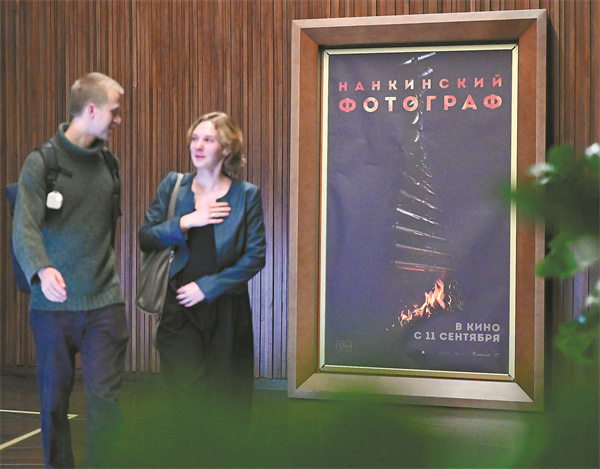
Alexander, a young Russian viewer, watched the film with his wife Lilia. After the screening, the couple lingered in front of the film's large poster board, taking photos as a memento.
"This film is sincere and thought-provoking," Alexander says. "It not only records a painful chapter of history but also showcases the tenacity and brilliance of human nature. It helps us transcend cultural differences and understand one another."
"How I wish there would be no more wars or separations in this world, and that all children could grow up happily in peace," Lilia says.
Before the screening, Alexander Zharov, CEO of Gazprom-Media Holding, a Russian media holding company that brought the film to Russia, says that the film documents the heinous crimes committed by Japanese militarists in Nanjing, seen through the eyes of Nanjing Massacre survivors.
"When you watch people fall right before your eyes, you can't help but feel their pain and fear," he notes.
Zharov believes the film carries a profound emotional resonance.
"The people of the Soviet Union and China suffered the greatest losses during World War II. We honor those who sacrificed their lives in the Soviet Union's Great Patriotic War, and we should also recognize the hardships endured by the Chinese people in the Chinese People's War of Resistance Against Japanese Aggression (1931-45). The Chinese people's victory is truly admirable," he says.
In Nanjing, in eastern China, more than 300,000 Chinese people were killed in just over 40 days following the city's fall to Japan on Dec 13, 1937. Across China, from 1931 to 1945, the war inflicted over 35 million casualties.
Li Na, an overseas Chinese who has lived in Russia for over 30 years, remained emotional long after the film ended.
"I've been looking forward to this film since it was released in China," she says. "Today, seeing the Russian-dubbed version, I'm convinced it can touch the hearts of audiences around the world."
The public release of the film Dead to Rights started on Sept 11 in 300 cinemas across Russia. At the same time, Blood Type, a Russian-produced film centered on the Soviet Union's Great Patriotic War, was screened in China.
Both films convey the tragedy of war and its enduring lessons.
"The simultaneous release is a testament to our joint efforts with Chinese partners to preserve historical memory," Zharov says.