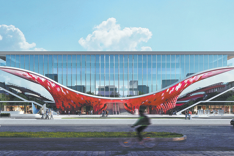
GBA sees major urban rail expansion








The recent expansion of Shenzhen's metro system in Guangdong province, highlighted by the opening of two new lines, provided new references for efficient urban rail construction in the Guangdong-Hong Kong-Macao Greater Bay Area, and will accelerate the integration of the GBA with enhanced regional connectivity, experts said.
The comments came after the second phase of Shenzhen Metro Line 16 and the second phase of Line 6's branch began trial operations on Sunday, pushing the city's total urban rail network to 609.6 kilometers across 428 stations. The South China metropolis saw an urban rail addition of nearly 200 km during the 14th Five-Year Plan period (2021-25), a fast runner to this end among major cities nationwide.
Key green breakthroughs were made in the 9.54-km Line 16 extension, undertaken by China Southern Railway Construction Investment Co Ltd, a unit of centrally-administered State-owned China Railway Construction Corp. The CRCC unit said among its undertakings, which include eight metro stations and a new depot, three of its stations were fully assembled adopting prefabricated construction methods, making it the operational metro line with the highest assembly rate in China.
Among the three stations, the Dakang Station is the largest fully prefabricated metro station nationwide, pioneering the use of assembly technology despite complex geological areas.
"This prefabricated approach involves manufacturing station components off-site in factories and then assembling them on-site, similar to 'building blocks', only with bigger ones in our case," said Zuo Duping, project manager from the CRCC unit.
"Compared to traditional cast-in-place methods, it offers enhanced safety, quality, efficiency and environmental benefits," said Zuo, adding that the construction method helped save 800 metric tons of steel and 600 cubic meters of timber. It also helped reduce construction waste by 90 percent, cut carbon emissions by 30 percent, and decrease the required workforce from an expected number of over 200 to merely 40.
"Applying advanced green building technologies, such as the BIM-based digital construction in the latest Shenzhen Metro's case, provides valuable references for other ongoing projects in the GBA, where construction teams may confront the same geographical conditions," the project manager said.
According to Shenzhen Metro, the city's rail transit mileage is expected to exceed 800 kilometers by around 2030.
Such achievements exemplify the ongoing efforts across major city clusters nationwide in upgrading infrastructure for a more integrated regional development, experts said.

"A core objective of enhancing infrastructure is to boost 'physical connectivity' in the GBA, aiming for a more efficient flow of people, goods, capital and information. Based on such improvements, a higher level of emotional bond will be forged, which is key to spurring GBA's integrated development and its future position among major bay areas globally," said Long Chaocan, an investment consultant with China Galaxy Securities Co Ltd.
According to a three-year action plan released by the Guangdong provincial government in March, the province has charted plans for over 400 major transportation projects, covering railways, airports and waterways, with the total expected investment exceeding 4 trillion yuan ($561.8 billion).
Many city clusters are also ramping up efforts in expanding urban railway networks. For example, in the Yangtze River Delta city cluster, also a major economic powerhouse, Xuzhou in Jiangsu province saw the opening of the first phase of Line 6 on Sunday.
The 23-km project, which achieves fully automatic train operation, journeys through 16 stations in the city, including a transit station that is integrated into the local high-speed railway station, said China Railway 24th Bureau Group Corp, one of the builders that participated in the project.






Today's Top News
- US actions fail to match its words on Taiwan question
- China's diplomacy to blaze new trails
- Visits point way to better future for all
- PLA tests joint combat strength for second day
- Xi stresses advancing rural areas' vitalization
- US arms sale to Taiwan will lead secessionists toward destruction