


Painting society spotlights oil as a growing medium in China







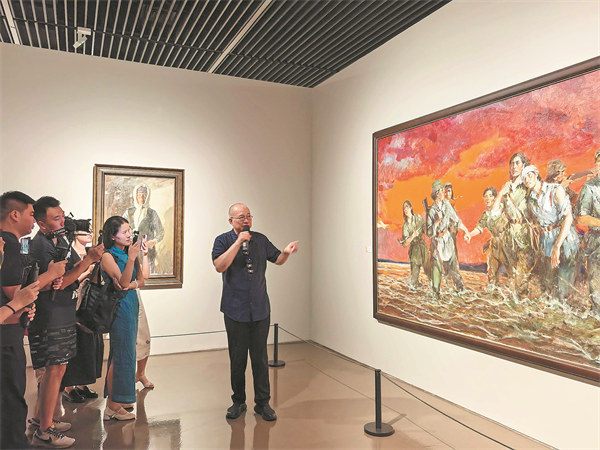
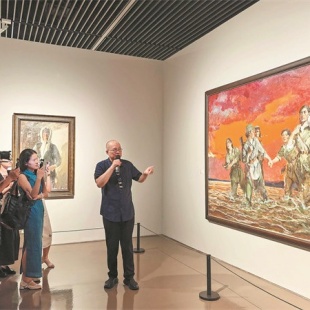
An exhibition commemorating the 30th anniversary of the China Oil Painting Society exemplifies the society's major role in shaping and showcasing the evolution of Chinese oil painting over the past three decades.
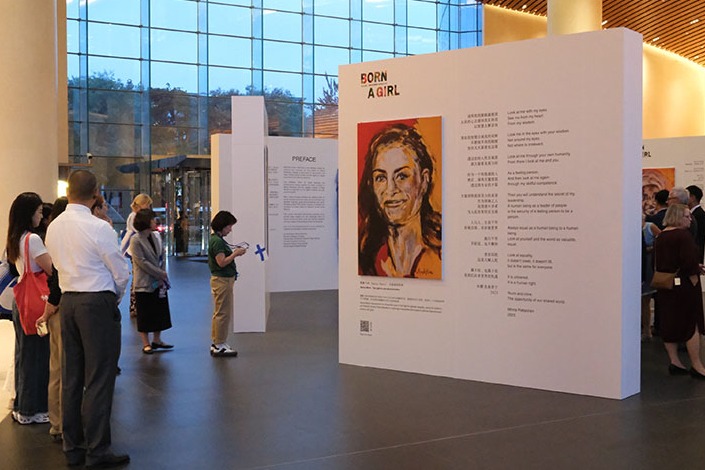
Held at the Shanghai Art Museum until Jan 4, The 30-Year Retrospective of the China Oil Painting Society presents more than 800 artworks by 370 artists arranged in four chapters — historical subjects, people and portraits, landscapes, and still life.
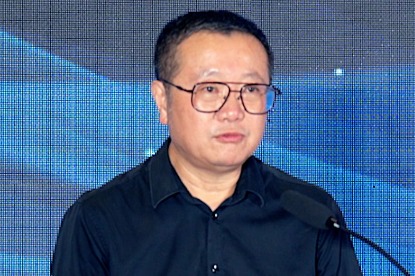
This exhibition brings together the most representative contemporary Chinese oil painters and some outstanding young artists who have recently emerged. It focuses on presenting renowned oil painters from different periods over the past 30 years since the establishment of the China Oil Painting Society, comprehensively demonstrating the overall creative strength of this medium, according to Xu Jiang, director of the society and the exhibition's curator.
In Europe, oil as a painting medium is recorded as early as the 11th century, evolving into a major painting medium in the 16th century. Western missionaries such as Matteo Ricci (1552-1610), from Macerata in central Italy, first introduced oil painting to China, which had a wide impact on imperial court art and Chinese folk art. However, it was not until the late 19th and early 20th centuries that oil painting truly took root in China when a series of Chinese artists returned to their home country after studying art in Europe.
Zhan Jianjun (1931-2023), the first director of the society, proposed at the society's founding that an important mission of China's oil painters was to build a distinctive Chinese school of oil painting.
"First, our oil painters should address Chinese reality and feature Chinese subjects while studying the Western oil painting vocabulary accumulated through centuries," Xu recalls. Eventually, Chinese oil painters would combine oil painting with Chinese culture to achieve poetic expressions of the Chinese spirit, philosophy and aesthetics.
Oil painting as an art genre has declined in the western contemporary art scene, Xu finds, "but that's not the case in China".
"We have made great progress in our artistic creation, especially in oil paintings."
The future center of oil painting creation will be China, he believes.
"I was the president of the China Academy of Art for 20 years. We now have more established schools, more students, and a stronger curriculum. We continue to research oil painting and use it to develop our own style."
Addressing the exhibition, Xu says: "We are presenting a few paintings by each of these 370 artists, to present his or her journey of exploration in art, as well as the connection between their artistic expression and the land, nation, and people."
Some of the most prominent Chinese painters, such as Jin Shangyi and Zhan, learned from Konstantin Maksimov (1913-93), a Russian artist who taught at the Central Academy of Fine Arts in China in the 1950s.
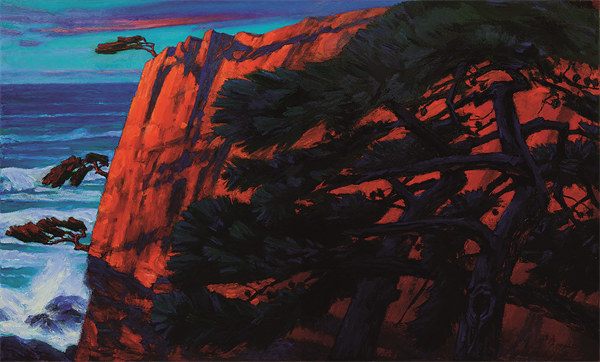
Listening to the Waves: Red Clouds, a large painting by Zhan, is on exhibition. The three-meter-wide piece depicts pine trees growing on the cliff overlooking the sea. Using palette knives to build texture, the artist borrowed from traditional Chinese landscape painting techniques to create a realistic and powerfully symbolic scene. Created in 2013, the painting speaks eloquently about the artist's inner world.
"Today people say AI can do anything, and paint in every possible style," Xu says. "AI is an algorithm devoid of human feelings, while emotion is a strong driving force of human creativity. Each stroke is filled with feelings. That's the advantage of human painting."
Wang Yichuan, executive director of the Shanghai Art Museum, states that the exhibition continues the century-long tradition of oil painting in Shanghai and signifies China's thriving oil painting development.
A series of lectures, artists' talks, and workshop events will take place during the exhibition to break down artistic barriers and promote cross-disciplinary integration of oil painting with technology, literature, music, and other fields, Wang says.