China-US trade talks disclose chances, challenges







The pragmatic and positive phone talks last month between President Xi Jinping and United States President Donald Trump, soon after the "candid, in-depth and constructive" bilateral trade talks in Madrid, Spain, augmented the upward outlook for other economies.
While global attention focused on Beijing and Washington, the ripple effects for smaller Southeast Asian economies are no less significant.
In their phone call, Xi emphasized that China and the US can fully achieve mutual success and common prosperity to benefit both nations and the rest of the world. Trump said the two countries can work together to get a lot of things done that are conducive to world peace and stability. In Madrid, both sides agreed on a "basic framework consensus" for handling the ownership of short-video platform TikTok in the US, committed to reducing investment barriers, and signaled broader cooperation.
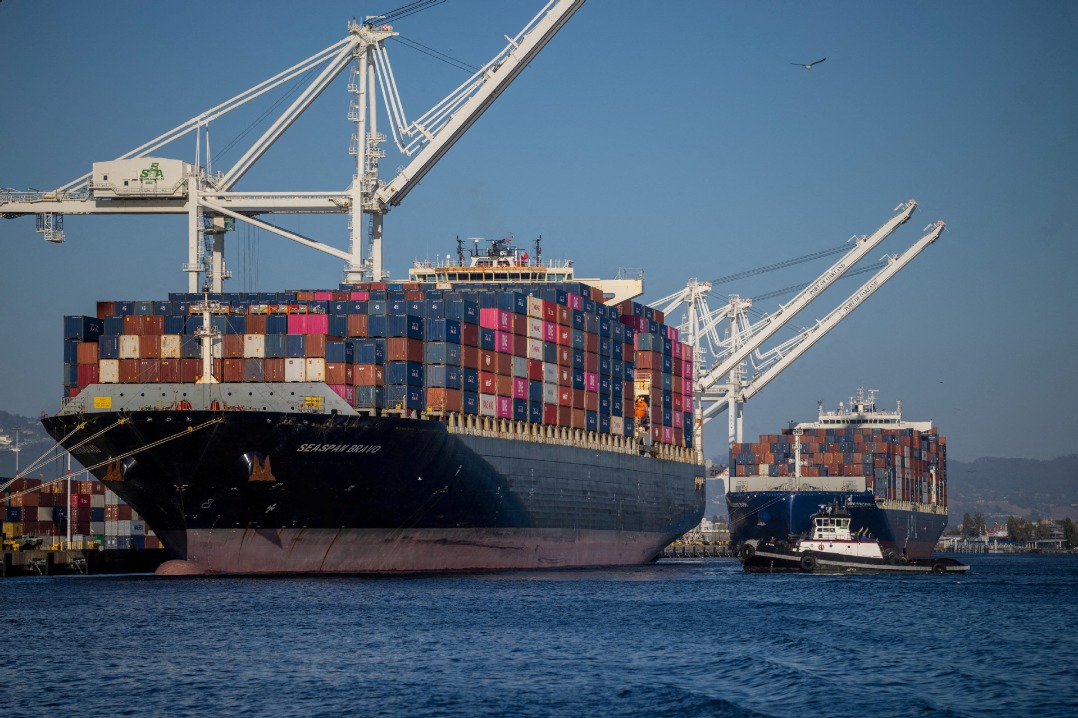
The talks have the potential to influence regional trade and investment flows. For example, Cambodia, alongside ASEAN states affected by US tariffs, could benefit if tensions ease. Supply chain stability may help Cambodia's core garments, textiles and electronics industries regain competitiveness, while foreign investors may return with renewed confidence. Stable supply chains would also strengthen the country's integration into regional production networks.
Beyond Cambodia, several ASEAN members that were heavily affected by US-initiated tariffs, most notably Vietnam, Malaysia and Thailand, stand to gain from the ongoing recalibration of US-China trade relations. Malaysia's semiconductor sector may now benefit from more predictable trade flows. With a strong supplier base and skilled workforce, Malaysia is well positioned to attract "China plus one" investment and strengthen its role in chip assembly and advanced production.
As China-US economic relations show signs of stabilization, the expected improvement in trade and investment flows has the potential to jazz up ASEAN economies. Thailand's automotive industry, hit hard by tariffs on cars and parts, could recover if Western markets become more accommodative. Vietnam has drawn investment from Samsung, Apple suppliers and other electronics giants.
Despite infrastructure and labor challenges, it can build on these gains if reforms in logistics and workforce skills continue, moving up the technology value chain.
The recognition of Washington and Beijing of the need for stable trade improves regional investment sentiment and thus boosts ASEAN's appeal to investors. However, structural competition between Washington and Beijing persists. For ASEAN, the lesson is clear: Seize economic opportunity but balance it with strategic caution.
For Cambodia, the lesson is twofold. First, open engagement with both China and the US is vital to safeguarding economic opportunity without eroding sovereignty. China is Cambodia's largest investor, financing infrastructure through the Belt and Road Initiative. Meanwhile, the US remains an important export market, especially for garments and footwear. Tariffs imposed by the US administration, which are as high as 19 percent, on Cambodian exports illustrate how engagement can mitigate risks but also underscore Cambodia's vulnerability.
Second, ASEAN's collective experience with tariffs imposed by the US administration highlights the danger of overdependence on single markets. By using trade diplomacy to maintain diversified partners, Cambodia, as part of ASEAN, benefits from its collective economic agreements, such as the Regional Comprehensive Economic Partnership. By reducing reliance on any single partner, the RCEP strengthens regional resilience and provides Cambodia with wider market access. Through diversified trade and careful diplomacy, Cambodia can preserve strategic autonomy while safeguarding economic growth.
Yet despite easing tensions between Washington and Beijing, challenges remain. US tariffs on Vietnam, Cambodia and other countries continue to unsettle exports, while ASEAN faces pressure to navigate between the two powers. Maintaining neutrality is increasingly complex as geopolitical rivalry intensifies.
In response, ASEAN has deepened its ties with China. The upgraded ASEAN-China Free Trade Agreement enhances investment and trade facilitation, reinforcing the region's economic links with Beijing. At the same time, China promotes multilateralism as a shield against unilateral measures, encouraging ASEAN states to resist protectionist pressures.
These dynamics show that while bilateral US-China dialogue is important, it cannot fully shield smaller economies from volatility. Regional frameworks like the RCEP thus serve as hedges, diversifying trade and reinforcing ASEAN's collective bargaining power.
So while the China-US talks represent both opportunity and caution for ASEAN members, balancing Chinese investment with US market access is essential to protecting growth and avoiding undermining sovereignty. The US tariffs make diversified trade and regional integration through the RCEP all the more valuable.
By leveraging multilateral platforms, the ASEAN neighbors can strengthen resilience, maintain strategic autonomy, and deepen integration into regional supply chains. The broader lesson is clear: Rational dialogue, balanced diplomacy and multilateral cooperation are indispensable for navigating an increasingly complex global economy.
The author is deputy director at the China-ASEAN Studies Center, Cam-Tech University in Cambodia.
The views do not necessarily reflect those of China Daily.