Rail reliability delivers steady success
China-Europe freight train network grows as competitive link to overseas markets







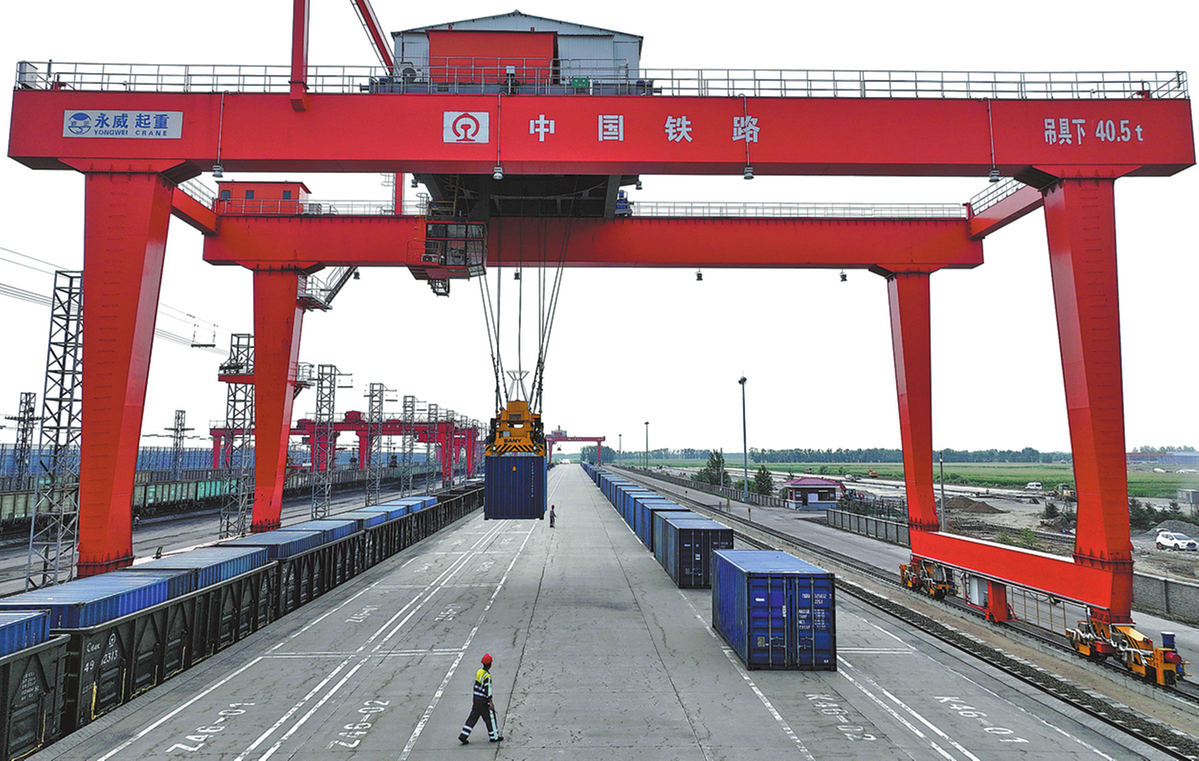
The multiple shock waves that hit global shipping in 2021 forced Shandong Linglong Tire, one of China's largest tire manufacturers and exporters, to reexamine its logistics.
A solution was quickly found in the China-Europe freight train network, a vital trade artery connecting manufacturing centers in China with markets in Central Asia and Europe.
"Sea transportation was so unstable," said Pan Wenfeng, head of Linglong's inland logistics department. "Prices skyrocketed and space was difficult to book. That gave us an opportunity to cooperate with the China-Europe Railway Express."
What began as a stopgap measure has since matured into a long-term and stable partnership.
"For overseas market expansion, sea transport is slow, with long delivery cycles that cannot ensure supply chain stability for our overseas production bases," Pan said.
"For critical raw materials and equipment where time efficiency matters, we now choose the China-Europe freight train. The train offers speed, lower costs and customized services. By using the rail service, our key raw materials and machinery arrive swiftly at overseas plants. Transit times are 50 percent faster than sea transport, greatly improving cash flow, reducing logistics costs and enhancing our global competitiveness."
Headquartered in Zhaoyuan in East China's Shandong province, Linglong has invested heavily abroad, with plants in Thailand and Serbia — the latter marking China's first tire factory in Europe.
Around 10 percent of Linglong's exports move via China-Europe freight trains.
Though sea freight still dominates its logistics, rail transport has become a strategic supplement, supporting the Belt and Road Initiative, boosting China's opening-up, and helping secure stable supply chains in an uncertain global environment.
Decade of expansion
From making just a handful of trips in 2011, the year of the network's launch, the China-Europe Railway Express has grown to handling 19,000 round trips in 2024, 10 percent up on the year prior, transporting over 2 million twenty-foot equivalent units, according to Xinhua News Agency.
In total, as of July, it's estimated that the service had completed more than 110,000 round trips, carrying goods worth over $450 billion.
The network has grown to cover nearly the entire Eurasian landmass. Inside China, three main routes — the western, central and eastern — attract cargo from different regions.
Beyond China's borders, three corresponding corridors stretch into Europe. Recent years have seen successful trial operations of the southern corridor, opening new gateways to the continent. Close coordination with foreign railway companies has expanded and diversified these international routes, creating a transcontinental network that is efficient, extends in multiple directions, and connects land and sea transport.
A total of 128 Chinese cities run freight trains to 229 cities in 26 European countries, and over 100 cities in 11 Asian countries. Customs procedures have also been streamlined. With the rollout of the "95306 System" digital platform, customs clearance that once took half a day now takes less than 30 minutes on average.
There are 14 regional consolidation hubs inside China that channel goods into outbound trains, ensuring smoother distribution. Cargo from different regions is gathered at these hubs and organized before being shipped to Europe. Nearly nine out of 10 China-Europe freight trains are assembled and dispatched through these hubs nationwide.
In the early years, there was a significant trade imbalance flowing east to west, with many empty containers on the return journey.
To address this, China Railway Container Transport, a State-owned logistics operator, established subsidiaries in Kazakhstan, Germany and Russia to forge closer partnerships with local railways, ports and logistics companies.
This deeper integration has gradually created a more balanced two-way flow, reducing empty runs and boosting overall efficiency.
A growing number of European exports, ranging from machinery and pharmaceuticals to luxury goods, are now heading east on trains that once returned half-empty.
This has contributed to lower costs for Chinese exporters and more reliable schedules, as the network no longer bears the inefficiencies of empty backhauls.
Transportation hubs, such as Xiamen in Fujian province, have felt this transformation.
"The China-Europe trains from Xiamen not only carry Chinese products abroad but bring back foreign goods into China," said Wu Wei, marketing manager at Xiamen International Logistics Port.
In recent years, the logistics port has received Belgian chocolates, Belarusian beef jerky, Polish yogurt, and cosmetics such as face masks and eye creams.
China and beyond
In Shandong, the first cold-chain train departed from Jiaozhou in May 2021. Since, the specialized service for perishable goods has expanded, with regular trains running from Qingdao, Jinan and Zibo, carrying fresh vegetables, seafood and frozen products to European markets.
"The growth has been transformative in the past decade," said Shang Mingzhu, a manager at the Jinan branch of China Railway Container Transport. "Cold-chain trains, designed to match Shandong's strengths in fresh produce and seafood, support Shandong products going global."
Across inland hubs, from Xi'an in Shaanxi province to Chengdu in Sichuan province, local governments and logistics providers are leveraging the railway to connect their industries to global supply chains.
For exporters of high-value goods, from electronics to auto parts, the railway has become a reliable bridge to European markets.
European partners are equally enthusiastic. "The China-Europe Railway Express provides customers with stable and fast transportation services," said Alona Toprak, managing director of DB Cargo Eurasia, a subsidiary of Germany's Deutsche Bahn, specializing in cross-border rail logistics for China, Central Asia and Europe.
"Many high-quality products are transported between Europe and China via the service. Now, with more frequent departures, our cooperation has expanded from traditional manufacturing to green energy, new energy vehicles and cross-border e-commerce, further facilitating consumer markets," she said.
Chinese goods, including consumer electronics, home appliances and daily-use products, can reach Europe faster and at better prices. At the same time, specialty products from Europe and other parts of Asia, such as Spanish wine, Dutch cheese, Polish apples, Thai durian and Laotian bananas, are increasingly available to Chinese consumers. This has created bigger markets and improved people's daily lives along the route.
The railway's rapid growth has also boosted industry, trade and investment. Railways, freight companies and logistics providers along the route are earning more stable income, while local people have gained jobs. Major cities served by the trains, including Lodz in Poland, Duisburg in Germany, and Madrid in Spain, have modernized their infrastructure, helping related industries grow quickly.
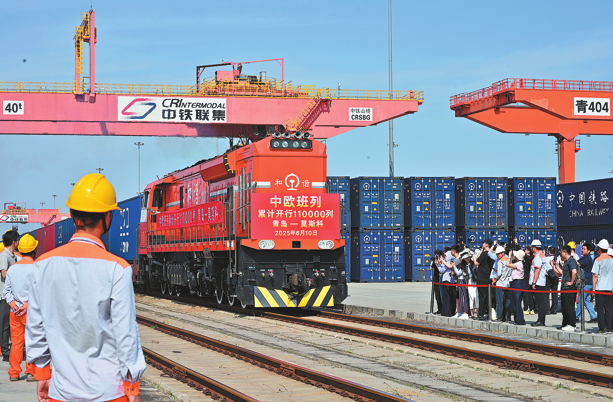
In June, the 110,000th train departed from Qingdao, Shandong province, carrying 55 containers of LCD displays and refrigerators worth 20 million yuan ($2.75 million) on a three-week journey to Moscow.
For Gao Yitian, head of the Jiaozhou branch of Jinan Railway Logistics Center, the milestone was another ticked off on his 25-year career in the railway industry. Gao began handling international trains in 2016, when services were still in their infancy.
"At the start, we were unfamiliar with the processes. Customs checks and documentation were slow. Sometimes we couldn't even gather enough cargo for one train in two weeks," Gao said.
"Now, the systems are optimized, efficiency has soared and trains depart daily.
"In 2016, cargo mainly consisted of clothing and footwear. Today, shipments range from home appliances to high-end manufacturing equipment. The trains now run at 120 kilometers per hour, up from 80 km/h a decade ago," he said.
Innovation and growth
A recent development has been the introduction of set-scheduled China-Europe freight trains. A total of 17 set-scheduled trains run a week, with transit times cut by more than 30 percent compared with regular China-Europe freight train services. Unlike regular cargo carriers, the trains adhere to a set schedule along the entire route, further reducing transport time and also allowing customers to accurately calculate journey times between cities.
Beyond bulk goods and consumer staples, specialized services cater to cross-border e-commerce, cold-chain food, postal shipments and automobiles. The range of goods has broadened to over 50 categories and 50,000 products, with three types of goods in particular — auto parts, machinery and electronics — making up more than 60 percent of exports last year.
New industries are also benefiting from the China-Europe Railway Express. Rail operators have addressed safety challenges in transporting new energy vehicles, lithium-ion batteries and solar panels, allowing these high-value exports to reach global markets more efficiently and reliably.
A China-Europe service center and a dedicated online portal offer one-stop platforms for contracts, customs, insurance, cargo tracking and smart containers with real-time monitoring. Overseas, 131 container depots in 17 countries provide convenient pickup and return options across most rail-linked cities.
Yang Ting contributed to this story.




Today's Top News
- China sets a world record in maglev technology
- Xi chairs CPC leadership meeting on Party conduct, anti-corruption work
- Why Hainan Free Trade Port stands out
- Rule of law strengthens business environment
- Documents affirm one-China principle
- Central SOEs urged to push upgrading