World must ensure that peace in Gaza will endure







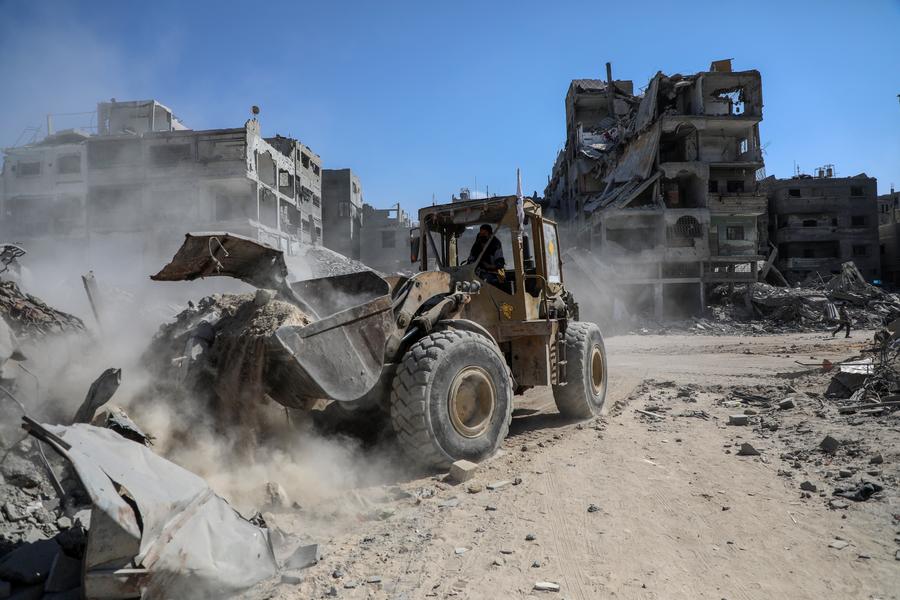
In a long-awaited development, Egypt hosted on Oct 13 the four-nation signing of the "Trump Declaration for Enduring Peace and Prosperity" during the Sharm El-Sheikh Peace Summit, underlining a phased ceasefire backed by the United States to end the devastating, two-year-long conflict in Gaza. The summit was co-chaired by US President Donald Trump and Egyptian President Abdel Fattah El-Sisi.
Though encompassing limited Israeli withdrawal and humanitarian aid corridors, the first phase of the Israel-Hamas truce offers a flicker of hope amid the ruins. Yet the agreement must be examined with cautious optimism and an eye on the deep-seated challenges that still threaten lasting peace.
The Sharm El-Sheikh summit was a diplomatic milestone, drawing leaders of Arab and Islamic states as well as Western countries while highlighting the US, Egypt, Qatar and Turkiye signing the joint declaration, with due respect for the efforts of the US president.
Trump again portrayed Gaza as a potential "Riviera of the Middle East" with $53 billion in reconstruction pledges from Arab and European donors. Egyptian President El-Sisi called the accord a "glimmer of hope", while European Council President Antonio Costa hailed it as a "crucial breakthrough". For the war-weary people of Gaza, even limited relief brings much-needed respite.
The initiative provides immediate humanitarian benefits — family reunifications and the reopening of supply routes. It builds on Egypt's sustained mediation and signals renewed international engagement after months of paralysis.
The US administration's intervention — however politically motivated — has, for the moment, compelled both sides to hold on to talks, together with at least eight key Arab and Islamic countries. But as with earlier ceasefires, the real question is whether this one can evolve into something more enduring.
A closer appraisal of the plan reveals ambiguities that threaten its durability. Its language on troop withdrawals and verification mechanisms is deliberately vague, perhaps to secure signatures, but vulnerable to differing interpretations.
The arrangement appears asymmetric — prioritizing Hamas' demilitarization while sidestepping Israel's settlement expansion and occupation of the West Bank. By excluding the Palestinian Authority from transitional governance, the accord risks creating an administrative vacuum.
Hamas leaders have warned that the deal ignores Palestinians' political rights, while Israeli Prime Minister Benjamin Netanyahu's absence from the summit — amid pressure from his far-right coalition — suggests lukewarm commitment.
As past truces have shown, without reciprocal obligations, temporary calm can quickly unravel.
The US deserves acknowledgment for catalyzing the latest round of diplomacy, but its dual role as Israel's chief military supporter and self-appointed mediator remains problematic. Washington's $8.7 billion in 2024 military assistance and its repeated United Nations Security Council vetoes of ceasefire resolutions cast doubt on its neutrality.
If not for the US vetoes since October 2023, the UN could have prevented some of the more than 67,000 deaths of Palestinians and Israel's weaponization of food aid. Such grim statistics underscore why any truce must extend beyond tactical calm to address accountability and reconstruction.
A Sept 16 report by the UN Independent International Commission of Inquiry accused Israel of grave violations of international law that may constitute genocide.
The findings, covering October 2023 to July 2025, described deliberate attacks on civilians, journalists and medical workers, along with the systematic destruction of life-sustaining infrastructure.
Starvation was used as a weapon, as the World Health Organization confirmed famine-like conditions in August, and UNICEF reported that a child was dying nearly every hour.
For a peace plan to gain credibility, the US must ensure Israel's compliance rather than shield it from accountability again and again. Otherwise, the perception that the plan favors Israeli objectives — achieving by diplomacy what could not be secured militarily — will persist.
A truce alone cannot deliver justice or stability; reconstruction, governance and international guarantees must follow.
To transform this fragile truce into a sustainable peace, several steps are essential. First, the international community should press for the enforcement of humanitarian guarantees, including continuous aid delivery monitored by UN agencies.
Second, diplomatic pressure must ensure adherence to ceasefire provisions and prevent any unilateral actions that could reignite violence.
Third, accountability processes — whether through the International Criminal Court or UN inquiries — should proceed independently to deter future violations.
Fourth, renewed commitment to the two-state solution is indispensable; only a sovereign, viable Palestine living alongside Israel in peace and security can end the recurring cycle of conflict.
The US initiative, despite its flaws, provides a starting point for de-escalation. Whether it becomes a turning point or a temporary truce will depend on the willingness of all parties — particularly Israel and the US — to act in good faith and address the root causes of the conflict.
As China has reiterated, true peace requires fairness, equality and respect for international law, not military force. Gaza belongs to its people, and its future must be built on justice, reconstruction and hope.
The world owes the people of Palestine not another pause, but a pathway — one that rebuilds their homes and restores their dignity within a just and enduring framework of peace.
The author is a geostrategist and political analyst based in Karachi, Pakistan.
The views do not necessarily reflect those of China Daily.