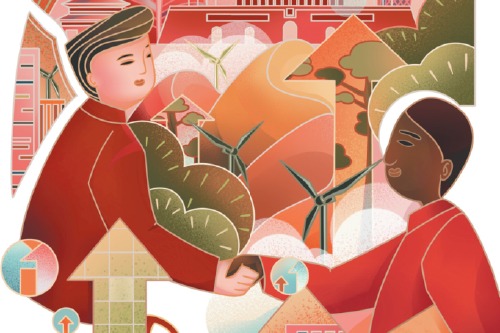
Prime example








China's green development provides a blueprint for the decarbonization of the Global South countries
China's commitment to peaking carbon dioxide emissions before 2030 and achieving carbon neutrality before 2060 has driven a rapid industrial transformation in China with significant implications for the Global South and the world. This transition is not only an environmental policy but also a strategic economic and geopolitical shift, offering developing nations a viable, scalable and affordable pathway to energy security and green development.
China's green progress rests on several pillars, three of which are of particular importance: unparalleled industrial scale, financial standardization and proactive global governance.
China has secured global dominance in clean technology manufacturing, fundamentally changing the global economics of energy. Chinese companies produce roughly 80 percent of the world's solar panels and 60 percent of its wind turbines. This production scale is the largest factor in the dramatic reduction of renewable energy costs, driving down the global cost of solar modules by about 80 percent over the past decade. China is achieving a similar trajectory with batteries. This achievement has made clean power competitive with fossil fuels globally. The country's green energy is rapidly expanding, cutting fossil fuel generation by 2 percent in the first half of 2025. The green sector itself is a central driver of the Chinese economy, with production and investment contributing approximately $1.9 trillion to the national economy in 2024. This validates the economic feasibility of rapid decarbonization even for major industrial economies.
Recognizing that financing is essential to the transition, China has worked to standardize green finance and strengthen sustainable finance governance internationally. China co-developed the Common Ground Taxonomy with the European Union, a standard later expanded into the Multi-Jurisdiction Common Ground Taxonomy to include Singapore. This standardization provides financial institutions and investors with a shared technical reference for identifying green assets, simplifying cross-border capital deployment. China also co-founded the Network of Central Banks and Supervisors for Greening the Financial System, a network of central banks (which the United States central bank exited in 2025) to better understand the financial risks, opportunities and tools of green finance. Furthermore, China led the establishment of multilateral financial institutions such as the Asian Infrastructure Investment Bank and the New Development Bank to support financing emerging markets' green development. Domestically, China invested $625 billion in clean energy in 2024, approximately one-third of the global total.
Finally, China is shouldering new responsibilities to drive global green governance, notably demonstrated by the announcement in September of its new Nationally Determined Contributions. This pledge, which said "China will, by 2035, reduce economy-wide net greenhouse gas emissions by 7 percent to 10 percent from peak levels, striving to do better", provides a conservative goal for climate action, which many believe can be overachieved. Simultaneously, China is actively constructing alternative models of global development with platforms such as the Shanghai Cooperation Organization, the Belt and Road Initiative and BRICS which are explicitly integrating environmental considerations and technical assistance, effectively embedding a green development mandate into a multipolar system of Global South engagement.
China's achievements offer other Global South nations tangible economic and geopolitical benefits, providing a proven model and affordable tools for their own transitions.
The success of China's green economy serves as a powerful demonstration that emerging economies can successfully integrate green development with industrial growth. The availability of low-cost Chinese clean technology, including solar panels and electric vehicles, enables emerging markets to quickly scale up electrification and partly "leapfrog" the fossil-fuel intensive stages of industrial development. The most immediate benefit is reduced energy costs. For example, in Pakistan, the plummeting price of Chinese solar modules has fueled 13.4 gigawatts of solar imports in the first half of 2025 alone which are used mostly for rooftop solar as a decentralized, cost-effective and reliable source of power.
China's role in South-South climate cooperation, often through technical assistance and development finance supported by the AIIB, the NDB and China's financial institutions in the Belt and Road countries, offers an additional and alternative source of climate funding and technology when existing commitments prove insufficient. Institutions such as BRICS and the SCO provide developing nations with forums to negotiate climate and development policy outside of traditional frameworks, potentially strengthening their opportunities to address their specific development priorities.
To solidify its role as a responsible global partner, China can integrate its domestic and overseas fossil fuel policies with its green ambitions.
A clear road map is essential to reduce emissions from existing fossil fuel assets both at home and within partner countries. This includes exploring mechanisms to phase down overseas coal plants built under previous BRI phases, actively replacing them with renewable energy infrastructure where partner countries, such as Pakistan, are receptive. Addressing the economic lock-in from earlier coal investments is crucial to align policy with long-term climate goals.
To avoid the perception of merely exporting products, China must pivot toward co-investment and joint research in emerging technologies. Collaborative ventures — such as the partnership between Fortescue Metals Group and China Baowu Steel Group in Australia on green hydrogen and green iron — should be actively scaled up and replicated with both developed and developing partner nations. This model of shared risk, co-innovation, and long-term trade agreements ensures partner countries gain economic agency and secure a position in the global green supply chain. Finally, China can consider strengthening its leadership in international climate governance in its alternative forums and existing global frameworks such as the United Nations Framework Convention on Climate Change, noting that climate change is a physical reality that requires a global response and not a political game. China can build more trust in both Global South and Global North countries by strengthening green technology exchange, financial support, as well as improving transparency on its climate progress. It can uphold the voice of the Global South and share the opportunities of a rapid green transition for all.
The author is the director and a professor at the Griffith Asia Institute at Griffith University in Brisbane, and the director and a visiting professor at the Green Finance & Development Center at the Fanhai International School of Finance at Fudan University. The author contributed this article to China Watch, a think tank powered by China Daily. The views do not necessarily reflect those of China Daily.
Contact the editor at editor@chinawatch.cn.