Beijing makes AI education compulsory in public schools
Capital is first provincial-level region to bring in high-tech learning across the board







Editor's Note: The rapid advancement of artificial intelligence is reshaping nearly every facet of human existence. This series will take an in-depth look at this transformative force, examining how AI is redefining the way we live, work and interact.
Beijing has become the first provincial-level region in China to launch compulsory comprehensive artificial intelligence education for primary and secondary schools, with the capital demonstrating the importance of incorporating the groundbreaking technology into early education.
This semester, over 1,400 primary and secondary schools in the city will provide no fewer than eight class hours of AI education covering all grade levels from primary through senior high schools.
This citywide initiative follows the release of two recent guidelines, which together define the positioning, content and instructional pathways for AI education.
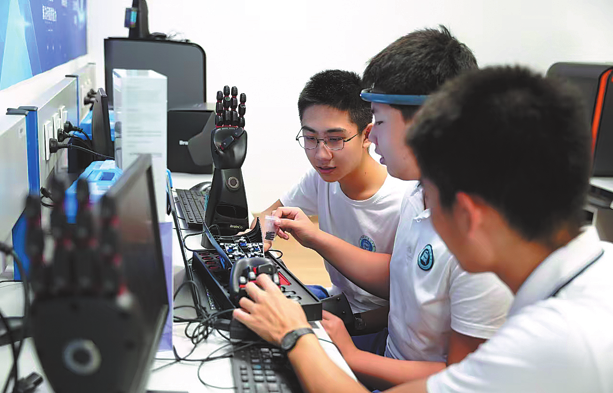
Schools such as Haidian District Experimental Primary School and Guangqumen Middle School are already pioneering comprehensive, multistage AI programs that equip students with both foundational knowledge and hands-on skills.
At Haidian Experimental Primary School, students from Grades 1 to 6 are progressively introduced to AI through interactive, project-based lessons. Younger students build basic AI awareness, middle graders learn fundamental principles, and upper-grade students advance to creating smart hardware applications, according to Shi Yuan, head of the school's information center.
"The courses are designed to make AI tangible and accessible," he said. "We focus on letting students experience AI through projects that connect to real-life scenarios."
The school employs a range of educational tools, including block-based programming platforms, iFlytek robots with image recognition capabilities, and large language models that help students generate executable code from Chinese instructions.
"We turn abstract concepts into tangible projects. It's not about making every child an expert, but about helping each one understand and interact confidently with AI," Shi said.
After-school clubs offer further exploration, with students studying more advanced projects and preparing for competitions, he added.
"Learning AI is not difficult for these young students as they are very interested in it. Just like people learning to use the computer some 20 or 30 years ago, the age of AI has come and we are not turning back."
Two Grade 6 students at the school, Miao Ruoyi, 11, and Fang Xi, 12, are both members of the programming club and started learning about AI in third grade.
Ruoyi finds great satisfaction in assembling robots. "Programming feels a bit challenging to me, but building things with my hands is much more interesting," she said.
She is strong in math and English and sees programming as a refreshing diversion.
The sense of accomplishment after finishing a robot — with components like clamps for grabbing buckets and rollers for shooting balls — keeps her motivated.
Xi, who has already won awards for his work in school competitions, said he feels he is gifted in learning AI and coding, and thinks they are actually more straightforward than learning academic subjects.
Guangqumen Middle School has built a continuous AI curriculum spanning primary, middle and high schools, according to Pei Yi, director of the school's talent cultivation center. Pei said that the goal is not only technical mastery but also preparing students for a human-machine collaborative future.
"In the future, human-machine collaboration will be inevitable. Students may not all become AI specialists, but they must learn how to use AI effectively," he said.
At the primary level, AI knowledge is integrated into information technology classes starting from the third grade. Lower grades focus on handson experience, while upper grades introduce basic programming. Extracurricular clubs, such as robotics and coding, create a seamless link with middle school education, he said.
For middle school students, seventh graders take a semester-long information technology course covering AI fundamentals, principles and applications. For eighth and ninth graders, AI learning shifts to subject-based activities such as designing "intelligent study companions" using generative AI tools. Off-campus study tours to universities, tech companies and institutions like the Chinese Academy of Sciences complement classroom learning, said Pei.
High school offers more specialized pathways. This year, the school launched an AI class emphasizing mathematics and science, developed in collaboration with institutions such as the Chinese Academy of Sciences and tech firms like Huawei. Students explore cutting-edge domains such as embodied intelligence, brain-computer interfaces and autonomous driving.
Beyond the classroom, the school organizes AI-themed science festivals, industry visits and research trips. A popular science lecture on the low-altitude economy with a local drone company is set to evolve into a full course.
Pei emphasized that the school's approach exceeds the requirements of the education authorities. "We want students to understand not only how AI works but also how it can be applied across disciplines," he said. AI tools are already used in physical education to analyze movement and in English classes to create interactive games.
When it comes to assignments, students are encouraged to use AI as an assistant — not a crutch. "We teach students to use AI to brainstorm or organize ideas — but not to rely on it entirely. Critical thinking and independent work remain essential," Pei added.
"The goal is not to turn every student into an AI expert, but to ensure they can proficiently use AI," he said. For students interested in AI, the curriculum offers in-depth exploration such as participating in scientific projects with universities. For others, it builds essential digital literacy, analogous to how internet skills became indispensable in the digital age.
Zhang Xuanyang, 15, from Guangqumen Middle School, won a first-place prize in a national robotics competition in Grade 8.
After narrowly qualifying for the national round, he spent seven days in training, debugging programs for six hours daily. The competition included autonomous tasks and an aerospace knowledge test. "I expected a second-place prize, so seeing my name in first place was thrilling," he said.
Zhang Yi, another student from the school, said the tide of technology is now surging forward, and it can't be stopped. Moreover, after getting in touch with it, he has developed a strong interest in technology. That's why he has kept learning.
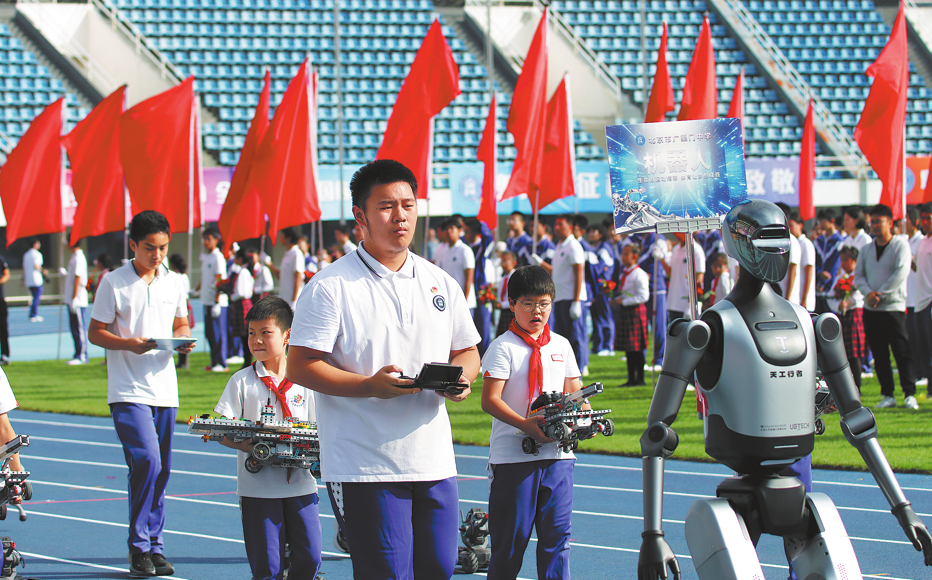
During the recent school sports meeting, Zhang Yi was in charge of operating a humanoid robot. "As long as you're familiar with its operations, the robot is extremely obedient," he said.
This is because it uses some AI technologies to adapt, and there are also AI codes inside it to ensure the smoothness of the operations, he said.
"We mainly had it walk forward and wave to the students in the stands, performing actions like that."
Despite their tech engagement, both maintain top academic rankings. They see AI as a tool that enhances — not replaces — traditional learning. "AI is a helper, not a replacement. We still prioritize asking teachers and independent thinking," Zhang Xuanyang said.



Today's Top News
- China suspends part of control measures on dual-use items export to US
- Andy Palmer: West can learn from China's long-term planning
- Mainland spokesman reiterates stand on Taiwan
- Xi to attend opening ceremony of National Games, declare Games open
- Xi urges deepening reform, opening-up during Guangdong inspection tour
- China releases white paper on low-carbon development