Sleep woes awaken huge business potential
Sector to surpass 1 trln yuan by 2030 due to stress-related tossing and turning







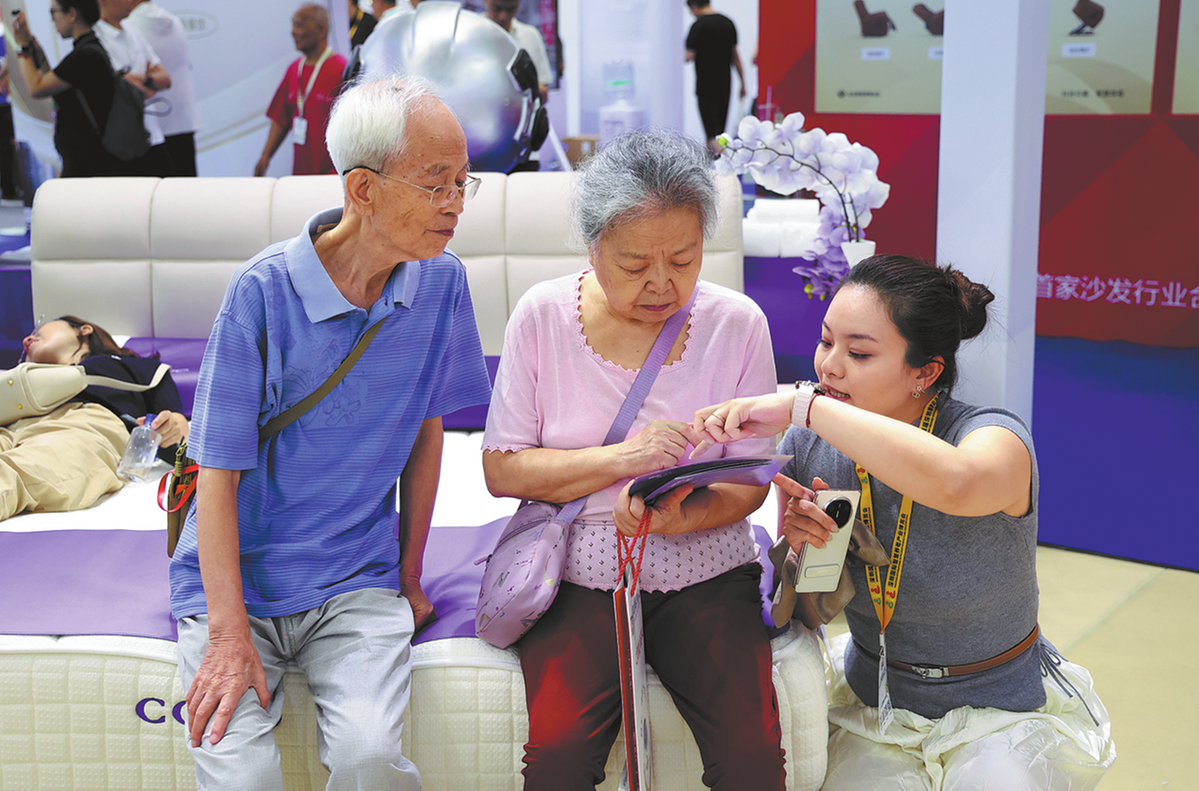
Cui Jiaojiao, a 31-year-old property agent in Beijing, has tried almost everything. Besieged by sleepless nights, she has stocked up on an arsenal of sleep aids — steam-heated eye masks to soothe fatigue, delicate mists for her pillows and a sleek wearable device to track her elusive rest.
"The real estate market is volatile, and your mind races. You just lie there, waiting for morning," Cui said, describing the anxiety that keeps her awake. "I'm investing in these products because I'm investing in my ability to sleep."
Cui is one of the millions of urban Chinese professionals for whom a good night's sleep has become a coveted, yet frustratingly distant, goal. Their collective yearning is no longer just a private health concern — it is the engine for a rapidly expanding multibillion-yuan "sleep economy".
China's sleep health industry, valued at 261.63 billion yuan ($36.8 billion) in 2016, expanded to 495.58 billion yuan by 2023, and the market is poised to surpass the trillion-yuan mark by 2030, according to a report released by Xilinmen Furniture Co Ltd and the Institute of Sociology at the Chinese Academy of Social Sciences in March.
What was once a niche market has surged into the mainstream, driven by the hypercompetitive pressures of a fast-evolving economy, the "always-on" culture fueled by digital saturation and the lingering anxieties of a society navigating rapid transformation, market watchers said.
Data from cloud-based digital commerce platform Flywheel show that more than 500 million people in China grappled with sleep disorders in 2025, with some 38.2 percent of adults experiencing insomnia.
One afternoon inside a softly lit pod just large enough for a reclining chair and a sleep-aid device, Zhang Yunhao — a 29-year-old coder at a Beijing-based internet company — closed his eyes. Outside, the relentless rhythm of the capital city continued. Inside, all was quiet.
Zhang is one of several customers at a sleep experience center in Haidian district, a neighborhood synonymous with tech firms and high-pressure jobs, who have come not to shop, but to simply rest.
"It's not a big space, but it's enough for a nap," said Zhang, a customer who visited during his lunch break.
"For many office workers in first-tier cities, finding a place to rest at midday has always been a headache. This place solves that problem. The venue provides a pair of noise-canceling earplugs and a steam eye mask, paired with their sleep device. It feels relaxing."
A search on review platform Dianping for "sleep" or "sleep aid" in Beijing reveals a growing ecosystem of such businesses. Sessions range from tens to hundreds of yuan. They fall broadly into two camps: one leveraging technology with sleep machines and even hyperbaric oxygen chambers — the other opting for therapy, employing sound baths and guided meditation.
Beyond the emerging brick-and-mortar sleep centers, the arsenal available to the weary has expanded to include virtual sleep companions, meditation apps, specialized pillows, calming body patches, "goodnight" milk with melatonin and soothing essential oils.
"The market has evolved from selling a product to selling an entire ecosystem of rest," said Zhu Keli, founding director of the China Institute of New Economy. "It's a granular business model. If there's a potential barrier to sleep — be it an achy neck, racing thoughts or a poorly scented room — there is now a product designed specifically to address it."