Trip to give momentum to cooperation
Meeting:?China, ROK both strive for regional peace, stability







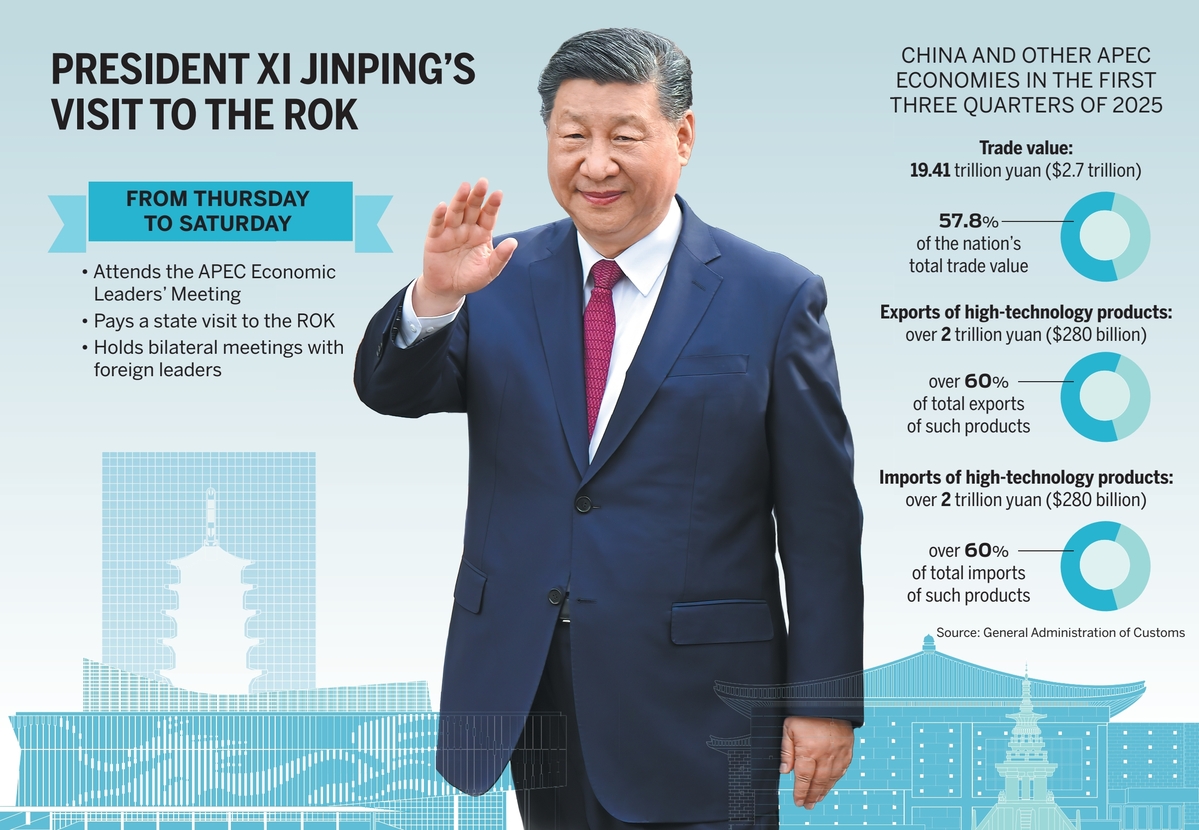
As President Xi Jinping embarks on a visit to the Republic of Korea to attend the 32nd APEC Economic Leaders' Meeting, observers said the international community is paying close attention to signals of dialogue and cooperation amid mounting challenges to multilateralism and sluggish global economic growth.
China is expected to continue working with all parties to discuss plans for regional prosperity and development, foster consensus on unity and cooperation, address global challenges and jointly chart a new chapter for Asia-Pacific development, they said.
During the three-day trip beginning on Thursday, Xi will deliver remarks at the APEC Economic Leaders' Meeting and hold bilateral talks with leaders of relevant economies. He will also pay a state visit to the ROK.
Xi, as the Chinese president, has attended every APEC Economic Leaders' Meeting since 2013, showing China's support and the active and constructive role the country plays in the region's highest-level, most extensive and most influential economic cooperation mechanism.
Cui Fan, a professor of international trade at the University of International Business and Economics in Beijing, said that at each of these meetings, the Chinese president has underscored the importance of advancing regional economic integration.
"It is expected that Xi will once again call for continued efforts in this regard in his remarks this year," Cui said, adding that this will reaffirm China's steadfast commitment to multilateralism at a time when economic globalization faces headwinds and protectionism is on the rise.
The Asia-Pacific region, which is home to one-third of the world's population, now accounts for more than 60 percent of the global economy and nearly half of world trade. It is the world's most dynamic growth engine and a prime example of regional economic integration.
Liu Chenyang, director of the APEC Study Center at Nankai University in Tianjin, said that holding the APEC meeting against the backdrop of growing uncertainty demonstrates the mechanism's vital role in bridging differences and maintaining dialogue across the Asia-Pacific region.
He said that the consensus to be reached among the leaders, if any, on issues such as trade and investment liberalization, innovation, the digital economy, and inclusive and sustainable growth will reflect the shared commitment of member economies to maintaining the regional economic order and promoting common prosperity.
"Since its establishment more than 30 years ago, APEC has effectively responded to challenges such as the financial crisis and the COVID-19 pandemic, and has played an important role in strengthening the cohesion of Asia-Pacific cooperation," Liu said.
"Compared with the past, Asia-Pacific cooperation faces greater challenges this year," he added. "What the international community is watching now is whether APEC can continue to put economic and trade cooperation at the forefront and build consensus despite differences."
Carlos Kuriyama, director of the Policy Support Unit at the APEC Secretariat, said in a news release that trade growth this year across the Asia-Pacific is expected to moderate after last year's strong performance.
"Sustaining momentum will depend on reducing policy uncertainty by sending clear signals to the business community, including those in digital and AI-enabled sectors," he said, noting that this year's APEC Economic Leaders' Meeting offers a critical opportunity to deepen cooperation and promote more inclusive and resilient growth.
Observers noted that small and medium-sized enterprises, which account for 97 percent of all businesses in APEC economies, are more likely to be affected by challenges such as protectionism and unilateralism.
According to Liu, from Nankai University, the upcoming meeting will once again highlight APEC's unique role as a "safe harbor" and a platform for members to strengthen solidarity and jointly cope with uncertainties.
"In particular, as the US imposes high tariffs against various countries, member economies expect APEC to serve as a counterbalance to unilateral actions and help ease the negative impact of protectionism," he said. "That's why expectations for China, as a major economy with growing leadership and influence, remain high."
China is currently the major trading partner of many Asia-Pacific economies and an important player in regional industrial and supply chains.
In the first three quarters of this year, China's trade with other APEC economies increased 2 percent year-on-year, reaching 19.41 trillion yuan ($2.7 trillion), and accounting for 57.8 percent of the nation's total trade value.
Muhammad Habib, a researcher at the Department of International Relations at the Centre for Strategic and International Studies in Indonesia, said that APEC plays an important role in maintaining trust across the Pacific region.
With rising protectionism and fragmentation, Habib said that it is important for economies to address trade-related concerns in a constructive way, whether these involve unfair practices, imbalances, overcapacity or tariffs.
"Openness and confidence require all sides to continue engaging in dialogue and taking steps for the greater good," he said. "The principles and platforms of multilateralism must be upheld throughout this process."
By firmly implementing the Regional Comprehensive Economic Partnership, actively advancing efforts to join the Comprehensive and Progressive Agreement for Trans-Pacific Partnership and the Digital Economy Partnership Agreement, and signing the China-ASEAN Free Trade Area 3.0 Upgrade Protocol, China has continuously injected its strength into building an open Asia-Pacific economy in recent years.
Herman Tiu Laurel, president of the Asian Century Philippines Strategic Studies Institute, a Manila-based think tank, said that China has pointed the way for economic globalization, injecting confidence and momentum into Asia-Pacific development.
Wirun Phichaiwongphakdee, director of the Thailand-China Research Center of the Belt and Road Initiative, said that China-proposed initiatives have become the most influential intellectual engines within APEC, providing theoretical guidance for the stable development of the entire Asia-Pacific region and charting the course for building a peaceful and prosperous region.
China-ROK relationship
Xi's state visit to the ROK is the first of its kind in 11 years, and he will meet with ROK President Lee Jae-myung for the first time since Lee took office in June.
It was during Xi's trip to Seoul in 2014 that the two sides agreed to further enrich the China-ROK strategic cooperative partnership, in order to make the two countries partners seeking common development, striving for regional peace, jointly promoting Asia's revitalization and enhancing world prosperity.
Kwon Ki-sik, head of the Korea-China City Friendship Association, said that a healthy and stable ROK-China relationship has implications beyond bilateral ties, holds great importance for regional peace and stability, and provides momentum for regional economic development.
Trade between China and the ROK has surged more than 60-fold in the 33 years since the establishment of diplomatic ties. China is now the ROK's largest trading partner, while the ROK is China's second-largest trading partner.
The two sides are currently accelerating negotiations on the second phase of their bilateral free trade agreement, which entered into force in 2015, to tap deeper into their cooperation potential in new areas.
"A good neighbor is not to be traded for gold," Xi once remarked, using this proverb to characterize China's relations with neighboring countries like the ROK. China consistently prioritizes its neighboring countries in its diplomatic agenda and actively calls for building a community with a shared future with neighboring countries.
Hwang Jae-ho, director of the Seoul-based Institute for Global Strategy and Cooperation, noted that China's neighborhood diplomacy, grounded in amity, sincerity, mutual benefit and inclusiveness, demonstrates strategic foresight and guides the development of relations among countries in the region.
Hwang said that China's efforts to build a community with a shared future with neighboring countries have boosted stability and prosperity in the Asia-Pacific and the wider world.




- AI support at heart of cybersecurity revision
- Guangzhou exempts kindergarten fees for select age groups
- World Shiology Forum focusing on food system opens in Hainan
- ELLE Style Awards position Sanya as a style capital
- Shanghai Tower Towerrunning Challenge to kick off in Nov
- Former Qinghai senior official receives life for bribery