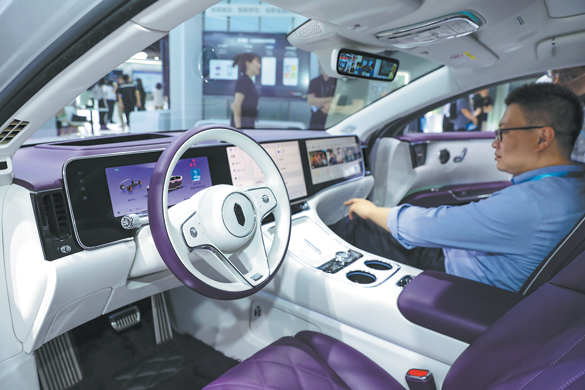
Unified market will make economy more resilient







Editor's note: The Recommendations of the Central Committee of the Communist Party of China for Formulating the 15th Five-Year Plan (2026-30) for National Economic and Social Development outline China's vision for the next stage of modernization. Zhu Min, a senior researcher at the China Center for International Economic Exchanges, told China Central Television that China will continue to develop its economy and enhance its global influence amid the complex global landscape. Below are excerpts from the interview. The views don't necessarily represent those of China Daily.
The recommendations for formulating the 15th Five-Year Plan emphasize quality, yet also include the element of quantity. The quantity has two important aspects. One is the quantum of economic growth. The country needs to maintain a growth rate of close to 5 percent to achieve its goal of per capita GDP of a moderately developed country by 2035.
When the external environment fluctuates, an effective way to cope with uncertainty is by strengthening internal stability.
So, the priorities are to ensure economic stability, productivity growth and improvements in development quality. To achieve these goals, the country needs to advance a unified national market.
Enhancing the stability of domestic circulation will help offset uncertainties in international circulation.
During the 15th Five-Year Plan period, a unified national market will be essential for strengthening internal stability. China is the world's second-largest economy, and with 1.4 billion people it has a large domestic market. But without a unified market, the economy cannot fully unleash its potential. This requires unified regulations and standards, unified infrastructure networks, unified information systems and a unified business environment, including intellectual property rights protection. A unified national market will give China the confidence to withstand external uncertainties.
Expanding opening-up reflects a new and significant structural transformation. On the one hand, China's door will open even wider to welcome global capital, technology and talent. On the other hand, China will accelerate the global expansion of its own enterprises. As global trade and industry and supply chains get reshaped, international and Chinese companies are diversifying by adopting the China+N paradigm, where "N" represents alternative sourcing and manufacturing hubs within Asia.
More importantly, Chinese companies are increasingly going global. From infrastructure projects under the Belt and Road Initiative to broader expansion in response to global trade frictions, China+N has begun to take shape. In the process, foreign enterprises have become more aware of how critical the Chinese market is. They recognize that without a firm foothold in China, they cannot maintain global competitiveness. This has led many companies to shift their research and development operations to China.
Meanwhile, Chinese companies have deepened cooperation with multinational corporations at home and abroad.
Through the global expansion of Chinese enterprises, China is building global supply chains with domestic companies at the core. This is gradually transforming the industrial structure that has been dominated by multinational corporations from developed countries. This is a major change in China's opening-up strategy.
Today, opening-up means not only attracting foreign investment, but also proactively supporting Chinese enterprises in going global.
For the past two years, China's outbound direct investment has exceeded the foreign direct investment in the country. The capital flowing out and the capital flowing in have now reached a balance. This is an extraordinary development in China's opening-up journey.


Today's Top News
- US?arms sale only a?'bomb' to Taiwan
- China-Cambodia-Thailand foreign ministers' meeting reaches three-point consensus
- Drills demonstrate China's resolve to defend sovereignty against external interference
- Trump says 'a lot closer' to Ukraine peace deal
- China pilots L3 vehicles on roads
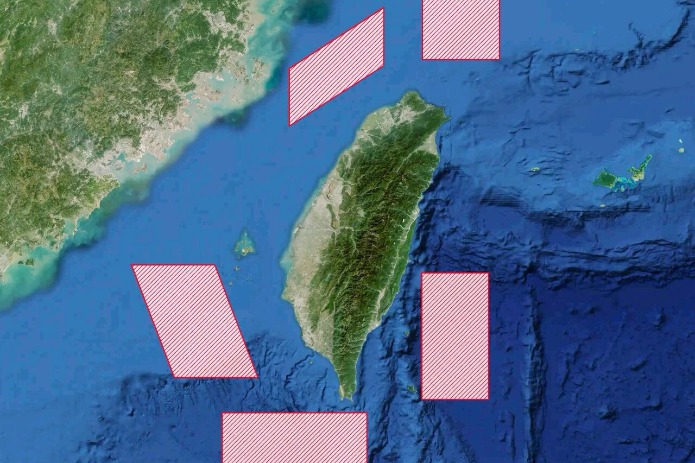
- PLA conducts 'Justice Mission 2025' drills around Taiwan