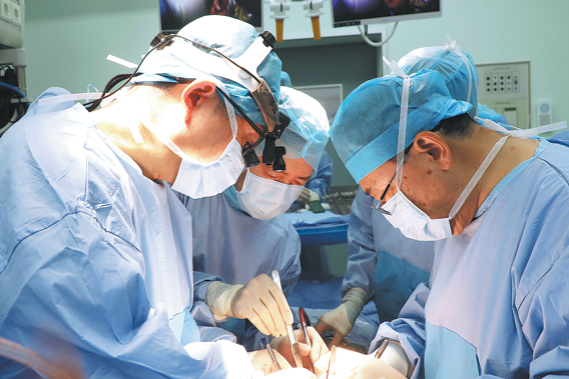
Technological self-reliance gains support
More innovation sought as pressure from Western countries continues







Following the fourth plenary session of the 20th Central Committee of the Communist Party of China, which emphasized boosting the nation's technological independence and innovation, university researchers and students are stepping up efforts to achieve breakthroughs in core technologies and foster new quality productive forces.
Be it creating better chips, exploring brain-computer connections, building smarter perception systems or redesigning educational tools, their work reflects a shared commitment to strengthening China's technological self-reliance, enhancing innovation capabilities and translating scientific discoveries into practical applications.
According to a communique released recently, the plenum stressed that the country should achieve greater self-reliance and strength in science and technology and steer the development of new quality productive forces.
The document said China should enhance the overall performance of its innovation system, raise innovation capacity across the board, strive to take a leading position in scientific and technological development, and continue to foster new quality productive forces.
Jian Zhijie, a doctoral candidate in integrated circuits at Tsinghua University, said that against the backdrop of export bans on advanced chips and external pressures, China must strengthen its determination to tackle "bottleneck" problems.
Amid trade tensions between China and the United States and continued pressure from Western countries on the integrated circuit industry, China has firmly advanced high-level sci-tech self-reliance, accelerated the cultivation of new quality productive forces and injected strong momentum into high-quality economic development, he said.
"As a doctoral researcher in high-performance chips, I recognize that these chips form the foundation of artificial intelligence development and represent crucial support for cultivating new quality productive forces," Jian added.
He pledged to focus his research on energy-efficient chip design and artificial intelligence algorithm integration, vowing to contribute his efforts to help the nation achieve high-level sci-tech self-reliance through practical action.
Yin Yongyue, a doctoral student in polymer chemistry and physics at the Renmin University of China, said his research focuses on developing brain-computer interface electrodes targeting chemical signals, aiming to tackle the fundamental molecular mechanisms of neurodegenerative diseases.
"This area is still largely unexplored and needs our full attention," he said.
Yin emphasized that enabling implanted interfaces to harmoniously coexist with organisms represents a critical step toward securing technological leadership. These devices must be highly sensitive, selective and compatible with living tissue, with long-term stability to resist bio-contamination and immune responses.
He said he aims to develop safer and more effective electrodes by experimenting with new materials and methods. He added that he would demonstrate the resilience to endure the solitude of foundational research and the vision for cross-disciplinary collaboration, focusing on long-term challenges rather than short-term trends, and pooling collective wisdom for sustained breakthroughs.
Zhang Libao, a professor at Beijing Normal University's School of Artificial Intelligence, studies intelligent systems that process spatial information. He identified problems such as poor data quality and difficulty sharing information as major obstacles.
"We need to create systems that can understand and react to their surroundings even when data is limited or of low quality," Zhang said. His team is designing models that can learn and make decisions with less reliance on large datasets, and early tests have shown positive results. Zhang also plans to promote real-world applications of this technology in environmental monitoring, disaster alerts and smart city development.
"This will contribute to enhancing the independent innovation capability and international competitiveness of China's space information industry," he said. "We will courageously pursue fundamental innovation and strive to secure key core technologies within our own grasp."
Zhang said he will promptly integrate the latest research findings, real-world challenges and firsthand problem-solving experience from the scientific frontlines into classroom teaching to nurture top-tier innovative talent equipped with both theoretical knowledge and practical skills.
Xu Tong, an associate professor at the School of Computer Science at the Beijing University of Posts and Telecommunications, is addressing how to adapt general AI tools for education.
He said existing AI platforms often do not meet the specific needs of teachers and students. His team developed the "Code Start "platform, which allows educators to create custom teaching assistants without any programming.
These AI assistants can help with tutoring, grading and creating personalized learning materials. The platform is already being used in several universities, including the Beijing University of Posts and Telecommunications and Heilongjiang International Studies University, Xu said.
He added that he intends to keep improving the system, focusing on making the platform more mature and inclusive.





Today's Top News
- NPC's 4th annual session slated for early March
- Civilizational links for a fairer world
- Manufacturing in China spurs global growth
- Taiwan lawmakers vote to pass motion to impeach Lai
- Xi: Steadfastly implement conduct rules
- High-speed rail reaches 50,000 km milestone