Learning by doing
Amid AI-driven changes and uncertain job markets, young Chinese are turning to practical training programs for a future-proof career path.







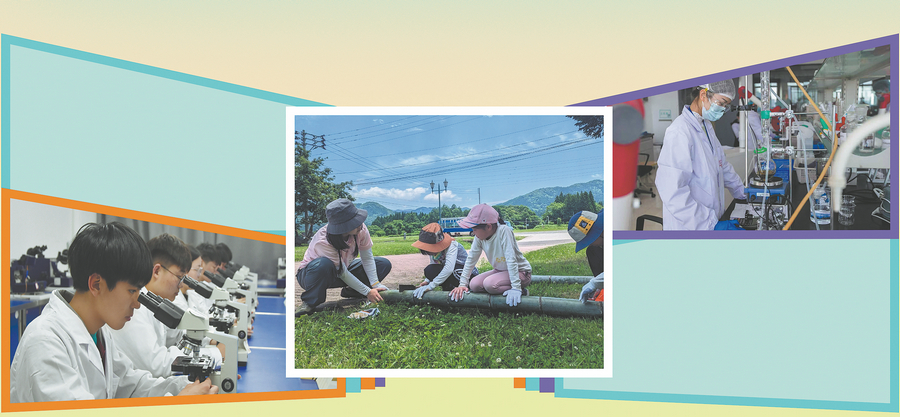
Yifan (pseudonym) can hardly believe that just six months ago, he was sitting in lecture halls writing papers on animation. Now, he spends his days in a laboratory, learning to operate an electron microscope (EM) and analyze ultra-thin metal samples.
This fall, the 21-year-old from Henan province entered Henan Chemical Technician College as a freshman in its EM program — despite already holding a bachelor's degree in animation production.
"It's a decision I made for myself," Yifan said. "I just want to master a skill that will still count in the years ahead."
His choice reflects a broader trend among Chinese youth. With uncertainty in the cultural and creative industries and job prospects being reshaped by AI, many are turning to practical, hands-on skills. Increasingly, university graduates are returning to vocational colleges for retraining.
Provinces such as Guangdong, Shandong, and Zhejiang now offer technician programs specifically for degree-holders to support higher-quality employment.
As a populous manufacturing province, Henan aims to turn its "demographic dividend" into a "talent dividend". According to a 2025 report by the Henan Provincial Government, the province now has about 19.5 million people with vocational or technical skills, including some 6.3 million at high-skilled levels.
At Henan Chemical Technician College, Yifan's EM major is among the most competitive — and most distinctive — programs nationwide. Within just two months, he had mastered key techniques such as sample preparation and equipment debugging, demonstrating the rigorous and hands-on nature of the training.
"In college, we focused on theory. Now, teachers guide us through the process — it's like learning directly from a master craftsman," Yifan said.
Su Wei, one of Yifan's instructors, has taught in the program since its launch in 2012. She said this fall's intake included about 100 students, 24 of whom already have higher education backgrounds — the highest number so far.
Students come from a wide range of majors. Su believes that even those from unrelated fields, though less technically prepared, bring unique strengths.
"For instance, liberal arts graduates tend to have open minds, imagination, and flexibility — qualities that can lead to new pathways in skills-based learning," she said.
Su also observed that students returning for retraining are highly motivated. "They know exactly what they want and are eager to prepare for their target jobs ahead of time," she said.
The college supports this preparation. During winter and summer breaks, its in-house testing and analysis center provides internships, giving students early exposure to laboratory and commercial testing projects.
The school has also built talent-recommendation mechanisms with nearly 100 employers nationwide. Since the EM program began, it has sent over 200 graduates to institutions such as the Chinese Center for Disease Control and Prevention and the Chinese Academy of Sciences.
Su believes the wave of retraining will continue, driven by the national push for vocational education, industry demand, and growing job anxiety among young people. But at its core, she said, the shift reflects the idea that vocational and higher education are parallel, not hierarchical.
"Research relies on the mind, skills rely on the hands. Those who can both think and do are exactly what the future needs," she said.
Retraining in nature
Berry (pseudonym) agrees. "Vocational schools are not a fallback for those who fail exams," said the 21-year-old, who chose to leave the academic track for a vocational program in nature education in rural Japan.
Between forests and rivers, she found a new rhythm of learning — one that values experience over theory.
She had originally majored in Japanese studies and planned to pursue a master's degree in sociology. But while writing her thesis, she realized she no longer wanted to follow the research path, as theory felt too distant from real life.
What eventually led her to enroll in vocational school to train as a professional outdoor educator was accompanying her younger siblings to their kindergarten outdoor activities. There, children ran through mud, pitched tents, and cooked simple meals while teachers quietly guided them. That approach to education — free yet nurturing — moved her deeply.
Unlike in university, her new classmates spanned a wide age range — from teenagers fresh out of high school to a 62-year-old former sociology teacher pursuing his dream of becoming a nature guide. Surrounded by people at such different life stages, Berry felt at ease, free from the usual peer pressure.
The curriculum was also something she had never experienced before. Instead of memorizing facts in classrooms, she spent most of her first year outdoors, exploring activities like skiing, camping, and hiking — learning by doing rather than by rote.
"From elementary school to college, we learned knowledge that was already proven. Now, I discover and test new knowledge through practice," she said.
Now in her second year, this hands-on approach continues through courses such as activity design and group facilitation. She now leads monthly nature programs for local elementary students — moments that make her feel she is becoming "a teacher in the truest sense".
"Here, I'm growing faster than I ever imagined," she said. "My resilience has strengthened significantly, and I'm getting closer to my dream career."
For peers still uncertain about retraining, she said it's true that learning a skill can give quicker results than studying theory — but that shouldn't be the main reason. "What matters most is knowing who you want to become and letting your choices align with that goal," she said.
You Yongzhi contributed to this story.
mengshuyan@i21st.cn