Lens on stablecoins to prevent fraud, capital flight, consumer harm







Chinese mainland regulators' latest move to bring stablecoins under further scrutiny signals a sharper focus on preventing fraud, capital flight and consumer harm, experts said.
This is also expected to clarify the regulatory boundaries in order to help cool irrational expectations around stablecoins and digital assets, they said.
The strengthened stance — announced at an interagency meeting led by the People's Bank of China, the country's central bank, last week — marks the clearest statement to date that stablecoins fall within the mainland's long-standing prohibition on virtual currency activities.
Stablecoins are cryptocurrencies that are designed to maintain a stable value by being pegged to fiat currencies or other real-world assets.
Liu Xiaochun, vice-president of the Shanghai Finance Institute, said the core policy message is to safeguard financial security and protect consumers from deceptive investment products. "Some people or institutions have engaged in misleading promotion, treating stablecoins or other virtual currencies as investment products and luring mainland residents to buy them.
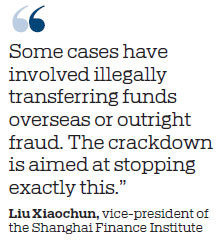
"Some cases have involved illegally transferring funds overseas or outright fraud. The crackdown is aimed at stopping exactly this," Liu said.
The interagency meeting has stressed that virtual currency-related activities are deemed illegal. According to the meeting, stablecoins, as a form of virtual currency, currently fail to meet requirements for customer identification and anti-money laundering safeguards, and could be used for fraud, money laundering and illicit cross-border fund transfers.
Liu said that such phrasing draws a clearer line for the market — stablecoins cannot be issued, underwritten, traded or used for payments on the mainland — ruling out the possibility of the issuance of onshore renminbi-backed stablecoins.
Xiang Haotian, an associate professor of finance at Peking University's Guanghua School of Management, said the clearer regulatory boundaries have demonstrated policymakers' priority — to cool speculation and prevent the public from being drawn into bubbles.
The latest move will prevent people with lower financial literacy from being misled and falling victim to scams, Xiang said. "Stablecoins still lack clear application scenarios, and their market scale is unknown. The public should avoid hype and return to rationality.
"The bad side is clearer than the good side, making tightening oversight in the short run beneficial for maintaining financial stability," Xiang said.
The fact that Hong Kong pilots a licensed stablecoin regime while the mainland maintains strict controls mirrors China's well-tested use of pilot areas to balance security with future opportunities, Xiang added.
In a written response to China Daily, a spokesperson of the Hong Kong Monetary Authority said the authority is currently reviewing the applications for stablecoin issuer licenses and aims to announce the first batch of licenses early next year.
"Considering the novelty and potential risks of stablecoin, the need for user protection, market capacity and long-term development, we expect to set a high bar for licensing. Only a handful of licenses will be granted initially," the spokesperson said.
The HKMA spokesperson added that where cross-border activities are involved, applicants should ensure that "they and their business partners have the necessary regulatory approvals and will comply with applicable regulations in Hong Kong and other relevant jurisdictions".
Experts pointed out that key issues requiring further clarification include whether mainland-owned companies registered in Hong Kong may legally engage in stablecoin operations locally, and whether the issuance of offshore renminbi-backed stablecoins would be permitted.
For example, Xiang said questions remain over whether a Hong Kong subsidiary of a mainland firm could use stablecoins to settle with foreign trade partners and then settle internally with its onshore parent through traditional, compliant channels.
If participation is allowed, he added, mainland and Hong Kong authorities will need new coordination mechanisms, especially in technology and monitoring, to prevent capital flight and money laundering through Hong Kong's stablecoin infrastructure.
Despite tightened controls, Liu from Shanghai Finance Institute said the mainland's stance would not hinder China's broader participation in global financial governance nor its push for renminbi internationalization in the digital era, as stablecoins are unlikely to become mainstream payment methods.






Today's Top News
- Disrupting market under fabricated veneer of 'national security' hurts US' own interest: China Daily editorial
- Yasukuni visit would add insult to injury: China Daily editorial
- Judicial reform critical for modernizing governance
- Effective use of investment emphasized
- China's shuttle diplomacy strives to reach ceasefire
- Nanjing Museum's handling of donated art, relics being probed