


Traditional instrument carries ancient waterway's flowing history







Close your eyes for a moment and imagine drifting down the ancient Grand Canal in a small wooden boat — listening not only to the push and pull of water, but to the centuries of stories carried along its banks.
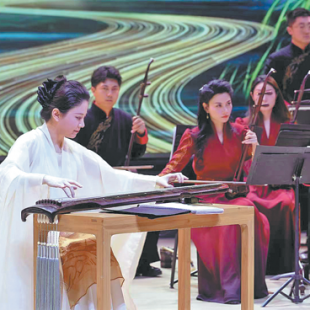
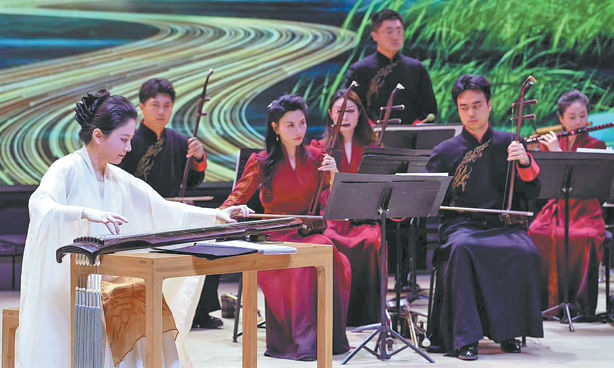
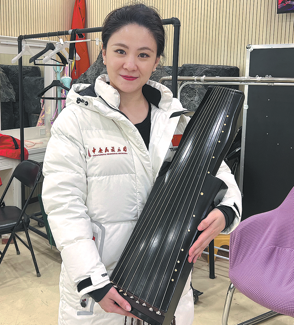
That imagined soundscape took artistic form on Nov 30, when the Grand Canal Rhapsody was staged at the China National Traditional Orchestra's concert hall. Funded by the Beijing Federation of Literary and Art Circles, the performance was spearheaded by artistic director Lu Ning, a young guqin (traditional Chinese zither) performer from the orchestra. She collaborated with her fellow musicians to present eight original compositions, primarily featuring the guqin, tracing the Grand Canal's journey from antiquity to the present day.
"For me, the guqin, like water, is in constant flux. While the players of the guqin may change, the music endures. Though the waters of the canal have flowed on, the canal itself remains."
Lu explains that she felt a natural resonance between the guqin and the Grand Canal's long passage of history, which became the inspiration for this creative endeavor.
The guqin, revered for more than 3,000 years, is considered one of the most esteemed instruments in ancient China, closely linked with scholars, poets and refined artistic sensibilities. The Grand Canal — stretching nearly 3,200 kilometers and serving as a lifeline for economic and cultural exchange between northern and southern China — has a history of over 2,500 years. It was inscribed on the UNESCO World Heritage list in 2014.
Zhao Zeming, the concert's music director and a young composer, states that the guqin and the Grand Canal mirror two important dimensions of China's historical development — the transmission of culture and the continuity of everyday life. If any instrument could express the Canal's entire story, he believes it must be the guqin.
The eight pieces in the performance varied in style. The opening piece, Primordial Flow, transported listeners to the wild beginnings of civilization, with gongs and drums echoing the canal's ancient flow. Reclining Drunk on the Stone paired the guqin with male vocals, evoking the free-spirited Wei-Jin (220-420) scholars wandering along the riverbanks. Bian River Rhapsody: Grand Movement, which is influenced by music from China's western region, re-created the bustling cosmopolitan atmosphere of the Sui (581-618) and Tang (618-907) dynasties. The finale, Echoes of the Era, celebrated the canal in modern times, bright with rhythmic vitality and confident in its forward motion.
The question of whether the guqin should be performed with other instruments has long been debated, Zhao stresses. Traditionally a literati instrument linked to elite culture, it can feel distant to today's audiences. To break this stereotype, the team added a small ensemble in addition to its traditional pairing with bamboo flutes and the xiao (Chinese vertical bamboo flute), giving the instrument new breathing room while retaining its contemplative character.
Lu hopes listeners see the guqin not simply as a relic of ancient refinement, but as an adaptable and expressive voice still growing with the times.
"Time preserves the best works," she says. "We shouldn't avoid new experiments out of fear of being outdated. If audiences enjoy even one piece at the concert, that's enough."
"Water" served as the core theme of this concert. Sometimes it surged like rolling waves; other times it shimmered like spring water. Yet, much of it flowed in suggestion rather than direct imitation. Lu encouraged composers to imagine not just water itself, but to imagine life along the river: "People relied on it for cooking and drinking."
"The Grand Canal's historical significance lies in the people living along its banks," Zhao adds. "In this sense, the China National Traditional Orchestra mirrors the canal itself — steady through shifting times, continually nourishing the people with culture."
Guqin master Zhao Jiazhen remarked after the performance that the concert used the guqin to connect cultural heritage with contemporary life, showcasing the enduring depth and vitality of traditional Chinese music.
Bai Shuhao contributed to this story.