AI integration in real economy expected to gather momentum
KPMG: 88% of Chinese CEOs express confidence in China's economic outlook







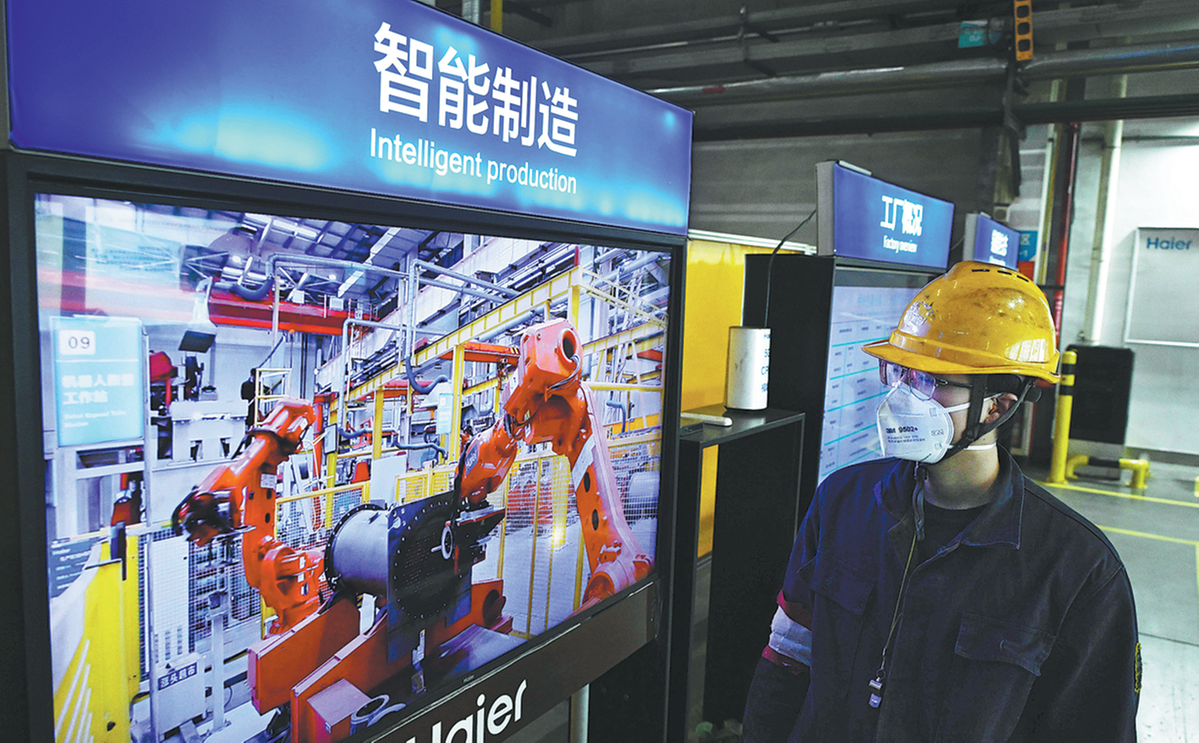
Chinese enterprises are accelerating their digital transformation and doubling down on artificial intelligence and technological innovation to enable AI to play a vital role in business operations and navigate a shifting economic landscape, according to a report from market consultancy KPMG.
The report said that 88 percent of Chinese CEOs express confidence in China's economic outlook, a significant increase of 17 percentage points from last year, marking the highest level in recent years.
It noted that 26 percent of Chinese CEOs have identified advancing business digitalization and connectivity as their top strategic priority for the next three years, exceeding the global average of 18 percent.
The value of artificial intelligence applications is beginning to be realized. Eighty-six percent of Chinese CEOs expect to see returns on their AI investments within three years, up sharply from 18 percent last year. Notably, one in five interviewees anticipated achieving returns in less than a year.
Moreover, 55 percent of Chinese CEOs are prioritizing compliance and reporting standards to meet investor and regulatory demands, compared to 51 percent globally.
"Over the past year, the global economy has continued its gradual recovery, with overall trade demand on the rise. Amid intensifying geopolitical tensions and growing trade frictions, businesses still face considerable uncertainty in pursuing steady growth," said Jacky Zou, chairman of KPMG China.
Against this backdrop, China's economy has continued to move forward steadily despite multiple headwinds. The rollout of a series of incremental policy measures has effectively boosted public expectations, Zou said.
He noted that Chinese CEOs' recognition of the value of AI has risen significantly, and this surge in confidence signals that the realization of AI's value is accelerating and that the technology is poised to profoundly reshape future industrial competition.
"Looking ahead to the 15th Five-Year Plan period (2026-30), as the nation's 'AI Plus' strategy takes deeper root and the industrial ecosystem continues to mature, the integration of AI with the real economy will gather pace, injecting powerful momentum into China's high-quality development."
However, an accelerated global adoption of AI is creating new challenges. CEOs express concerns regarding ethical implications (59 percent), data readiness (52 percent) and lack of regulation (50 percent). A clear consensus is emerging that robust governance frameworks will be critical for AI's sustained success.
While concerns persist that AI could lead to widespread job losses, 61 percent of global CEOs say they are actively hiring new talent with AI and broader technology skills.
In terms of concrete actions, 56 percent of Chinese CEOs are communicating openly with employees about the impact of AI on their roles, a proportion higher than the global average of 46 percent.
Meanwhile, Chinese CEOs are particularly focused on the medium- to long-term impact of AI on business operations. Specifically, the widespread application of AI in enterprise production and management requires substantial upfront investment in computing power, algorithms and data infrastructure.
According to the survey, 79 percent of Chinese respondents are concerned about the high technology infrastructure costs, a proportion above the global average.
The research surveyed 1,350 CEOs from 11 key markets across 12 key sectors including asset management, automotive, banking, consumer and retail, energy and healthcare between August and September.
Pan Helin, a member of the Expert Committee for Information and Communication Economy, which is part of the Ministry of Industry and Information Technology, said the rapid adoption of digital technologies represented by AI will inject fresh impetus into the country's economic growth and speed up the digital and intelligent upgrade of traditional industries.
He noted that AI is increasingly perceived as a key driver to build resilient supply chains and help companies adapt more quickly to sudden changes and take data-driven and real-time actions.
Some Chinese enterprises are facing mounting difficulties — such as budgetary shortfalls and inadequate skills training — in the process of digital transformation, he said, adding that these companies should devise long-term plans for digital transformation and continuously pour money into this field.
More efforts should be made to pool more resources into improving the quality of data that satisfy the training of AI models, optimizing algorithms and cultivating talent specialized in the field of AI, said Wang Peng, an associate researcher at the Beijing Academy of Social Sciences.
fanfeifei@chinadaily.com.cn