Is embodied AI hype or hope?








Humans have always wanted machines to relieve them of physical labor and assist them with intellectual tasks. Over the centuries, there has been an exponential growth in the use of machines. We have now reached a stage where robots assist us with all kinds of manual tasks and demonstrate impressive skills.
The same developments apply to intellectual activities. Since the advent of ChatGPT, everyone is probably aware of the potential of artificial intelligence. This development is astonishing: how can machines have so much knowledge and produce meaningful texts and conclusions? Is there any limit? And why do the corresponding programs require so many resources?
But first things first: The term "artificial intelligence" was coined in the 1950s by American mathematician John McCarthy at a workshop on the further development of computers, particularly regarding what they would be capable of in the future. He once said that this term did not arise from deep scientific reflection, but simply because they hoped to generate interest in the term and thus secure funding for the workshop!
However, as early as 1939, Westinghouse exhibited a human-like device called Elektro at the 1939 World's Fair in New York. Elektro could walk, talk and hear. By today's standards, it was extremely primitive, but it was a humanoid robot accompanied by Sparko, a dog-like device. In 1941, German pioneer Konrad Zuse presented the first modern computer. By the early 1950s, computer-based control of electric motors had been developed and put into production. These developments laid the foundation for today's systems, although at the time no one could have imagined the capabilities that computers have today.
These developments raise the question of whether machines can match or even surpass human intelligence. How can this be achieved? I see three levels.
First, AI traditionally replicates certain human cognitive abilities, but only within a narrow field. However, it can perform tasks much faster and more effectively. Examples include mathematical reasoning, playing chess and reading maps for navigation. While today everyone would agree that these are human achievements that can and should be transferred to machines, in 1956 this was the stuff of science fiction. These dreams have become a reality today, but these things are no longer considered to be AI. As McCarthy once said, "When it works, nobody calls it AI anymore."
Generative AI is the latest development to enter public awareness. It is characterized by its ability to generate new texts, images and sounds in response to natural language prompts. However, training this "disembodied AI" requires vast amounts of data from cyberspace and enormous computational power. This also means that it is only very indirectly linked to our real world.
Second, in order to generate more "real-life" data on which to base AI training, it is possible to create a computer-generated environment that closely resembles the physics of the real world. In this world, virtual objects replicate the physical properties of real-world objects as accurately as possible. For example, a drop of water looks and behaves like a drop of water on earth. We can then use this virtual universe, or "metaverse", to develop AI by enabling machine learning systems to explore and experiment, fostering curiosity and the ability to cope with an increasing variety of environmental situations. However, this metaverse is man-made and therefore only depicts the real world as seen by humans. The real surprises that shape our lives and that have contributed to the development of our human intelligence are not to be expected there.
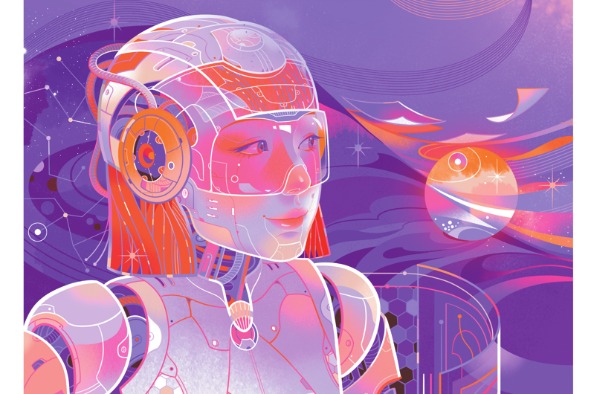
At the third level, these limitations can be overcome by enabling computers to act independently in the real world through robots which perceive their environment using sensors. Using their actuators (hands, arms and legs), they can alter this environment and then perceive the resulting effects. This creates a closed loop of perception, intelligent understanding and the execution of actions. A machine with an embedded or externally connected AI computer system can, in a sense, go out into the world "on its own", learn and develop its own intelligence. This "embodied intelligence" is therefore bound to a body and is tailored to the robot's unique characteristics, including its perception and its capabilities to act.
What can we expect in the future? Clearly, the integration of AI and robots — not necessarily humanoid robots with legs, but a wide variety of forms — is the way forward if we want intelligent machines to perform useful tasks. If these "embodied" agents can directly understand our real world and combine this knowledge with what they have learned from cyberspace, it could lead to synergies or even symbiosis, making us smarter and significantly broadening our horizons.
Policymakers and researchers have a key responsibility to invest in this type of robotics as part of their central task of promoting human development. Furthermore, the tangible benefits of using these machines to produce goods will soon become apparent in the short and medium term.
Countries with the highest robot density, such as China, the Republic of Korea, Singapore, Germany and Japan, have enormous productivity advantages. This gap will widen significantly with the introduction of embodied agents. Countries with a broad industrial base and corresponding data resources and who understand how to combine software, embedded computer systems, sensors, mechatronics and AI are best placed to bring such machines to the market.
It is no coincidence that these countries are already leaders in robotics. Given the impressive achievements of Chinese start-ups in humanoid robotics, and the country's stated goal to become a leader in embodied AI — as outlined in China's 15th Five-Year Plan (2026-30) recommendations and the "AI Plus" initiative — we can expect great things if these plans are pursued intelligently. Competition from other countries is also intensifying, so it will be interesting to see the innovative products that will emerge in this field in the coming years. I can't wait to find out!
The author is chaired professor and the director of the Robotics, AI and Embedded Systems research group at the Technical University of Munich in Germany and an elected member of the German National Academy of Science and Engineering and an IEEE Fellow.
The views don't necessarily reflect those of China Daily.
If you have a specific expertise, or would like to share your thought about our stories, then send us your writings at opinion@chinadaily.com.cn, and comment@chinadaily.com.cn.