Desert relic transforms into dance
Stage production uses Han brocade to inspire a beloved performance that will share its story beyond China's borders, Chen Nan reports.







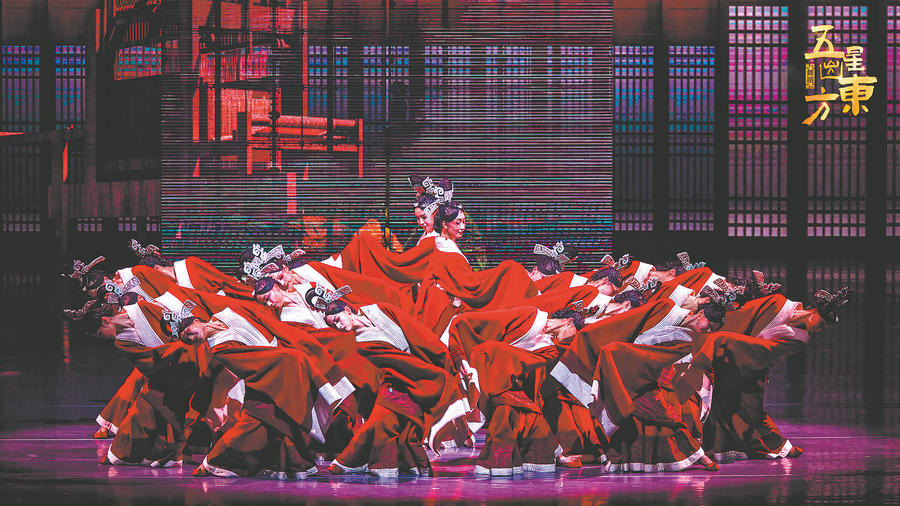
Yue Feng, former director of the Xinjiang cultural heritage bureau, recalls the moment the artifact was unearthed.
"When we first saw it, the brilliance of the colors, the quality of the craftsmanship — it was as if we were looking at a piece of art from today, not two millennia ago. The dyes had not faded, and the fibers remained intact. It was astonishing," he says.
The brocade, which bears the phrase "wuxing chu dongfang li zhongguo" ("five planets rise in the east to bring fortune to the central plains"), is a rare artifact that blends both cultural and historical significance. Its imagery, featuring mythical creatures of Chinese culture, such as phoenixes and qilin, speaks to the high level of artistic achievement during the Han Dynasty.
"This piece embodies the sophisticated techniques of Han textile artistry, with its dense, high-quality weaving that was once used for ceremonial and imperial purposes," Yue notes.
Beyond its artistic value, the inscription on the brocade also offers a glimpse into ancient Chinese cosmology and its philosophical outlook, according to Yue.
"Wuxing" reflects the Han people's understanding of astronomical phenomena, while "zhongguo", a word that first appeared in an inscription from the Western Zhou (c. 11th century-771 BC) period, marks an early reference to the concept of the central plains, the heart of ancient Chinese civilization.
"These dance performances will introduce Canadian audiences to a story that has been preserved for over 2,000 years. It is a story of peace, understanding and shared human experience. In a world where history often feels distant, we have the opportunity to bring that history to life, to show how cultures across time and space can come together," Yue adds.