


Resilient spirit carries prisoner to prosperity
Man escapes captivity to become a legendary commercial magnate, Xu Fan reports.







The series is adapted from writer Zhao Zhiyu's 2013 novel Da Sheng Yi Ren (The Tycoon). Inspired by renowned merchants in ancient China's commercial history, the novel depicts a vast landscape of major business groups across the country, highlighting their distinct regional characteristics in provinces such as Anhui, Jiangsu, and Shanxi.
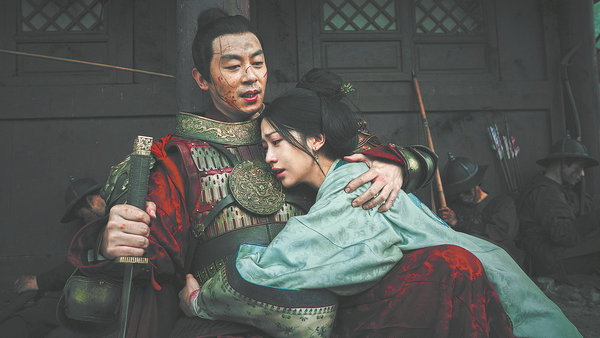
Refined into a faster-paced, twist-filled narrative, the drama uses only a few episodes to recount Gu's escape. He hides in a wooden barrel filled with water and live fish — cargo belonging to Mabang, an ancient logistics company that used horses to transport goods, from Shanxi.
Later, to repay the mabang's leader, who risks his life to save him, Gu volunteers to lead a group of transporters through a treacherous swamp, delivering plague medicine to a noble on the Inner Mongolian grasslands who urgently needs it to treat his soldiers. This journey marks the beginning of Gu's legendary commercial career.
The sharp-witted protagonist then masters finance knowledge through Shanxi piaohao (family-owned banking firms), enters the tea trade in Anhui, and later ventures into the salt industry in Jiangsu. Step by step, his commercial empire expands until he can negotiate on an equal footing with foreign merchants from Britain's East India Company.
Although Gu's story reflects the complexity and grandeur of China's commercial landscape in the late Qing Dynasty, director Zhang says that Gu's resilient life, in which he witnesses the tragic fate of those he cherishes, demonstrates how "the flower of commercial civilization" wouldn't have bloomed under the constraints of the Qing-era feudal rule.
"When the producer recommended the novel to me — all seven volumes — I was immediately drawn in by the gripping storyline," recalls Zhang.
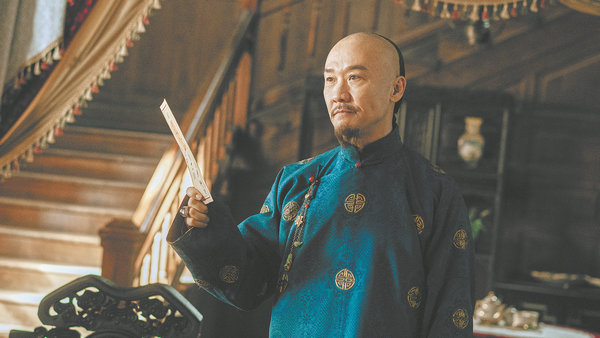
An award-winning film veteran known for historical hits, such as the 2019 series Ming Dynasty and the 2022 show The Long River, also set in the Qing Dynasty, Zhang says that the novel's portrayal of Gu reminded him of Wei Xiaobao, the nobody-turned-legend protagonist in late wuxia (stories on kung fu masters) novelist Louis Cha's Lu Ding Ji (The Deer and the Cauldron).
"Wei is fictional, but the backdrop and some of the other characters, like Qing Emperor Kangxi, are real. Gu is fictional, too, but the backdrop of late Qing commercial development is real. That mix of 'made-up' and 'authentic' is fascinating," Zhang says.
In an effort to stay faithful to historical facts, the crew tailored 3,000 costumes and spent 150 days filming Gu's business adventures across four provinces and the Inner Mongolia autonomous region — from the snow-covered forests of Heilongjiang and a century-old village in Anhui to Hengdian World Studios in Zhejiang province, the country's largest shooting base for films and TV shows.
But what has made Gu more charming is not how he makes his fortune. Instead, it is the Confucian values and Chinese intellectuals' mark on him that made the role larger than life.
In the series, Gu is portrayed as academically gifted from a young age. A native of Anhui province, he leaves his rural hometown to take the keju, feudal China's most demanding civil service examination, in Beijing, hoping to earn a government post. However, he is tricked into believing that his mother has fallen ill, leading him to attempt an unauthorized early departure from the exam site. As a result, he is wrongfully punished.
"Although Gu later becomes a businessman, he adheres to the principles of a traditional Chinese intellectual. He values benevolence, righteousness, propriety, wisdom, and integrity. His strong moral compass makes him a new kind of figure emerging from the old system. That's what I find truly fascinating," Zhang explains.