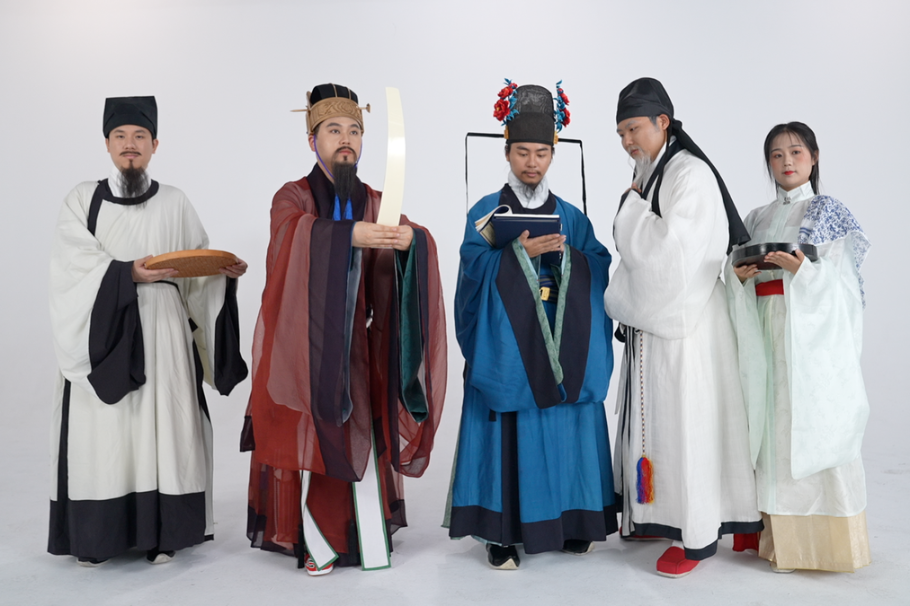
Traditional Chinese art inspires climate conversation







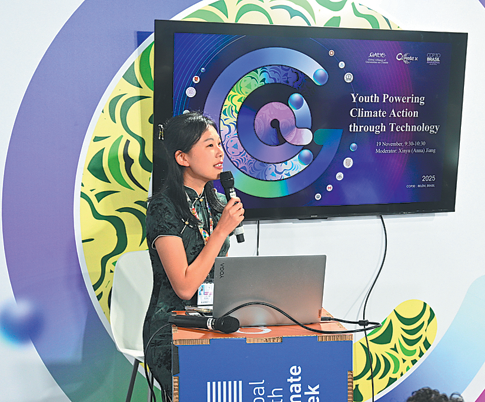
Diverse, dynamic, and alive. This was my first impression upon entering the venue of the United Nations Climate Change Conference, or COP30, on Nov 10 in Belem, a city at the heart of the Brazilian Amazon.
Interactive displays of innovative achievements, corporate green project launches, youth-led roundtable discussions, and immersive cultural experiences all kept me constantly on the move, drifting from one pavilion to another.
Beyond the formal negotiations in the meeting rooms, various side events were held by different parties across the pavilions. With my lanyard loaded with pins and my heart full of excitement, I gradually made up my mind that it was time for me not just to participate, but to take on another role: organizing a side event of my own.
The idea of blending Chinese painting into the session then popped into my mind.
On the day of the event, as an image of a painting depicting spectacular landscapes in exuberant colors on a golden backdrop was projected onto the screen, the audience's eyes immediately fixed on it. It was A Thousand Li of Rivers and Mountains. "If you've seen this painting, please raise your hand," I asked. Only a few did. When I mentioned that the scroll spans over 10 meters — long enough to literally stretch across our pavilion — people instinctively looked from left to right and let out a gasp.
"Look closely," I said. "Though filled with vast mountains and rivers, the painting is dotted with traces of human life — fishing villages along the water, pavilions and bridges nestled in the terrain, and travelers and recluses moving quietly through the landscape." I explained the ideal of an inhabitable and traversable world, where humans are not the protagonists of nature but part of it.
I then shifted to how the painting was composed with the scattered perspective, or what some call a "God's-eye view".The artist adopted a panoramic, mobile viewpoint like a bird soaring above the world, compressing a long span of rivers and mountains into one single scroll. This perspective suggests that humans are both participants in and observers of nature, rather than its masters.
As we explored the history of Chinese painting and what it might offer to contemporary climate solutions, more people were drawn in. What unfolded in that room made clear that, even when unfamiliar, Chinese painting offers a unique language through which people can intuitively connect with nature. Rather than presenting a fixed image of the world, it opens a way of seeing — one that emphasizes perception, relationship, and resonance over mere representation.
A broader view
This perspective stayed with me as I moved from pavilion to pavilion. At the side event "Fostering South-South Collaboration: Scaling Climate Tech Solutions through Shared Innovation", I was encouraged to see that it is no longer a one-way process where the Global North delivers solutions and the Global South acts accordingly. Countries from the Global South are increasingly designing their own pathways, articulating their needs clearly, and seeking collaboration on their own terms.
A participant from Guyana shared that the country aims to source around 80 percent of its energy from renewables by 2030 — an ambitious goal that cannot be achieved without South-South cooperation, technology sharing, and capacity building.
Looking more closely also brought deeper questions into view. Behind technological progress often lie layers of structural inequality. When I asked Michal Nachmany, founder and CEO of Climate Policy Radar, how we might balance the benefits and energy costs of AI in climate adaptation, she noted that the impacts of AI extend far beyond energy use. They include geographic inequalities linked to data-center locations, biases embedded in training data, and hidden labor costs. The key issue, she emphasized, is not technology itself, but who controls it, how it is used, and whom it serves.
This is a lesson Chinese landscape painting has long offered: development is not only about expansion, but about knowing where to stop, where to leave space, and whom to make room for. It asks not only how high our peaks may rise, but whether we can still recognize ourselves as part of the rivers and mountains we depend on.
In Belem, bringing this perspective into COP30 felt like adding a single brushstroke to a vast global canvas — a reminder that as the world charts its climate path, it will also need the restraint, humility, and balance that have shaped Chinese understandings of landscape for centuries.
Written by Jiang Xinyu, 20, an undergraduate majoring in English at Tsinghua University.