Placing humanity at AI's core
Drawing on Taoist ideas, the U8 World Innovation Summit in Beijing explores how AI can coexist with human subjectivity and inner fulfillment.








At Beijing's Zhongguancun National Innovation Demonstration Zone Exhibition Center, discussions about artificial intelligence (AI) moved in an unusual direction. Instead of the familiar focus on speed and scale, attention turned to a more basic question: how AI relates to human subjectivity.
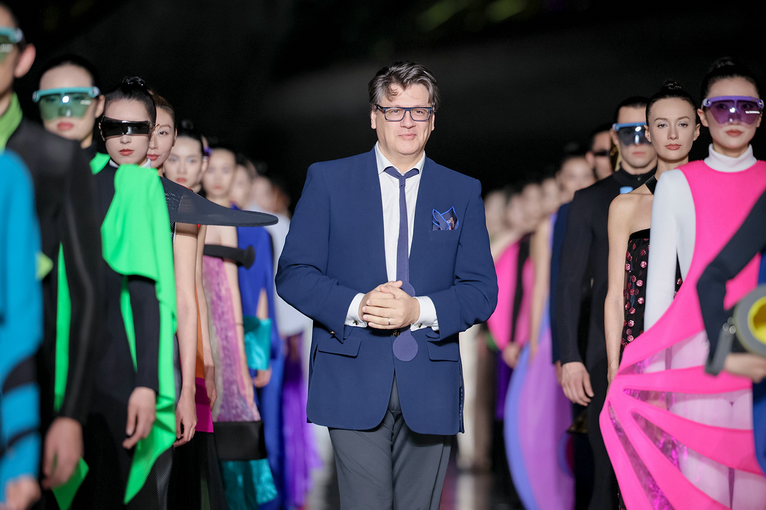
That perspective shaped the U8 World Innovation Summit (U8-WIS) 2025 Annual Summit, held at the venue on Dec 13.
Founded by students from eight leading universities worldwide, the forum blended academic inquiry with youthful initiative.
Under the theme "Xiaoyao You" — a Taoist concept often translated as "free and easy wandering" — more than 40 scientists, entrepreneurs, and professionals gathered alongside nearly 1,000 young participants to explore how technology might contribute to human flourishing and a deeper sense of inner fullness.
One of the speakers who took up that question was Joseph Sifakis, a Turing Award laureate and academician of the Chinese Academy of Sciences, who joined remotely as a guest lecturer.
Sifakis challenged a common assumption in today's AI discourse: that progress means building machines that can outperform humans at every task.
"AI may soon pass medical exams as well as students," he said. "But does that mean AI should be allowed to practice as a doctor?"
For Sifakis, the point was that performance benchmarks can be a misleading measure of success. While current AI systems may excel at certain defined tasks, he noted, they still lack situational awareness, adaptability, and creative reasoning — capacities required once machines are expected to carry human-level responsibility.
AI, he suggested, should be designed to align with human life rather than replace it. "The success of AI will depend on its ability to understand and contribute to systems of human attention — the ultimate stage of this kind of technological development," he said.
From this perspective, he argued that China is well-positioned to articulate a human-centered vision of AI — one that places societal needs on equal footing with technological advancement.
Gu Shi, a well-known science fiction writer who also delivered a keynote, approached this vision by drawing on imagined futures to examine how emerging technologies are reshaping the human condition.
In one conversation with a robotics practitioner at the forum, she realized that a device she had once invented for a story was already moving into real-world development.
It wasn't the first time her fiction had arrived early. In The MagiMirror Algorithm, a short story published in 2022, the "MagiMirror" is a micro-expression analysis app embedded in contact lenses — an always-on system that reads emotion as seamlessly as sight itself. Now, just three years later, Gu believes that today's AI is beginning to resemble the MagiMirror, functioning like an external organ growing onto the human body.
"As technologies increasingly integrate into everyday life, such extensions will only multiply," she said.
Yet in the story, the system is ultimately suspended: reading others without their consent is deemed an ethical violation — a decision that suggests technological capability may need to give way to human agency and choice.
For Gu, this is precisely where science fiction matters. "Science fiction cannot halt technological progress, but by imagining future scenarios, it helps us better understand the implications of our actions today," she said.
That emphasis on agency also shapes her view of AI in her creative process. Gu does use AI tools during the research phase to learn unfamiliar disciplines and map technical possibilities, but when it comes to writing itself, she draws a clear line. "For me, creation is joy — even a painful one — so I don't want anyone else to play the game for me," she said, adding that letting AI write in her place would reduce the creator to a mere spectator.
Gu remains optimistic about the younger generation of creators. She believes they will choose to hold onto authorship rather than hand it over to machines — learning to take full ownership of imagination and language as their craft.