


Where statues sway in the wind
Xiaoxitian Temple's suspended sculptures come alive in a landmark Beijing exhibition blending ancient artistry with technology, Wang Kaihao reports.







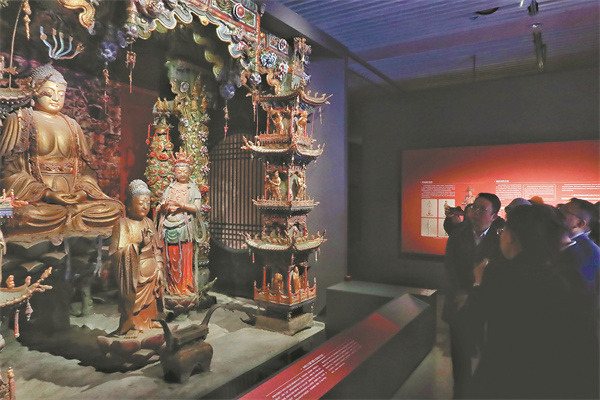
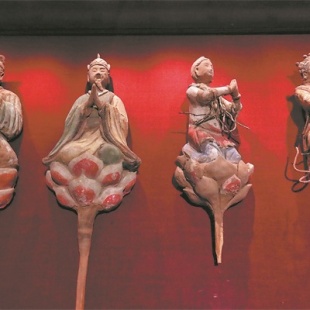
Visitors to the exhibition can appreciate the technique by looking at fragments of statues that have been replaced in previous renovations of the temple, as these fragments have been placed at ground level.
The construction of Xiaoxitian began in 1629 and was led by a monk from Wutai Mountain, a Buddhist holy place in Shanxi. Most Buddhist temples have one or three Buddha statues on their main altar, but there are five in Xiaoxitian, reflecting the builders' exceptional understanding of Zen.
Of course, it is impossible to physically move this visual wonder to Beijing in its entirety, but the exhibition's life-size replica of the Buddhist altar on display offers visitors the chance to contemplate the vastness of the universe.
But while the first pilgrims to the temple in 1644 may have marveled at this new, vividly portrayed image of heaven, the outside world had already started to descend into chaos; the Ming Dynasty fell that same year after major social upheavals, and the early years of the Qing Dynasty (1644-1911) witnessed a sustained war.
Xiaoxitian is thus widely honored as a unique episode in the popularity of Ming suspended sculptures.
In that era of dramatic change, however, those pious believers continued to seek inner peace.
A group of precious Buddhist statues from both the late Ming and early Qing dynasties that were donated by monks and pilgrims and once worshipped in Xiaoxitian are also on display in the Beijing exhibition, offering a vivid demonstration of Buddhist art from that time.
For visitors to the exhibition who have never been to Xiaoxitian, new technology is being used to showcase its majesty.
A digitalization project was launched for the exhibition that used technologies like visual algorithm modeling and AI reconstruction to digitalize the main hall at Xiaoxitian to "millimeter-level precision".
According to Wang Yun, head of the exhibition's technical team, AI high-definition enhancement technology was also applied to accurately highlight and clearly present colors that have faded over time and show details of damaged areas based on existing information.
"We have therefore established a permanent and authentic 'digital archive' of the magnificent suspended sculptures of Xiaoxitian," Wang says.